
Imagine this. You’re a freelance writer, and a client’s article is due. You can deliver it by Friday, but only if they send the approved images by Monday. You form the email in your first language, translate it line by line, paste it into ChatGPT and type: “Make this sound natural.” That’s AI as a polisher, not yet AI as a thinking partner.
It comes back clean.
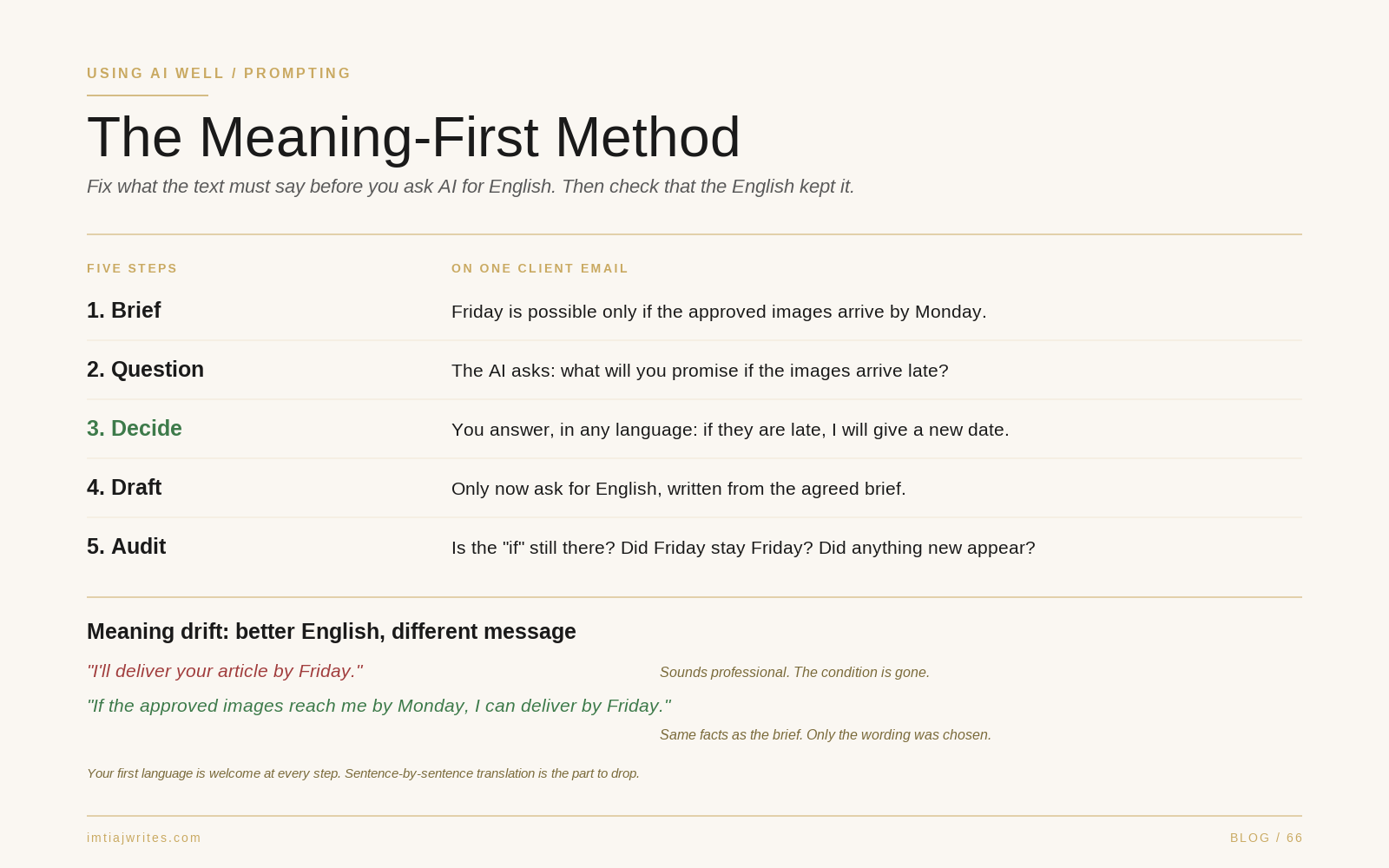
❌ “I’ll deliver your article by Friday.”
It sounds professional. It’s also a promise you never made. The condition is gone.
✅ “If the approved images reach me by Monday, I can deliver the article by Friday. If they arrive later, I’ll confirm a new date.”
(That exchange is an illustration I wrote for this post, not a saved chat. The pattern is common enough that you can test it yourself in two minutes.)
The second version isn’t more “native.” It’s more accurate. A polisher improves the English before anyone has agreed on what the English must say. A thinking partner helps you agree on that first.
The short answer: Use AI in a different order. First, let it ask you questions until your meaning is fixed. Then let it draft from that agreed meaning. Then make it check that nothing changed. Your first language is welcome at every step. Translating sentence by sentence is the part to drop, and only for writing that starts from your own ideas.
What “Stop Translating” Does Not Mean
It doesn’t mean stop thinking in Bangla, Spanish, Arabic or Mandarin.
The research doesn’t support that advice. A 2025 study in Computer Assisted Language Learning watched how university students really use machine translation while writing in English. It found four patterns of translation use: as a language bridge, an alarm bell, a critical sword and a creativity springboard. So translation was a way of checking and thinking for these writers, and not only a crutch.
Older research points the same way. In a well-known 1992 study, Kobayashi and Rinnert compared translation with direct writing among Japanese university students. Later researchers still cite two things from it: students used their first language well for developing ideas, and leaning on translation too heavily could get in the way of writing for an English-speaking reader.
Both things are true together. Your first language is where your best thinking often lives. The trouble starts when you carry that thinking into English one sentence at a time, because the sentence shapes come along too. I’ve written before about why forcing yourself to think in English doesn’t solve this.
So the change this post asks for is narrow. Keep your language. Change what you ask the tool to do.
Three Jobs That Feel Like One
When a sentence won’t come out right, it feels like one problem: “my English.” It is usually one of three different problems, and each needs different help.
| The job | What it sounds like in your head | What actually helps |
|---|---|---|
| Meaning | “I have a point, but I can’t say which part matters.” | Questions, examples, evidence |
| Expression | “I know exactly what I mean. I can’t find the English for it.” | A clear brief, then two or three wordings to compare |
| Fidelity | “I must put this approved text into English without changing it.” | Faithful translation and a careful check |
“Translate this and make it more persuasive” mixes all three. The tool can’t tell if it’s allowed to change the offer, drop a condition, or add a claim to be persuasive. So it guesses. And you get smooth English with no record of what changed.
That is why so much polished text still sounds translated, or worse, says something you didn’t mean.
How a Fluent Rewrite Changes Your Meaning
I call this meaning drift: the English gets better while the message moves. It rarely looks like an error, which is why it’s easy to miss. These three pairs are illustrations, but you’ll recognise the shapes.
A subscription FAQ. The fact: customers can cancel any time, and past payments are not refunded.
❌ “Cancel anytime and get your money back.”
✅ “You can cancel your subscription at any time. Payments already made are not refunded.”
A product page. The fact: after the setup guide was rewritten, the team noticed fewer repeat questions. Nobody measured anything.
❌ “Our new onboarding cut support tickets by 40%.”
✅ “After we rewrote the setup guide, the team noticed fewer repeat questions. We haven’t measured the effect yet.”
A status update. Your notes say: “After Amina spoke to Sara, she changed the deadline.” Your notes don’t say who “she” is.
❌ “After Amina spoke to Sara, Amina changed the deadline.”
✅ “After Amina spoke to Sara, the deadline changed. I’m confirming who approved it.”
None of these is a grammar fix. The first invents a refund. The second invents a number. The third picks a person. A grammar checker will pass all three wrong versions, and so will a quick read when you’re tired.
The Meaning-First Method
The Meaning-First Method is a five-step way of using AI as a thinking partner: Brief, Question, Decide, Draft, Audit. You fix what the text must say before you ask for English, and you check the English against that afterward. It’s a working method I’m proposing here, built from the research below and from editing practice. It hasn’t been tested in a study.
Here it is on the Friday email.
1. Brief. Write the facts in plain notes, in any language. Who is reading. What you want them to do. The dates, numbers, names and conditions. What you don’t know yet.
Reader: client. Goal: set the delivery date. Facts: Friday is possible only if approved images arrive Monday. Unknown: what happens if they’re late.
2. Question. Ask the AI to question you instead of writing for you. A good question here: “What will you promise if the images arrive on Wednesday?” You hadn’t decided. Now you have to.
3. Decide. Answer in your own words. “If they’re late, I’ll give a new date.” This step is yours alone. It’s also the step that sentence-by-sentence translation skips.
4. Draft. Now ask for English, from the agreed brief only.
5. Audit. Compare the draft with the brief. Is the “if” still there? Did Friday stay Friday? Did anything new appear?
Notice where the English happens: step four of five. By then there is very little left for the tool to guess.
Three Prompts That Do This Work
I’ve already published 15 ChatGPT prompts for non-native writers. For this method you only need three, each with one job. Change the parts in brackets.
The reverse interview (for the Question step)
text
I'm writing [an email / a page / a post] for [reader] about [topic].
Do not draft anything yet. Ask me one question at a time to find out
what I mean, what I can prove, and what I'm unsure about. I may answer
in [my first language] or in mixed notes. After five answers, show me:
MY POINT, MY FACTS, CONDITIONS, and OPEN QUESTIONS.
Keep your own suggestions separate from what I told you.
Answering in your first language is fine. It is often faster and more exact, and prompting in your first language has its own technique worth knowing. If typing the answers feels slow, speak them; I covered that in voice-first drafting with ChatGPT.
The bounded draft (for the Draft step)
text
Write [format, length] for [reader]. Use only this brief: [paste brief].
Keep every date, number, name, condition and product term exactly as given.
If something is missing, write [VERIFY] instead of filling the gap.
Register: [for example, friendly but firm]. English: [US / UK].
The meaning-drift audit (for the Audit step)
text
Compare MY BRIEF with THE DRAFT. List every change in: who did what,
how certain a claim is, numbers, dates, conditions, prices or refund
terms, and tone. Quote the exact words that changed.
Do not rewrite anything until I approve.
One caution. The audit prompt is a second reader, not a fact-checker. It can spot that “if” disappeared. It can’t know if your client really approved the images. And if the brief contains client material, check what your contract allows before you paste it into any tool.
Not Every Sentence Needs Fixing
Here’s a result most prompts never give you: “This is already fine.”
Say you’re writing to an agency for the first time, and your draft says: “I would be grateful if you could review the sample.” You ask the AI to make it sound native, and it offers:
❌ “Hey! Check out my killer case study. Got any gigs?”
✅ “I would be grateful if you could review the sample.”
Your original was polite and correct for a first contact. Formal isn’t the same as broken. The rewrite only swapped your register for a worse one.
So before accepting any change, give it one of four labels:
👉🏼 Fix: it was wrong, or it blocked your meaning.
👉🏼 Adapt: it was fine, but this reader or channel needs something different.
👉🏼 Keep: it works. Leave it.
👉🏼 Ask: nobody knows yet. Go and find out, like the Amina and Sara line.
“Keep” protects your voice. “Ask” protects your facts. Both are real outcomes of editing, and editing AI copy so it still sounds like you depends on using them.
When Translation Is the Right Tool
Sometimes faithful translation is exactly the job.
A client sends a legally approved disclaimer and needs it in English. A safety instruction has to match the original. You’re quoting what a customer really said. In each case the source text is the authority. Asking AI to “make it punchy” could change an obligation or a right, and that isn’t yours to change.
For these, ask for a faithful translation, keep the original beside it, check the key terms one by one, and send anything that changes the meaning back to the person who approved it.
The test is simple. If the ideas are yours and the text is new, start with questions. If the text already exists and someone signed it off, translate it faithfully.
What the Research Says, and Where It Stops
Studies that test this directly on working writers don’t seem to exist yet. What exists is classroom research, and it supports a careful version of the idea.
In a 2026 study in the Journal of Second Language Writing, 113 Chinese university students were randomly assigned to plan an essay with AI, plan alone, or not plan. The AI-planning group earned higher scores and wrote more complex language than both other groups. But on accuracy and fluency, planning with AI and planning alone did equally well; both simply beat no planning. So thinking before writing helps, and AI can be one good way to do it. It isn’t the only way.
A 2026 study in SAGE Open gave 77 Chinese undergraduates AI prompts that asked them questions as they wrote. Students who got questions adapted to their draft monitored and revised more, and showed a short-term gain in managing their own writing. At the later follow-up test, that advantage over the comparison group had gone.
And a 12-week study followed 25 multilingual academic writers working with AI. The writers kept control through repeated cycles: propose, evaluate what came back, tighten the limits, keep what fits. Brief, Question, Decide, Draft, Audit is that same loop, written down as steps.
The limits matter. These were students and academic writers, not copywriters with clients. Nobody has measured whether question-first prompting wins you better-paid work. Treat the method as something to try on your next email, not as proven science.
A Better Draft Is Not a Better Writer
The 77-student result deserves a second look, because it says something uncomfortable. The help worked while it was there. It faded when it was gone.
A paragraph can come out well with AI and teach you nothing. Those are two different results, and only you know which one you need today. On deadline, you may only need the good draft.
But if you want the skill to stay, add one small habit. After a session, pick one decision from the audit, like keeping the condition in a promise. Next time, write that kind of sentence yourself first, with no tool open. Then compare. If you want the fuller version of that habit, it starts with a clear idea of what natural English means, so you know what you’re aiming at.
Start With One Email
Take the next email where a date, a price or a condition matters. Before you ask for English, write three lines of brief and let the AI ask you two questions. Then draft, then audit.
It adds about three minutes. What you get back is an email that says what you meant, in English you chose.
The tool can supply sentences all day. Deciding what they must say is still your job, and it’s the part of the job clients pay for.
Frequently Asked Questions
What does it mean to use AI as a thinking partner?
It means asking AI to question you before it writes for you. Instead of “make this sound natural,” you let it ask what you mean, what you can prove and what is still unknown. Then it drafts from that agreed meaning and checks that nothing changed.
Should I stop thinking in my first language when I write in English?
No. Research on multilingual writers shows the first language is useful for developing ideas and checking meaning. The habit to drop is translating sentence by sentence, because it carries sentence shapes into English. Think and take notes in any language, then draft the English from the agreed meaning.
Can I write my ChatGPT prompts in my own language?
Yes. You can answer its questions or give notes in your first language or a mix. Give names, numbers, product terms and dates in English as well, and ask it to confirm what it understood before it drafts anything.
What is meaning drift in AI rewriting?
Meaning drift is when an AI rewrite improves the English but changes the message. A condition disappears, “may” becomes “will,” a number is added, or a refund is promised that was never offered. It rarely looks like an error, so you have to check the draft against your original facts.
When should I translate instead of prompting?
Translate faithfully when the source text already exists and has been approved: legal terms, safety instructions, contracts and direct quotes. In those cases the source is the authority, and creative rewriting can change an obligation. Use question-first prompting for new writing built from your own ideas.
Does using AI this way improve my English over time?
Not automatically. In one 2026 study of 77 students, the benefit of AI questions showed up during supported writing but was not maintained at a later follow-up test. If you want lasting skill, write one similar sentence without AI next time and compare it with what you’d have accepted before.
Where to Go Next
👉🏼 Why forcing yourself to think in English doesn’t help, and what works better.
👉🏼 Voice-First Drafting: Using ChatGPT Voice to Beat the Blank Page: a faster way to give the AI your raw thinking.
👉🏼 How to Edit AI Copy So It Sounds Human: what to do with the draft once the meaning is safe.
👉🏼 Or start here: Get the free Natural English Edit, 15 patterns that make copy sound translated, with the ChatGPT prompts to fix every one.
