
Imagine three drafts of the same request sitting in front of you.
I would be grateful if you could provide the revised draft by Thursday.
Could you send the revised draft by Thursday?
Can you send the revised draft over by Thursday?
All three are correct. Not one has a grammar error a tool would flag. And you’ve probably been told, by an editor, a colleague, or an AI, that one of them “sounds more natural” without anyone explaining what that means or how you’d check it yourself.
That’s the problem with natural English as a target. It’s the most common feedback non-native writers receive and the least defined. So this post does the thing nobody bothered to do: it gives you a working definition, shows where it comes from, and turns it into three questions you can run on any sentence.
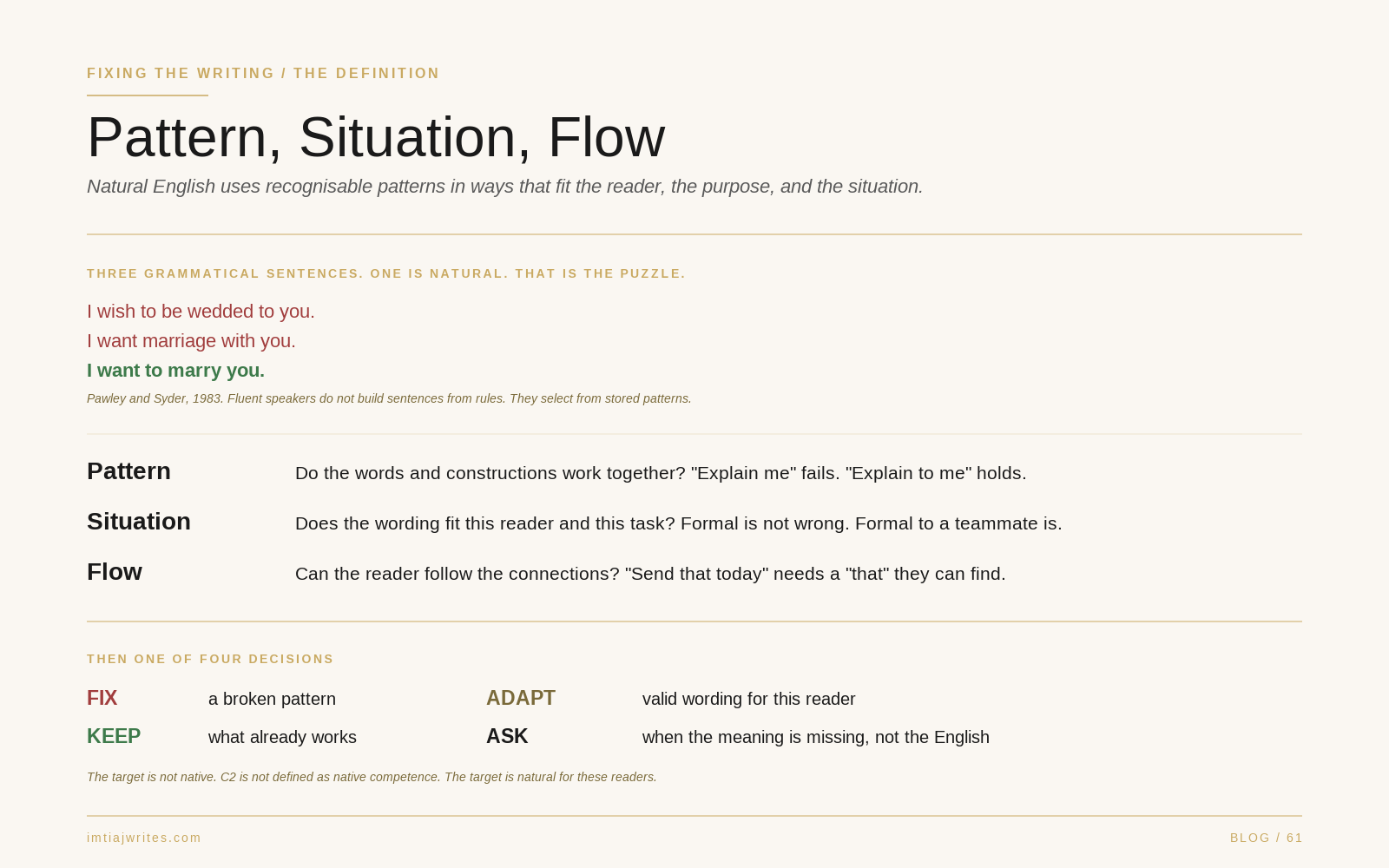
Here’s the definition. Natural English uses recognisable English patterns in ways that fit the intended readers, purpose, and situation.
Every word in that sentence is doing a job, and the rest of the post is about what each one means.
The forty-year-old puzzle
The best description of your exact problem was written in 1983, by two linguists who weren’t thinking about copywriters at all.
Andrew Pawley and Frances Syder noticed something that grammar couldn’t explain. A native speaker, wanting to propose, says “I want to marry you.” They don’t say “I wish to be wedded to you” or “I want marriage with you,” even though both are perfectly grammatical. Out of all the correct ways to say a thing, fluent speakers reliably pick the one that sounds right. Pawley and Syder called this nativelike selection, and they called it a puzzle, because the selection can’t be derived from grammar rules. Grammar generates all three. Something else picks.
Their answer was that fluent speakers don’t build most sentences from scratch. They select from a large stored stock of ready-made patterns: chunks, collocations, sentence stems, thousands of them, absorbed through exposure rather than taught as rules. “I want to marry you” is a stored pattern. “I wish to be wedded to you” is a sentence you’d have to construct, and constructing is what a non-native writer does when the stored pattern isn’t there yet.
That’s the whole mechanism behind “correct but unnatural.” You learned the rules. The rules produce grammatical sentences. But the rules can’t tell you which grammatical sentence a fluent reader expects, because that knowledge was never a rule. It was a stock. This is why the two-pass edit separates correctness from naturalness: they’re different kinds of knowledge, and the first can be perfect while the second is missing.
Why the target is not “native”
Pawley and Syder called it nativelike selection, and that word has done damage. It set native speech as the finish line, and a whole industry of “sound like a native” tools grew up around it.
But the Council of Europe’s framework for language proficiency, the CEFR, is explicit that its highest level, C2, is not defined as native or near-native competence. C2 is mastery. It isn’t imitation. And in professional writing for global readers, native isn’t even the right target, because native English includes a great deal that’s regional, casual, or unclear to a reader in another country.
So the definition says recognisable patterns, not native patterns, and it says fit the intended readers, not fit a native speaker’s ear. The question is never “would a native say this.” It’s “does this reader, for this purpose, in this situation, recognise it and follow it.”
Take “prepone.” It means to move something earlier, it’s standard in Indian English, and Cambridge lists it as such. “Can we prepone the review to Tuesday?” is natural English for a team that shares the word. For a reader in Berlin it isn’t, not because it’s wrong but because the pattern isn’t in that reader’s stock. The decision is adaptation for a specific audience, not correction of an error. Confusing those two is how non-native writers end up apologising for English that was never broken.
Three questions, then a decision
Here’s the definition turned into a diagnostic. Three questions in order, then one of four decisions.
Pattern. Do the words and constructions work together?
This is the level Pawley and Syder were describing, and it’s where the genuine errors live. Prepositions after verbs, which words combine with which, the shape a construction takes.
❌ She explained me the brief.
✅ She explained the brief to me.
“Explain” takes “something to someone.” That’s not a native-ear judgment. It’s a documented pattern, checkable in any usage reference, and fixing it is a correction with a reason. The pattern layer is where most of what I’ve written about lives: prepositions, phrasal verbs, collocations. It’s the layer that’s actually learnable as a list, because the patterns are finite even if the list is long.
Situation. Does the wording fit this reader and this task?
Now the three request drafts from the opening. None has a pattern problem. What separates them is situation.
“I would be grateful if you could provide” fits a formal relationship, a first contact with someone senior, a context where distance is appropriate. “Could you send” fits an ordinary working exchange. “Can you send it over” fits an established, familiar one. For most project emails I’d start from the middle. But the first isn’t wrong, and the third isn’t better. Cambridge’s grammar distinguishes formal, informal, and neutral registers, and it’s explicit that neutral and formal are not defective. A sentence doesn’t need a contraction, a phrasal verb, or a conversational aside before it becomes good professional English. That’s worth saying twice, because most “sound natural” advice implies the opposite, and non-native writers who follow it end up overcorrecting into a chattiness that fits nothing.
Flow. Can the reader follow the connections?
The third layer is the one nobody teaches, and it produces “unnatural” feedback that has nothing to do with the sentence.
Take “Could you send that today?” In a team chat, right after you’ve discussed a specific draft, it’s perfect. As the opening line of a first email, it’s baffling, because the reader can’t recover what “that” is. The sentence didn’t change. The context did, and without the referent the sentence fails.
Same with transitions. Non-native writers, taught that good writing has connectives, insert “therefore” and “moreover” between sentences that aren’t actually connected that way. A reader feels the seam. The fix isn’t a different connective. It’s checking whether the relationship the word claims actually exists.
A lot of what gets called unnatural is a missing-context problem wearing a language problem’s clothes.
Then decide: FIX, ADAPT, KEEP, or ASK.
Fix a broken pattern. Adapt valid wording for this reader or situation. Keep what already works. Ask when what’s missing is meaning, not English, because rewriting an ambiguous sentence invents a meaning the writer never chose.
This is the same four-way call I described for editing tools in Grammarly vs ChatGPT, with “adapt” in place of “optional,” because naturalness is about fit rather than preference. The keep decision matters most for this audience. If every sentence a tool flags gets changed, you never learn which of your own sentences were already right, and some of them were.
Change the context, not the sentence
Here’s a way to see the definition working that no before-and-after pair can show you. Keep the sentence fixed and move it between situations.
“We regret to inform you that your proposal was not selected.” In a formal selection notice, this is exactly right. Sent to a close teammate about a routine internal decision, it’s strangely distant, and they’d wonder what they did. Same words. The situation decides.
“The meeting ate the morning.” In a reflective piece, the metaphor carries voice and it belongs. On a timesheet that needs hours, it’s useless. Nobody should flatten it into “the meeting was long” just because it’s unusual. The question is whether the choice does work where it sits.
“That is not what the results show.” Following a clearly stated interpretation, it’s a precise rebuttal. As an opening line with no results and no claim in view, it’s an accusation aimed at nothing.
Three sentences, none of them changed, each natural in one place and not in another. That’s the definition’s last clause doing its work. Natural is not a property a sentence has. It’s a fit between a sentence and a situation.
What actual public writing tells you
If natural meant conversational, the writing people trust most would be conversational, and it isn’t.
Google’s developer style guide asks for a conversational tone and then explicitly warns writers not to write exactly the way they speak. Stripe’s API documentation keeps “idempotent,” a technical term almost nobody uses in speech, because the readers need it and a plainer word would be less accurate. GOV.UK’s service-error pattern opens with “Sorry, there is a problem with the service,” neutral, not chatty, because a person who’s just hit an error wants information, not warmth.
Three professional registers, none casual, all natural for their readers. The universal template, “write like you talk,” produces writing that’s natural for a conversation and wrong for a technical reference, a legal notice, or a product page. The only universal rule is the definition: fit the reader, the purpose, the situation.
One warning about trusting the ear
There’s a temptation, when you finally have fluent colleagues, to outsource naturalness to them. “You’re native, does this sound right?” And they’ll tell you, confidently.
A study published in Studies in Second Language Acquisition in late 2025 tested that confidence. Ninety-three participants, native speakers and advanced and intermediate second-language speakers, judged 300 paired expressions for how common and how strongly associated they were, and the judgments were compared against corpus statistics. Every group agreed only weakly with the corpus. The group that agreed most, particularly on frequency, was the advanced second-language group, not the natives.
That’s a narrow finding about one task, not proof that non-native writers judge naturalness better. But it’s enough to retire one habit: “I’m a native speaker” is not a reason. When a correction matters, ask for the pattern behind it, check a usage reference for constructions and a collocation reference for combinations, and compare against writing in the same register. Naturalness is checkable. It doesn’t have to be taken on faith, from anyone.
Two things the definition protects
Meaning. “We may publish on Friday if approval arrives by Wednesday” becomes, under a fluency-first edit, “We will publish on Friday.” Smoother. Also a different commitment, with the condition gone. A sentence that sounds better and means something else is a worse sentence. Naturalness is a criterion for choosing among sentences that say what you meant. It’s never a licence to change what you meant.
Deliberate voice. An unusual choice is not automatically an unnatural one. “The meeting ate the morning” is odd on purpose. The test for any edit to a distinctive sentence is: what does the original choice contribute, and what problem would changing it solve? If the answer to the second is “none, an editor just wouldn’t have written it that way,” keep it. There’s a difference between an unfamiliar choice, a broken pattern, and a deliberate effect, and only one of the three needs fixing. That protection is the whole point of the voice you’re allowed to keep.
The honest limit
This definition is editorial, not scientific. Pawley and Syder’s stored-pattern account is the best explanation I know for why grammar isn’t enough, but it’s a theory of how fluent speakers work, not a measuring instrument. The 2025 study is one task with 93 people. Cambridge’s register distinctions are guidance, not law. I ran no corpus searches and I’m not going to tell you one phrasing is “statistically dominant” when I didn’t count.
What the definition gives you is something the vague version never did: a way to ask why. Why does this sound off? Pattern, situation, or flow? Is it broken, or just formal, or just missing its context? Fix, adapt, keep, or ask?
You’ll still get told to make it sound natural. Now you can ask the person what they mean, and check whether they’re right.
Frequently Asked Questions
What does natural English actually mean?
Natural English uses recognisable English patterns in ways that fit the intended readers, purpose, and situation. It is not the same as native English, and it is not the same as casual English. A formal notice, a technical reference, and a chat message can each be natural for their readers while sounding nothing like each other.
Why does my English sound unnatural when the grammar is correct?
Because grammar and naturalness are different kinds of knowledge. Grammar rules generate many correct sentences; fluent speakers select among them using a stored stock of familiar patterns, a mechanism linguists Pawley and Syder described in 1983. A non-native writer who has learned the rules but not yet the stock constructs sentences that are correct but not the ones a reader expects.
Is natural English the same as native English?
No. The CEFR’s highest proficiency level, C2, is explicitly not defined as native competence. Native English includes regional, casual, and unclear usage that would be wrong for many professional and global readers. The target for a professional writer is natural for the intended audience, not imitation of a native speaker.
Should I write the way I speak to sound more natural?
Not as a rule. Google’s own style guide asks for a conversational tone while warning against writing exactly as you speak. Neutral and formal registers are natural in the situations that call for them. Writing like you talk produces natural conversation and unnatural technical documentation, legal notices, and formal requests.
How do I check whether a phrase is natural without asking a native speaker?
Identify what you’re unsure of: the construction, the word combination, the formality, or the audience’s familiarity with a term. Then check the matching evidence: a usage reference for constructions, a collocation reference for combinations, and comparable published writing for register. Research suggests native intuition agrees only weakly with actual usage data, so a checkable reason beats a confident ear.
Where to go next
👉🏼 For the pass where pattern, situation, and flow get checked, see the two-pass edit.
👉🏼 For the pattern layer in detail, see prepositions that mark you as non-native and phrasal verbs in copy.
👉🏼 For the formal habits that confuse register with correctness, see unlearning school English.
👉🏼 For the four decisions applied to editing tools, see Grammarly vs ChatGPT.
Pattern, situation, flow. Fix, adapt, keep, ask. Natural is a fit, not a sound.
