
You’ve probably sat in front of a document with the cursor blinking and a topic you know cold, and produced nothing for forty minutes. Not because you had nothing to say. Because every time a sentence started forming, the search for the right English word arrived at the same moment and the two collided.
If that’s familiar, the first thing to know is that it isn’t a discipline problem, and it isn’t a sign your English is weak. It’s measurable, and it has a cause.
In 2006, Roca de Larios, Manchón and Murphy tracked writers composing in their first and second languages and found that in the second language they spent twice as much time dealing with formulation problems, the work of turning an idea into words. Then the finding that matters for you: that extra cost did not depend on proficiency. Advanced writers paid it too. A 2008 follow-up found formulation was the single largest share of composing time at every level.
So the blank page for a non-native writer isn’t the absence of an idea. It’s the idea and the English fighting for the same attention, with the English costing double. This post is about separating them, and ChatGPT Voice is one way to do that. Not the only way, and not a magic one.
Voice or dictation, and why the difference matters
Two different things get called “using ChatGPT Voice,” and they solve different problems.
Voice is a spoken conversation. You talk, it responds, you talk again. What it’s good at is asking you questions, which is the thing a blank page never does.
Dictation records what you say and turns it into text you can read and edit before anything happens to it. What it’s good at is getting words out of your head when you already know roughly what they are.
And there’s a third route the marketing never mentions: typed fragments, or a typed interview, for days when speaking English out loud is its own kind of pressure. That’s not a failure to use Voice properly. It’s the same method with a different input.
The choice, honestly: if you need someone to ask you what your point is, use Voice. If you know your point and want to inspect the captured words before trusting them, use Dictation. If speaking is more demanding than writing today, type. The method below works with all three, because the method isn’t about the microphone.
One limitation worth knowing before you start. OpenAI’s own documentation says Voice transcripts may not exactly reproduce what was said, and that pauses or background noise can trigger a response even when you asked it to wait. So don’t build a workflow around “stay silent until I say finished.” Build it around checking what came back.
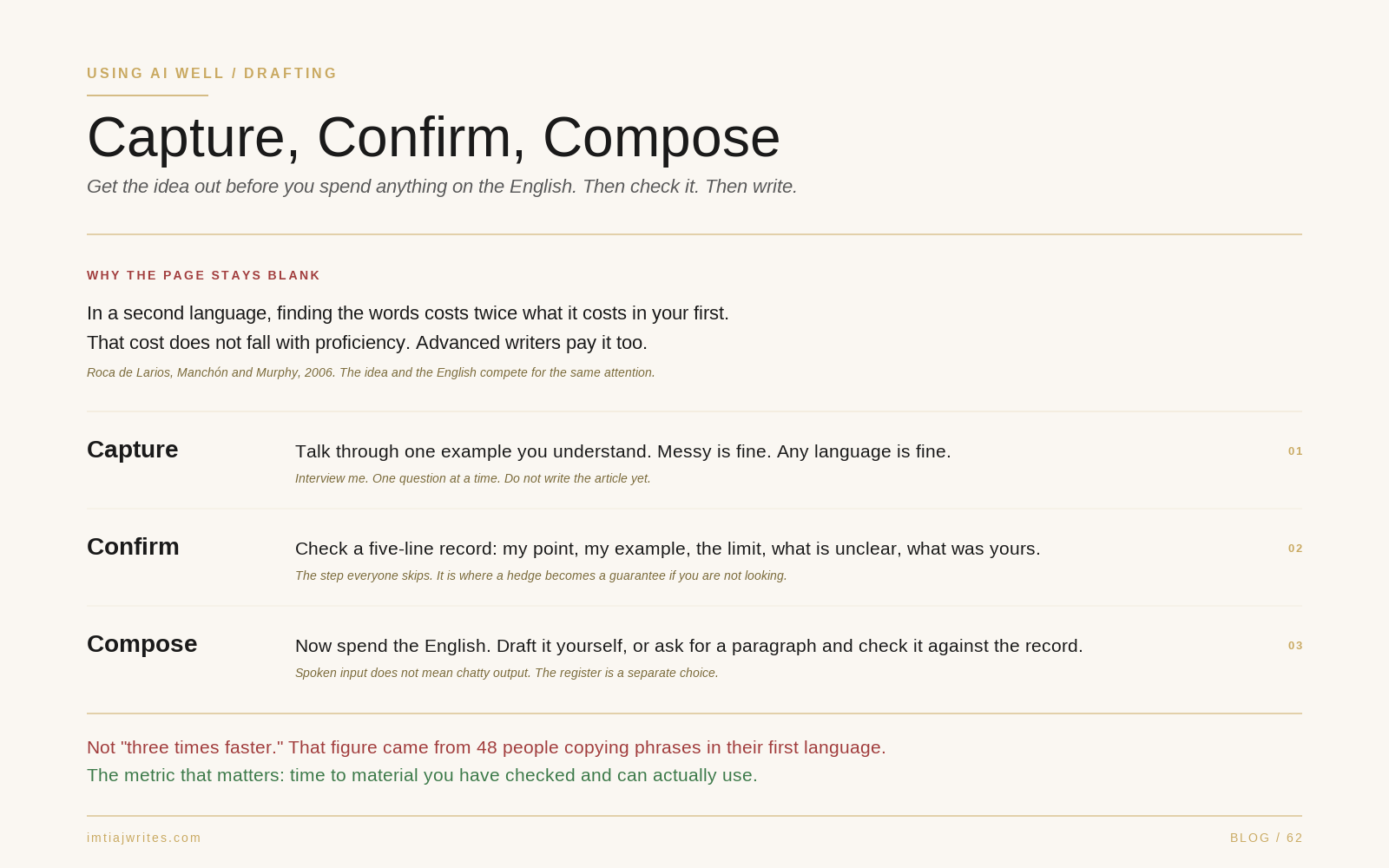
Capture, Confirm, Compose
Here’s the method. Three steps, and the middle one is the one everybody skips.
Capture: explain one example before you try to write anything.
Don’t ask for an introduction. Don’t ask for help with the article. Ask it to interview you about one concrete thing you understand.
❌ Help me write a compelling introduction about onboarding.
✅ Ask me about one onboarding problem I’ve noticed. One question at a time. Don’t draft anything yet.
The first prompt asks the tool to produce English about a topic you haven’t yet found your point on, which means it will find a point for you, and it won’t be yours. The second asks it to extract material: an observation, a distinction, an example, an objection. That material is what you were failing to get onto the page, and it comes out in speech because speech doesn’t wait for the right word the way typing does.
Speak messily. Repeat yourself. Say “I don’t know the English word for this but it’s the thing where,” and describe it. Say a phrase in your first language if that’s where it lives. The capture step isn’t a performance, and a tool that corrects your English during it is doing the wrong job. Tell it not to.
Confirm: check a five-line record before asking for prose.
This is the step that makes the method safe, and it’s the one no “just talk to ChatGPT” advice includes.
Before any drafting, ask for a short record, not a transcript, with five labels:
My point. Is this actually what I meant to argue?
My example. Did I supply this, and is it accurate and mine to use?
Limit. Did a condition, an exception, or an “I’m not sure” disappear?
Unclear. What still needs checking or research?
Your suggestion. Which ideas came from the tool, not from me?
Read it as an editor, not a grateful author. The record is supposed to represent what you meant accurately enough to build on. It isn’t supposed to sound good yet.
And separate two things the record can’t do for you. “Yes, that’s what I said” confirms faithfulness. It doesn’t confirm the claim is true. If you said, “I remember reading that this converts better,” the record can faithfully capture that you remember it. Whether it’s right is a different job.
Compose: now spend the English.
Only after the record is confirmed, ask for a paragraph, an outline, or a bounded section. Or write it yourself from the record, which is often the better move, because the record has done the hard part and the drafting is now formulation with the idea already fixed.
Then check the draft against the record before you check it for elegance. Did it add a claim? Turn a hedge into a promise? Invent a cause? Drop the limit? Those are the questions. “Does it sound good” comes after.
The teardown: where fluency eats the point
Here’s what the method protects against. This is an illustrative case, not a recorded session.
A writer captures, in messy spoken notes:
“I’m not saying short onboarding is always better. In this example the reader has already entered a work email. The next screen asks for the same email again. I’d remove the repeated request, unless there’s a verification reason. I don’t have a conversion number. That’s the point I can’t turn into an opening.”
There’s no introduction there. But there’s a real observation, a real example, a stated limit, and an honest gap. That’s more than most drafts start with.
Now here’s what a fluency-first draft does with it:
❌ Shorter onboarding always converts better. Remove extra fields to increase sign-ups.
Confident. Clean. And wrong three times over. The writer explicitly said not always. The example was a repeated request, not “extra fields” in general. And there was no conversion number, which the draft has quietly supplied as a certainty. The English got better, and the claim got worse, and a tool did it in one move.
The confirm record catches all three. Point: an unnecessary repeated request, not all long onboarding. Example: the same email asked twice. Limit: verification might justify it. Unclear: no conversion data. With that checked, a faithful paragraph writes itself:
✅ Before you shorten an onboarding flow, look for a question the user has already answered. In this example, the next screen asks for the same work email again. Remove that repetition unless it serves a verification requirement.
Same material. Same writer. The rough explanation already contained something worth writing. The job was organising it without changing the claim, and that job only gets done if there’s a step where you check.
The same failure shows up as a delivery estimate that becomes a guarantee, a half-remembered study that becomes a statistic, and an interviewer that gradually replaces your position with its own thesis because its questions were leading. All three are caught at confirm. None are caught by reading the final draft and asking whether it sounds nice.
Two things that trip non-native writers specifically
Language hesitation and idea uncertainty need different responses.
These sound similar in a capture session, and they’re not:
“I know what this does, but I can’t remember the English term.”
“I don’t know whether this claim is true.”
The first is a wording question. The tool can offer terms, and you pick. The second is an evidence question, and the right response is a qualification or a cut, not a more confident sentence. A model that “solves” both by making the sentence sound sure has turned your honesty about not knowing into a false claim. Watch for it at confirm.
Spoken input doesn’t mean chatty output.
There’s a reflex, once you’ve talked something through, to publish it in the register you spoke it in. Don’t. Google’s own style guide, which asks for a conversational tone, explicitly warns against writing exactly the way you speak. A proposal keeps its precise conditions. A technical explanation keeps its terminology. The input method and the final register are separate choices, and the register belongs to the reader, which is the whole argument of what natural English actually is.
The “three times faster” claim, and why I’m not making it
You’ll see it everywhere: speech is three times faster than typing. The number is real, and it doesn’t mean what the marketing says.
It comes from a 2017 lab study of 48 people copying short phrases that were handed to them, in their first language, comparing a speech engine against a phone keyboard. English speech entry was 2.93 times faster at that task. The researchers used copying precisely so that the study would measure input speed and not the work of composing.
That’s the opposite of your situation. You’re composing in a second language, and the expensive part is formulation, not typing. A study that deliberately removed formulation from the measurement can’t tell you anything about a workflow whose entire point is managing formulation.
So the metric I’d use isn’t speaking speed. It’s time to materialise; you’ve checked and can actually use. That includes setup, the capture conversation, reading the record, correcting it, and organising the result. On that measure, voice-first may or may not beat your current process. The blank trial log in the research this post draws on is blank on purpose. Run it on one real piece and find out for yourself, rather than trusting a number that was never about you.
Keep the safeguards visible
A voice conversation isn’t automatically private. OpenAI documents an account-level control for whether your conversations are used to improve its models, and turning it off doesn’t delete anything from your history. Check the setting, and more importantly, don’t talk through an unpublished client draft in any tool without knowing you’re allowed to. The setting is a control, not a permission. I covered the same principle for text tools in Grammarly vs ChatGPT, and it applies harder here, because talking feels less like handing something over than pasting does.
And keep typing in real time throughout. Names, numbers, technical terms, links, and corrections: type them. Mixing input methods isn’t cheating. It’s the method.
The prompt
Here’s the capture prompt built to enforce all of the above:
Help me prepare material for a blog for [readers] about [topic]. Interview me. Do not write the article yet.
Ask one short question at a time. Start with a concrete problem my reader has. Let me finish and keep your replies brief.
Do not correct my English during capture. Ask about my example and its limits before suggesting your own ideas.
Before drafting, summarise my point, example, qualifications, and unresolved questions for me to check. Keep your suggestions separate from what I supplied.
Nothing in it is a magic phrase. The whole value is the separation it enforces: material from you first, prose from that material second, and a checkpoint in between. That separation is the same principle as the two-pass edit, applied one stage earlier. There, correctness and naturalness are kept apart. Here, the idea and the English are.
The honest limit
I found no study showing this exact workflow improves professional writing for non-native writers. The formulation research explains why the blank page happens; it doesn’t test this fix. The hybrid speech-and-keyboard research exists but is small, non-randomised, and measured lexical variety rather than quality. The recognition research warns that a readable transcript can still paraphrase, complete, or alter what you said, which is a reason for the confirm step, not a prediction about your accent.
So this is a method to try and assess, not a proven intervention. What I’d stand behind is narrower and, I think, more useful: the thing keeping your page blank is a cost you can measure and separate, and any process that lets you get the idea out before you pay for the English is worth an afternoon’s trial.
Capture the idea. Confirm the record. Then, and only then, compose the English. The blank page was never about the words.
Frequently Asked Questions
Why can’t I start writing even when I know the topic well?
For second-language writers, research shows the work of turning ideas into words takes about twice as long as in the first language, and this doesn’t improve with proficiency. The idea and the English compete for the same attention at the same moment, and the page stays blank. Separating the two by getting the idea out first in speech or rough notes removes the collision.
What’s the difference between ChatGPT Voice and Dictation for writing?
Voice is a spoken conversation, useful when you need questions to help you find your point. Dictation converts speech to text you can read and edit before using it, useful when you know your point and want to inspect the words. Typed fragments work with the same method for days when speaking English is its own pressure.
Is speaking really three times faster than typing?
That figure comes from a 2017 study of 48 people copying supplied phrases in their first language, deliberately excluding the work of composing. It doesn’t apply to composing original content in a second language. A better measure is the time to the material you’ve checked and can actually use.
How do I stop ChatGPT from changing my meaning when it drafts from my spoken notes?
Insert a confirmation step. Before any drafting, ask for a short record of your point, your example, any limits or conditions, what’s still unclear, and which ideas were the tool’s rather than yours. Check that against what you meant, then draft, then check the draft against the record before judging its style.
Should my final text sound conversational if I spoke the first draft?
No. The input method and final register are separate choices. A spoken capture can become a formal proposal, a precise technical explanation, or a conversational post depending on the reader. Google’s style guide asks for a conversational tone while explicitly warning against writing exactly as you speak.
Where to go next
👉🏼 For the principle of separating the two costs, one stage later, see the two-pass edit.
👉🏼 For why the final register belongs to the reader, not the input, see what natural English actually is.
👉🏼 For the same meaning-preservation discipline applied to editing tools, see Grammarly vs ChatGPT.
👉🏼 For prompts that keep the tool in its lane, see 15 ChatGPT prompts for non-native writers.
Capture, confirm, compose. The blank page was never about the words.
