
Imagine you paste a paragraph into ChatGPT and type “make this sound more natural.” It hands back something smoother, more confident, and completely unlike anything you’d write. You accept it because it’s better English. Three months later, your entire portfolio sounds like a model wrote it, and you can’t remember what your own writing sounded like.
That’s what a bad prompt does. Not a wrong answer, a silent replacement. The ChatGPT prompts for non-native writers below are built to prevent exactly that, because a vague instruction hands the model your voice and a specific one keeps it.
Each prompt does one of three jobs: diagnose a problem, fix one narrow thing, or protect your voice from the model’s defaults. Under each, I’ve shown the kind of output it produces, and for three of them I’ve included the actual ChatGPT response (all fifteen will make the post too long!) so you can see the shape before you spend an evening testing. Exact wording varies by model version, so treat the outputs as the shape of the answer, not a script.
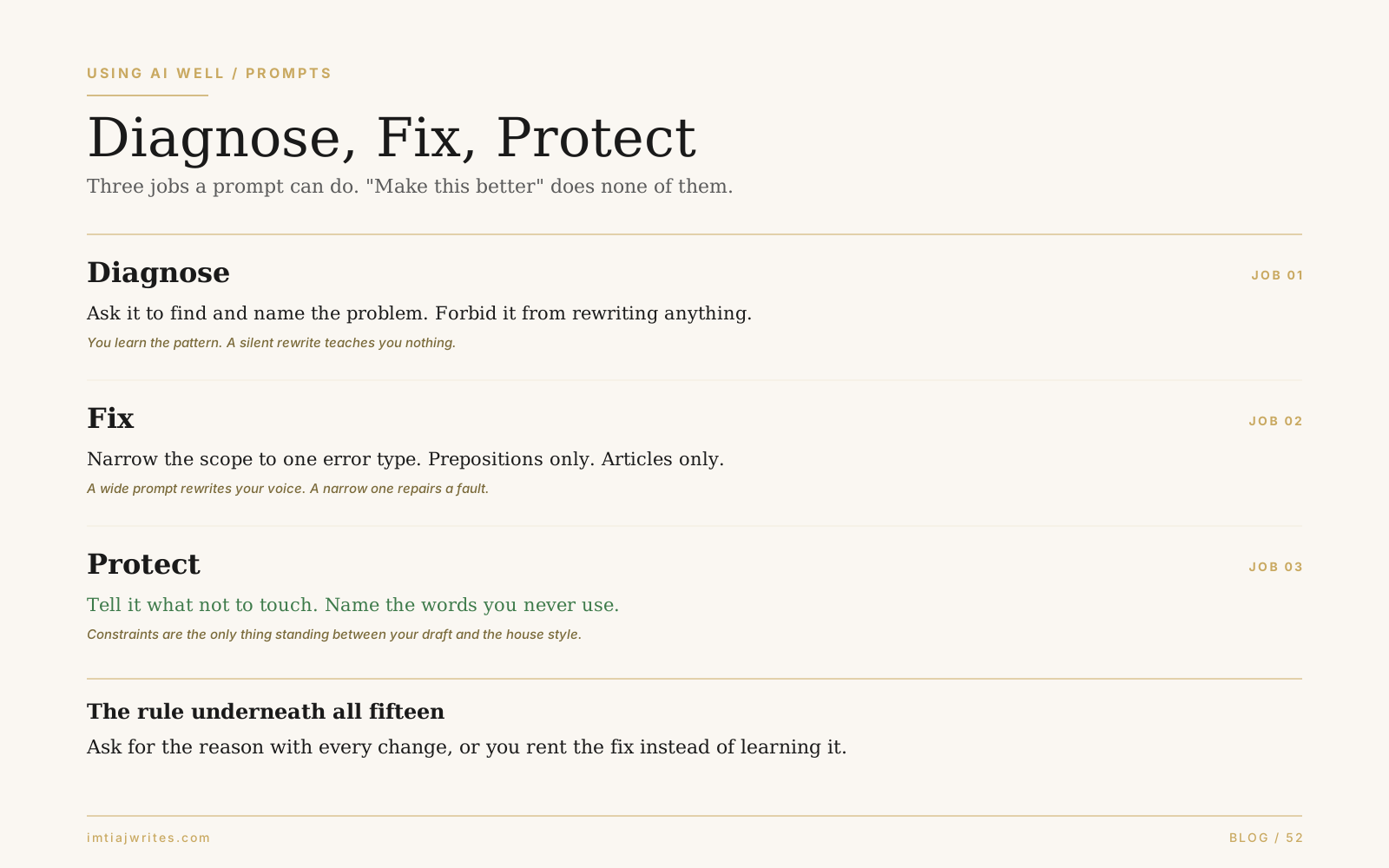
Part 1: Diagnose (prompts 1 to 5)
These find the problem and name it. Critically, they forbid rewriting, because a silent rewrite teaches you nothing and you’ll make the same error next week.
1. The tell-finder
Read this text. List only the specific words or phrases that would signal to a native English reader that this wasn’t written by a native speaker. Do not rewrite anything. For each item, give a one-line reason.
❌ Vague version: “Does this sound non-native?”
✅ What the prompt above returns: a list like “discuss about the plan” → discuss takes no preposition; “kindly revert” → common in South Asian business English, reads as dated elsewhere; “do the needful” → regional, unfamiliar to most Western readers.
That list is worth more than a rewrite, because it’s transferable to every future draft.
2. The register check
What register does this read as: academic, corporate, casual, or conversational-professional? Quote the three sentences that most set that register, and say what makes each one land that way.
Output: a verdict plus evidence. Usually you discover your writing is one notch more formal than you intended, which is the most common non-native pattern and the hardest to self-diagnose.
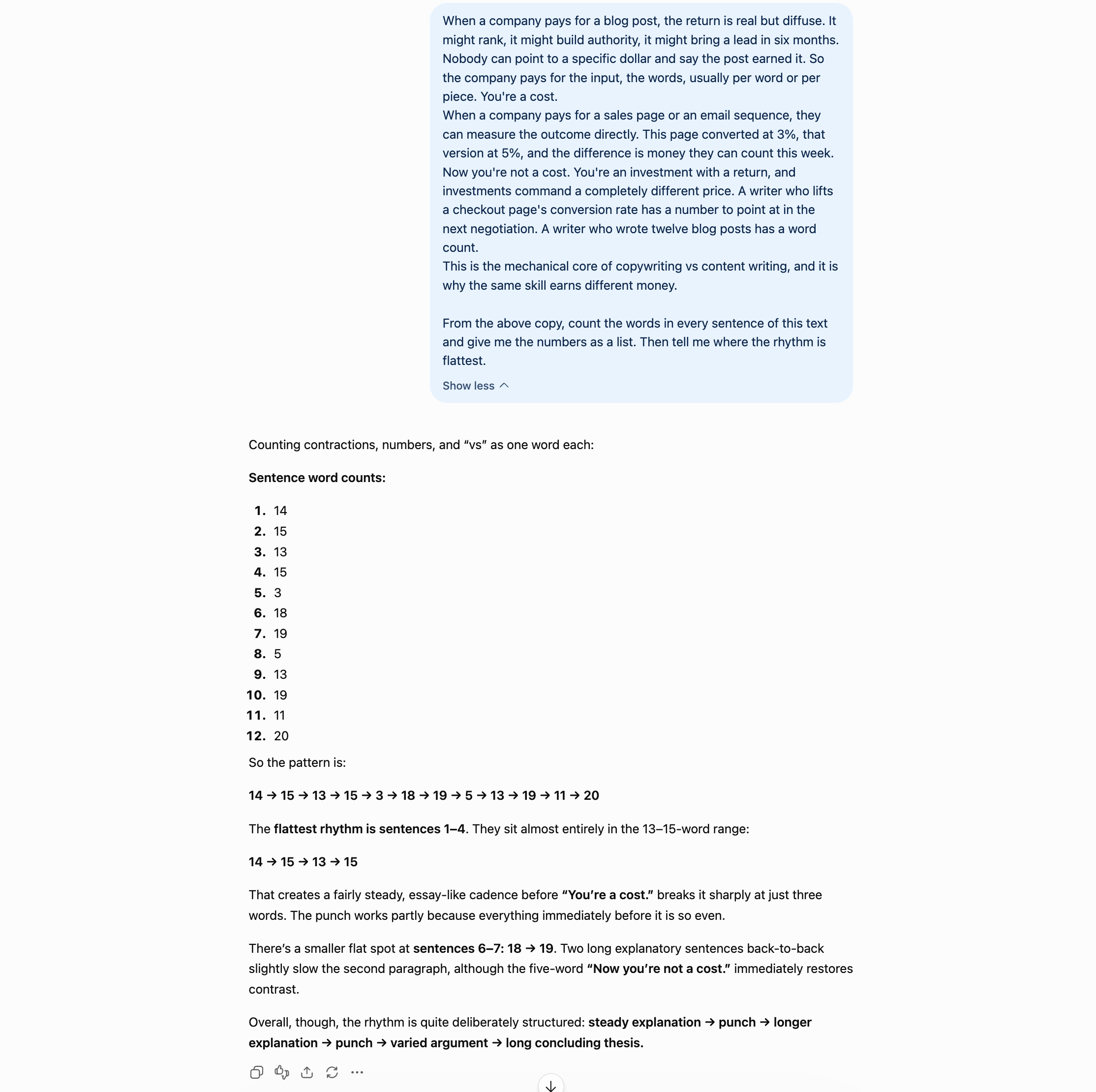
3. The rhythm audit
Count the words in every sentence of this text and give me the numbers as a list. Then tell me where the rhythm is flattest. Reply in short.
Output: something like 19, 22, 18, 21, 20 → your sentence lengths barely vary between sentences 1 and 5, which reads as even and processed. This is the mechanical version of a problem most writers can feel but not locate. I covered why this specific pattern matters in sentence length and non-native writing.
4. The say-it-out-loud test
For each sentence, tell me whether a fluent native professional would actually say it out loud to a colleague. For any that fail, show the spoken version alongside the original. Don’t change the ones that pass.
Output: a two-column comparison. “Please be advised that the meeting has been rescheduled” fails, “Heads up, the meeting moved” passes.
5. The AI-tell audit
This text may have been edited by AI. Identify any phrasing that reads as machine-generated: overused transitions, inflated significance, hedge stacking, rule-of-three constructions. List them without rewriting.
Useful when you’ve already run something through a tool and want to know what it left behind.
Part 2: Fix (prompts 6 to 10)
These repair one narrow thing. Narrowness is the whole point: a wide prompt rewrites your voice, a narrow one repairs a fault and leaves everything else alone.
6. Prepositions only
Check only the prepositions and verb-preposition pairings in this text. List each error and its correction, nothing else. Do not touch grammar, style, or word choice.
Output: depends of → depends on. responsible of → responsible for. discuss about → discuss. Nothing else changes. This is the single highest-value narrow prompt for most non-native writers, for reasons I laid out in the prepositions that mark you as non-native.
7. Articles only
Check only the articles (a, an, the) and whether each is correct, missing, or unnecessary. Give me a list of corrections with a one-line reason for each. Change nothing else.
8. Collocations only
Flag any word pairings here that are grammatically correct but not what a native speaker would naturally pair together. Give the natural alternative for each.
Output: “make a research” → do research. “strong rain” → heavy rain. “high experience” → extensive experience. These are the errors no grammar checker catches, because nothing is technically wrong.
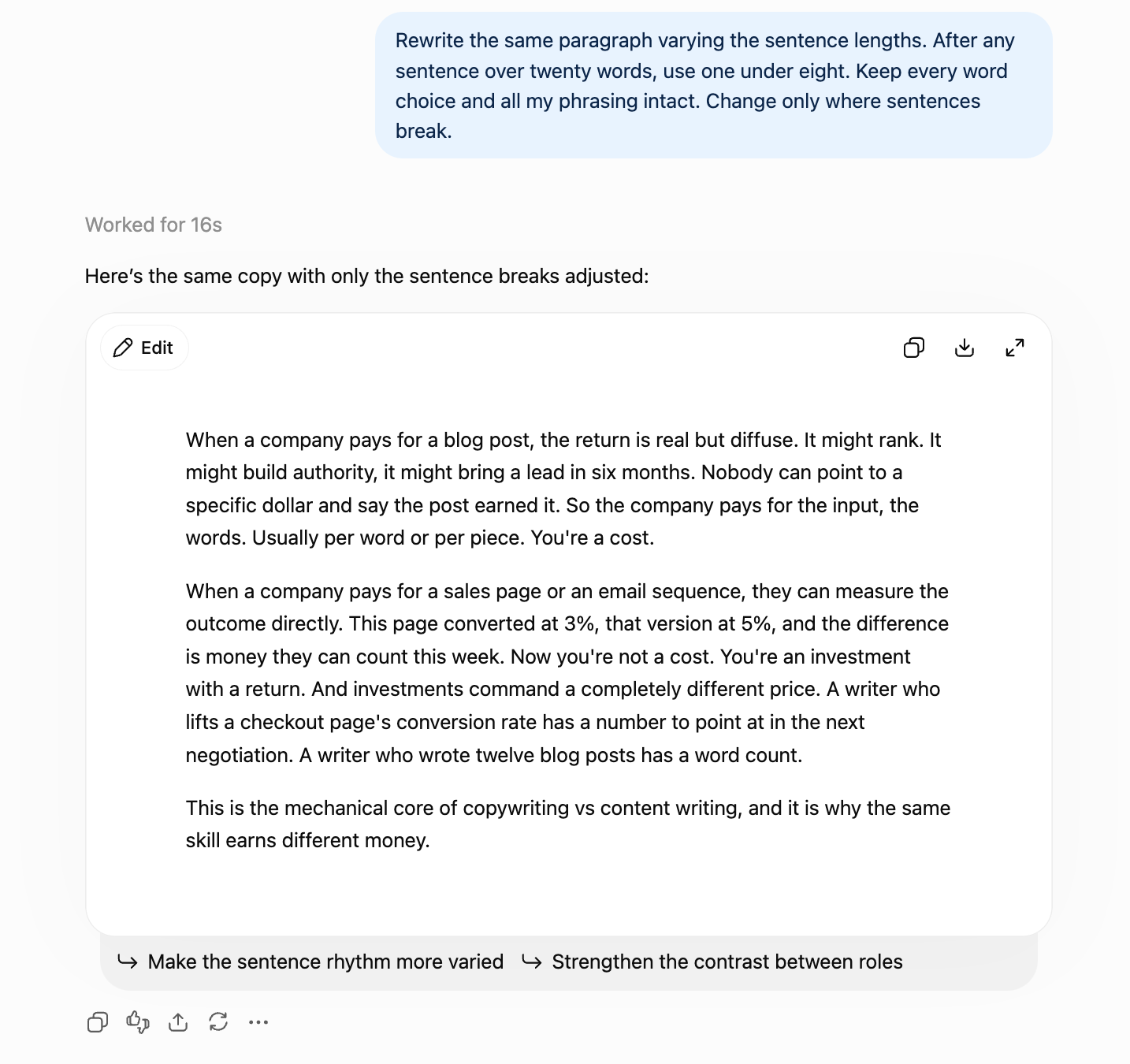
9. The rhythm fix
Rewrite this paragraph varying the sentence lengths. After any sentence over twenty words, use one under eight. Keep every word choice and all my phrasing intact. Change only where sentences break.
The constraint at the end is what makes this safe. Without it, the model reorganizes your vocabulary too.
10. The reason-with-every-fix
Correct the errors in this text. For each correction, state the rule or convention behind it in one line. I want to learn the pattern, not just receive the fix.
This is the prompt I’d keep if I could keep one. It converts every edit into a lesson, which is the difference between building an instinct and renting one.
Part 3: Protect (prompts 11 to 15)
These stop the model from replacing you with itself. They matter more than the fix prompts, and almost nobody uses them.
11. The voice brief builder
Here are five samples of my writing. Write a description of my voice specific enough that another writer could imitate it. Include the constructions I avoid, my typical sentence rhythm, and my register. Be concrete, not flattering.
Output: a paragraph you save and paste into every future session. This is the highest-leverage prompt on the list, because it turns your voice into an instruction the model can follow.
12. The minimal-edit instruction
Fix only what is actually wrong. Do not improve, tighten, restyle, or “elevate” anything that is already correct. If a sentence is clumsy but not incorrect, leave it. List every change you made.
❌ What happens without this: the model silently upgrades twelve sentences you never asked it to touch.
✅ What happens with it: three corrections, listed, and your paragraph otherwise intact.
13. The banned-words guard
When editing my text, never use these words: delve, leverage, robust, seamless, tapestry, testament, landscape, realm, navigate, and elevate. Never open with a rhetorical question. Never use the “not X, but Y” construction.
Specificity is what makes this work. “Avoid AI-sounding language” produces nothing. A named list produces compliance.
14. The voice drift check
Compare this new draft against my writing samples. Point to the specific places where it stops sounding like me and starts sounding like generic professional English. Don’t fix them, just mark them.
Run this on anything you’ve iterated on for a while. Voice drifts gradually and you stop noticing.
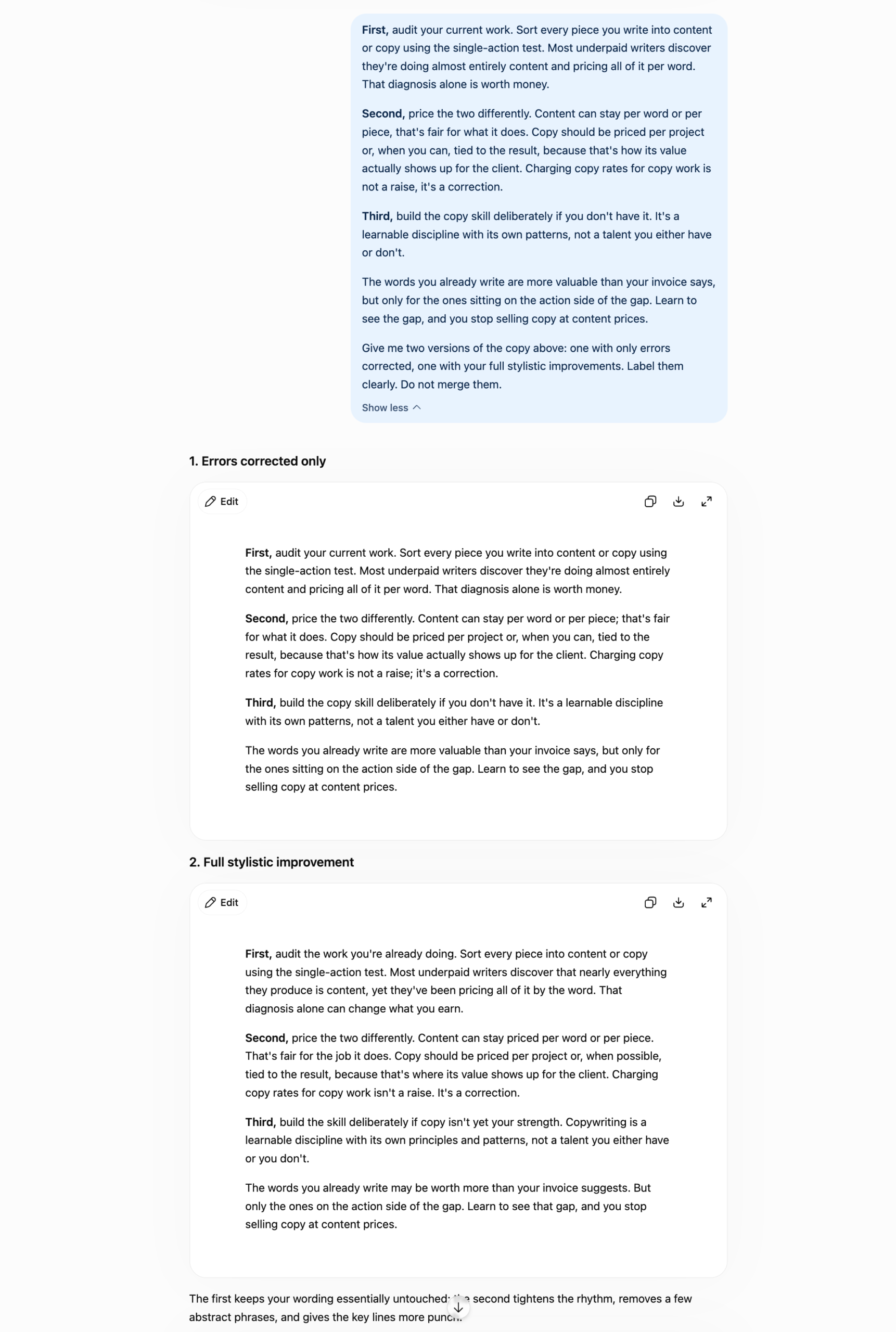
15. The two-version comparison
Give me two versions of this paragraph: one with only errors corrected, one with your full stylistic improvements. Label them clearly. Do not merge them.
Output: two blocks. You almost always want the first one, and seeing them side by side shows you exactly how much the model would have taken if you’d asked vaguely.
The rule underneath all fifteen
Every prompt here does one of three things: names a problem, repairs one narrow fault, or constrains what the model may touch. What none of them does is hand over the whole paragraph and hope.
That’s the actual skill. Not collecting prompts, but understanding that scope is the variable. A wide prompt gets you the model’s voice. A narrow prompt gets you your own writing with one thing fixed.
And run these in the right pass. Diagnosis and narrow fixes belong in the correctness read, never mixed with the naturalness read, which is the separation I described in the two-pass edit. Mixing them is how you end up accepting a stylistic rewrite while you thought you were fixing grammar.
One last thing worth saying plainly. Prompt 10 exists because the goal isn’t a clean draft today. It’s not needing the prompt in a year. Ask for the reason every time, and the list gets shorter as your instinct gets better.
Frequently Asked Questions
What is the best ChatGPT prompt for non-native English writers?
The highest-value one asks the model to identify problems without rewriting: “List only the phrases that would signal to a native reader this wasn’t written by a native speaker. Do not rewrite. Give a one-line reason for each.” Diagnosis transfers to future drafts, while a silent rewrite only fixes the current one.
Why does ChatGPT make my writing sound generic?
Because vague prompts like “make this better” give the model permission to replace your voice with its default register. Narrow, constrained prompts that name exactly what to fix and what to leave alone produce corrections rather than replacements.
How do I stop ChatGPT from changing my writing style?
Give it explicit constraints. Tell it to fix only actual errors and leave clumsy-but-correct sentences alone, provide a list of specific words it must never use, and ask it to list every change it made. Constraints are the only thing standing between your draft and the model’s house style.
Can ChatGPT teach me English rather than just correcting it?
Yes, if you ask it to. Adding “state the rule or convention behind each correction in one line” to any editing prompt turns each fix into a lesson. Without that, you get a corrected draft and make the same error next week.
Do these prompts work with Claude or other AI models?
The principles transfer, since narrow scope and explicit constraints improve output from any model. The exact wording of responses varies by model and version, and models differ in how well they hold a trained voice across a long session.
Where to go next
👉🏼 For which model actually holds your voice, see ChatGPT vs Claude for copywriting.
👉🏼 For the editing method, these prompts fit inside, see the two-pass edit.
👉🏼 For the specific errors prompt 6 catches, see prepositions that mark you as non-native.
👉🏼 For my full tool stack, see the AI writing tools I actually use.
Scope is the variable. Narrow the prompt, keep the voice, and ask for the reason every time.
