
I wrote a LinkedIn post by hand. No AI draft, no AI rewrite, just me typing it out the way I always do. Then I pasted it into GPTZero, the most widely used AI detector on the market.
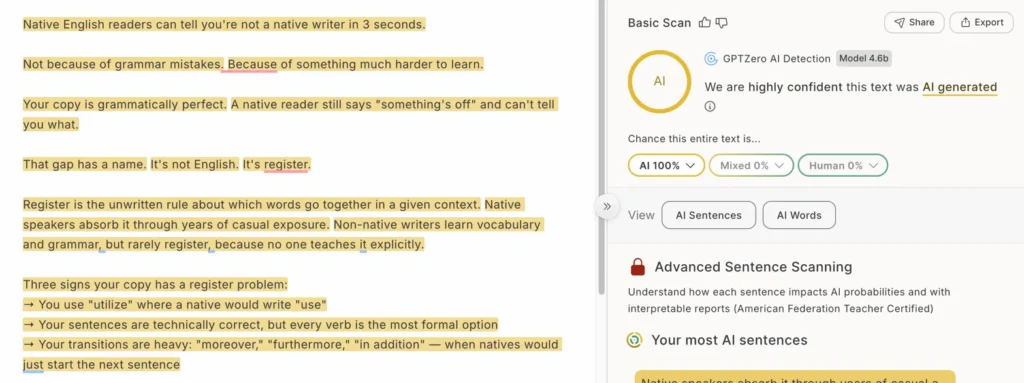
GPTZero flagged human writing of mine as 100% AI. Not 60, not 80. One hundred percent, with the label “We are highly confident this text was AI generated.”
This post is the full result of that test, with the screenshot, the exact text, and the honest explanation of why it happened. If you are a non-native writer who has ever worried about being falsely flagged, this is what the problem actually looks like when you run the experiment yourself. I tested GPTZero on human writing, and the result is worse than most people expect.
If you want the underlying mechanism (why detectors flag clean writing, how perplexity works), that is covered in full in the post on why AI detectors flag your writing. This post is the field test, not the theory.
What I tested
The text was a real LinkedIn post of mine. It argues that native English readers can spot a non-native writer in seconds, not because of grammar but because of register, the unwritten rule about which words go together in which context. It is a post about a skill machines find hard to copy, and it was written entirely by a human who has that skill. That irony is the whole story here.
I did not pick an unusually robotic piece to game the result. I picked a normal post, the kind I publish often. It has short sentences. It has clean grammar. It has a clear structure with a couple of arrow bullets. In other words, it has exactly the qualities I work hard to put into my professional writing.
That is the trap, and we will get to it.
The result, in full
Here is what GPTZero returned.
Overall verdict: “We are highly confident this text was AI generated.”
❌ AI: 100%
❌ Mixed: 0%
❌ Human: 0%
The tool highlighted nearly every sentence in yellow as AI-likely. The model used was GPTZero’s 4.6b. There was no ambiguity in the result and no “this might be mixed” softening. The detector was certain, and it was certainly wrong.
I know it was wrong because I wrote it. There is no version history dispute here, no ghostwriter, no AI draft I cleaned up. The post is human, and the most popular detector on the market rated it as not human at all, with full confidence.
Why clean non-native copy gets flagged
This is the part that matters for you, because the reason is not random. This is not the first time GPTZero flagged human writing that was clean and clear. The Stanford study found the same pattern at scale.
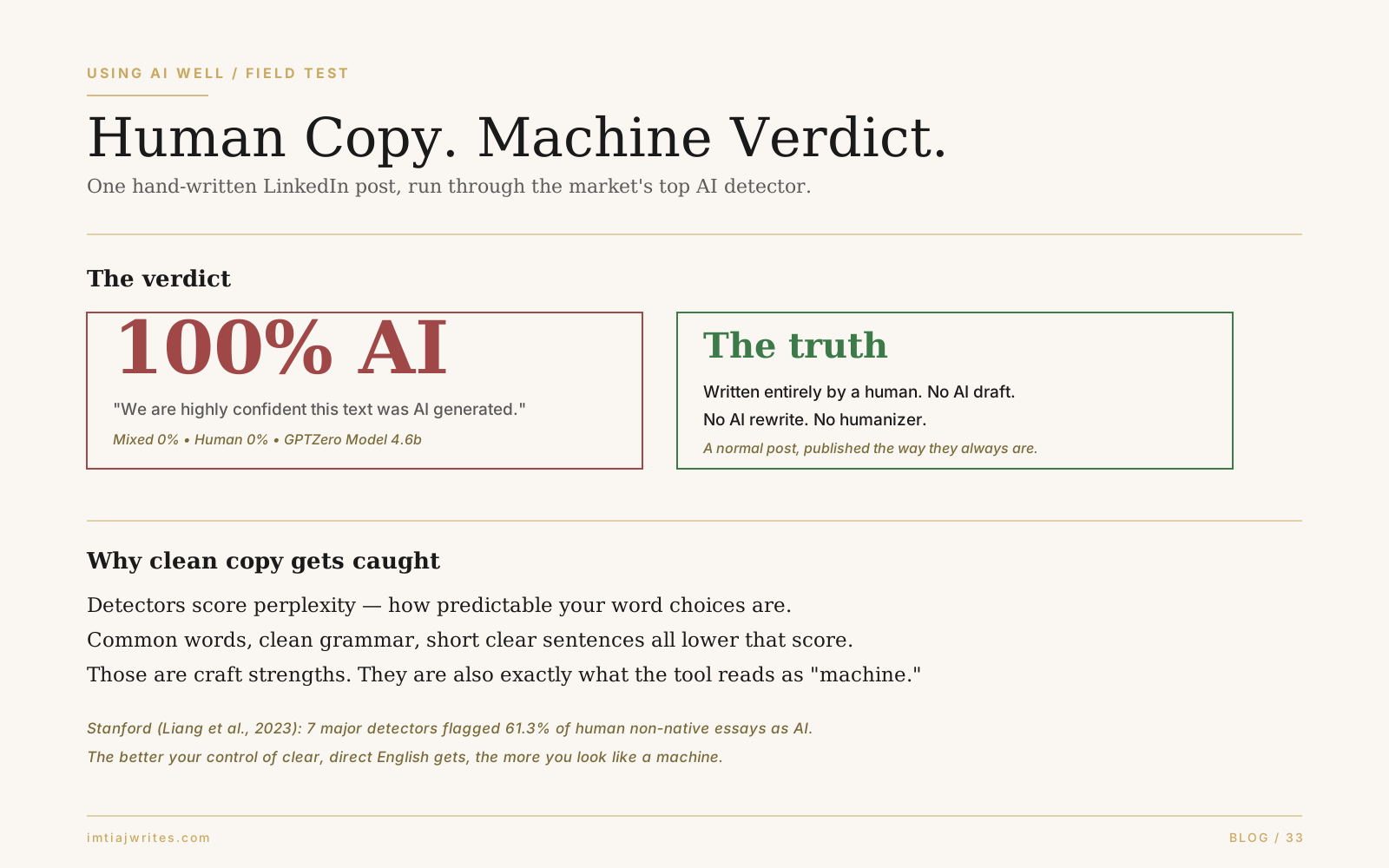
AI detectors mostly score something called perplexity, which is a measure of how predictable your word choices are. Low perplexity (common words, clean structure, unsurprising phrasing) reads as AI. High perplexity (rare words, irregular structure, surprising turns) reads as human. As Stanford professor James Zou, senior author of the landmark study on this bias, put it: if you use common English words, the detector gives a low perplexity score and is likely to flag the text as AI, while fancier words are more likely to be classified as human.
Now look at what good non-native professional writing actually does. It uses clear, common words on purpose. It keeps sentences clean. It avoids the showy vocabulary that native writers sometimes reach for, because clarity is the goal. Every one of those is a craft strength. Every one of those also lowers your perplexity score, which pushes you toward the “AI” label.
The Stanford study by Liang and colleagues, published in the journal Patterns in 2023, found this exact pattern at scale: seven major detectors flagged 61.3% of human-written TOEFL essays by non-native speakers as AI-generated, while flagging native-written essays at near-zero rates. My 100% result is not a freak event. It is the rule, landing on one post.
There is a second irony worth naming. My post is full of short, punchy sentences, because that is a deliberate style choice. “It’s not English. It’s register.” That rhythm is human craft. But short, declarative, low-surprise sentences are also exactly what these tools read as machine-made. The better your control of clean, direct English gets, the more you look like a machine to a perplexity detector.
❌ The assumption: AI detectors flag bad or robotic writing.
✅ The reality: AI detectors flag predictable writing, and clear professional non-native copy is often highly predictable by design.
What this means for you
Three honest takeaways.
One: the detector’s number is not evidence about you. A 100% AI score on human writing tells you about the limits of the tool, not about the quality or origin of your work. When you internalize that, the panic of being flagged loses most of its power. The tool is unreliable in a known, measured, published way.
Two: never paste your writing into a public detector to “check” it before sending. Some non-native writers run their own work through GPTZero out of anxiety, see a high AI score, and then damage their own copy trying to lower it. They add weird words, break their clean sentences, and make the writing worse to satisfy a broken gauge. Do not edit your voice to please a perplexity score. That is optimizing for the wrong target.
Three: keep the evidence that you wrote it. Since the tool can flag you at any time, the protection is not a better score. It is a documented process. Write in Google Docs with version history on, so the proof exists before anyone asks. The full client-facing version of this, what to say when a client sends you a scary detector screenshot, is in the post on being falsely accused of using AI.
What I did not do, and will not do
I did not run my post through a “humanizer” tool to lower the score, and I would not recommend you do either. Those tools work by adding the irregularity and odd word choices that raise perplexity. They lower your AI score by making your writing worse, less clear, less yours. For a non-native professional whose entire edge is clean, controlled, register-aware English, that trade is backwards. You would be damaging the exact skill you spent years building to satisfy a tool that is wrong in the first place.
The goal was never to beat the detector. The goal is to write well and be able to prove the work is yours. The detector is a flawed gauge sitting on the side of the road. You do not redesign your car to please a broken speedometer.
The honest limit of this test
One test of one post on one detector is not a study. It is a single data point, and I want to be clear about that. GPTZero may score a different post of mine as human. Other detectors may disagree with GPTZero on this same text, which is itself useful, because three detectors giving three different scores on identical writing is strong evidence that the whole category is unreliable.
What this single test does show, concretely, is that the most popular detector on the market can take a genuinely human piece of professional writing by a non-native author and rate it 100% AI with high confidence. The peer-reviewed research already told us this happens to most non-native writing. Running it myself just turned a statistic into something I could see on my own screen, with my own words.
If it can happen to this post, it can happen to yours. Not because your writing is bad. Because the tool measures the wrong thing, and your strengths look like its red flags.
Frequently Asked Questions
Is GPTZero accurate for detecting AI writing?
Not reliably, especially for non-native English writers. In my own test, GPTZero rated a 100% human-written LinkedIn post as 100% AI with high confidence. This matches peer-reviewed findings: a 2023 Stanford study found major detectors flagged 61.3% of human-written non-native essays as AI-generated. The tools measure predictability (perplexity), not actual authorship, so clean, clear writing is frequently misread as machine-made.
Why did GPTZero flag my human writing as AI?
Because AI detectors score how predictable your word choices are, not whether a human wrote them. Common vocabulary, clean grammar, and short clear sentences all lower your “perplexity” score, which pushes the text toward the AI label. These are craft strengths in professional writing, but they overlap with the patterns large language models were trained to produce, so good non-native copy gets caught.
Should I run my own writing through GPTZero before sending it to a client?
No. Checking your own work out of anxiety often backfires. A false high score can lead you to damage your clean writing by adding odd words and breaking good sentences just to lower the number. Instead of testing against a flawed gauge, keep proof that you wrote the work, such as Google Docs version history, which is the evidence that actually matters if a question ever comes up.
Does a high AI score mean my writing is bad?
No. A high AI score often means your writing is clear and predictable, which are usually good qualities. The detector cannot tell the difference between “predictable because a machine made it” and “predictable because a skilled human chose clear words on purpose.” The score is a statement about the tool’s method, not about your skill or the origin of your work.
What should I do if a client flags my work using GPTZero?
Stay calm, do not apologize for something you did not do, and offer concrete evidence like your version history. Normalize the false positive by noting that detectors flag clean writing often. The full step-by-step client response is covered in the post on being falsely accused of using AI, which includes the exact message to send and the contract clause that prevents the problem.
Are AI humanizer tools a good way to pass detectors?
Not for professional non-native writers. Humanizer tools lower AI scores by adding the irregular, less predictable phrasing that raises perplexity, which usually makes your writing less clear and less like you. For a writer whose advantage is clean, controlled English, that trade damages your core strength to satisfy an unreliable tool. Better to write well and document your process.
Where to go next
For the mechanism behind why this happens (perplexity, burstiness, the full technical picture), read why AI detectors flag your writing.
➡️ For the client playbook when someone sends you a detector screenshot, read what to do when you are falsely accused of using AI.
➡️ For the register skill my flagged post was actually about (the thing detectors cannot measure and clients pay for), read why your English copy sounds translated.
➡️ For the diagnostic on your own writing, the Natural English Edit is the 15-pattern checklist with prompts to run on your own copy. Free.
I ran my human copy through GPTZero and it said 100% AI. The number was wrong. Your job is not to chase the number. It is to write well and keep the receipts.
