
I ran a piece of my own copy through three detectors on the same afternoon. GPTZero said 100% AI. Originality.ai said 96%. Copyleaks said 100%. I had written every word of it myself, in one sitting, with no model involved at any stage.
That is the whole problem in one paragraph. AI detectors flag your writing using a statistical method that systematically misreads the way most fluent non-native writers compose sentences. It is not your fault. It is not your English. It is not because your writing “sounds like AI.”
Here is the actual diagnosis, why it happens, and what works versus what wastes your time.
The headline number, with a real source
In 2023, a Stanford team ran seven widely used AI detectors against 91 essays written by non-native English speakers and 88 essays written by US eighth graders. The 91 were TOEFL essays from a Chinese educational forum. The 88 came from the Hewlett Foundation’s ASAP dataset. The detectors handled the US student essays with near-perfect accuracy. They labelled more than half of the TOEFL essays as AI-generated, at an average false positive rate of 61.22%.
All seven detectors unanimously misclassified 18 of the 91 TOEFL essays, which is 19.8%. At least one detector flagged 89 of the 91, which is 97.8%. The study is Liang, Yuksekgonul, Mao, Wu and Zou, “GPT detectors are biased against non-native English writers”, published in Patterns, and Stanford HAI wrote it up here.
Read those numbers slowly. Nineteen out of every hundred non-native essays were called AI unanimously, by every detector tested. Ninety-seven out of every hundred were flagged by at least one. The native eighth-grade essays sailed through at a 5.19% false positive rate.
That last pair is the number worth memorising. 61.22% against 5.19% is not a small bias. Human writing by non-native speakers was flagged at almost twelve times the rate of human writing by native speakers, in the same test, by the same tools, on the same day. The cause is structural rather than a bug anyone is about to fix. When I ran the same kind of experiment on real ESL client copy instead of student essays, the results came out the same shape.
AI detection is shaky in general, even on native writing. OpenAI shut down its own AI text classifier on 20 July 2023, citing its low rate of accuracy. At launch, that classifier correctly identified 26% of AI-written text while incorrectly flagging 9% of human-written content. The company that builds the models could not reliably detect its own output. That should set the bar for how much weight to give third-party tools claiming 99% accuracy.
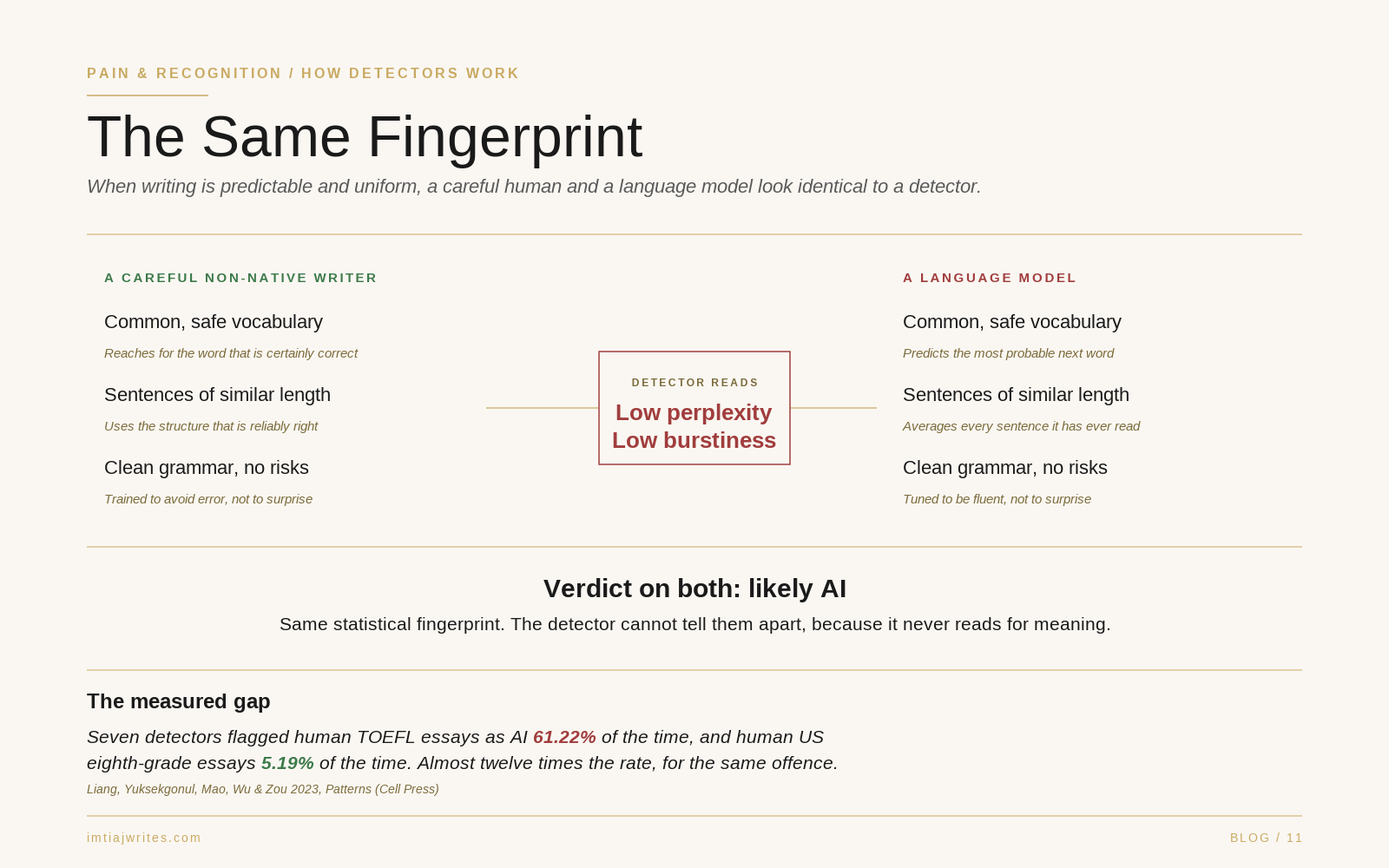
What detectors actually measure (and why it matters)
AI detectors measure two things, mostly. Both have technical names worth knowing, because they are the entire game.
Perplexity is how surprised the detector is by your next word. If your sentence reads “The cat sat on the mat,” perplexity is low, because the model expected those words. If it reads “The cat sat on the existential,” perplexity is high, because the model did not see that coming. AI-generated text tends to have low perplexity, since the model is by definition picking the most probable next word. The detector reads low perplexity and concludes “probably AI.”
Burstiness is how much sentence length and structure vary across a paragraph. Native speakers write with high burstiness: a short punchy sentence next to a winding one next to a medium one. AI tends to produce uniform, even-paced prose. Low burstiness, low burstiness, low burstiness, says the detector, so it must be AI.
Now look at how a fluent non-native professional writes. Vocabulary stays inside a controlled, dependable range, because you use words you know are correct rather than reaching for the unusual one. Sentence structure stays even, because you were taught English through exercises that rewarded consistency. Transitions are explicit (“Furthermore,” “In addition,” “Moreover”) because that is how you were trained to signal flow.
Every one of those habits produces low perplexity and low burstiness. Every one of those habits is what the detector reads as “AI.”
The cruel part: these habits are evidence that you learned English well. You picked the safe word, wrote the clean sentence, used the connector that signals structure. The detector reads those patterns and concludes a machine wrote it. Academic writers get hit hardest of anyone, because the house style of scholarship demands exactly those moves: hedge every claim, cite densely, keep the structure fixed.
The mechanism, named: The Fluency Trap
I call this dynamic The Fluency Trap. The more carefully you have learned English as a second language, the more you have internalised “correct” patterns, controlled vocabulary and predictable structure. And the more of that you have internalised, the more closely your output matches what AI generators produce. Both you and the model are picking the most probable next word. You learned to do that on purpose, because picking the unexpected word in a second language is risky. The model does it because that is how it was built.
Result: you and the AI converge on the same statistical fingerprint. The detector cannot distinguish you. If you want this argument aimed squarely at working ESL writers rather than at the research, I set it out separately there.
That also explains why the Stanford team’s mitigation experiment was so revealing. When the researchers used ChatGPT to enhance the vocabulary of the TOEFL essays, making them sound more like native-speaker writing, the average false positive rate fell from 61.22% to 11.77%. Running it the other way, simplifying the word choices in the US eighth-grade essays to mirror non-native writing, pushed misclassification up from 5.19% to 56.65%.
Same authors. Same essays. No AI anywhere in the process. Only the style changed. The detectors are not really detecting AI. They are detecting writing produced inside a narrower vocabulary range, which is to say they are detecting non-native fluency.
Before and afters: what trips the detector and what doesn’t
Here are three pairs, all real patterns from non-native professional writing. The ❌ versions are what most fluent non-native writers default to. The ✅ versions are what reliably brings the AI score down. They do it by breaking the perplexity and burstiness signals, not by sounding “less AI” in any meaningful way.
Pattern: predictable transitions
❌ Furthermore, the platform offers robust analytics. In addition, it provides seamless integration with existing tools. Moreover, the dashboard is highly customizable.
✅ The analytics are deeper than most. Integration is the part that surprised me, because it actually worked on the first try. And you can rebuild the dashboard layout however you want.
The first version is grammatically clean and uses three textbook transitions in a row. Detector reads: low perplexity, low burstiness, AI. The second varies sentence length, drops the formal connectors, and slips in one unusual phrasing (“the part that surprised me”) that raises perplexity.
Pattern: safe-vocabulary defaulting
❌ Our solution helps businesses optimize their workflow and improve operational efficiency.
✅ This cuts a step out of the workflow you probably do twice a week.
“Solution,” “optimize” and “operational efficiency” are the safest words in their category. You picked them because they are correct. The detector picks them for the same reason. The second version is concrete and less expected, and it reads better to a human anyway.
Pattern: uniform sentence rhythm
❌ The product launches next month. The features include real-time collaboration. The pricing starts at $29 per user.
✅ Product’s out next month. Real-time collaboration is the headline feature, but the pricing is what’ll move it: $29 per user, which undercuts most of the category.
Three short sentences of similar length in a row is exactly the burstiness signature AI generates by default. Mixing one short sentence with one longer, more varied one breaks the pattern. This rhythm problem is the same one I covered in why your English copy sounds translated. It shows up in detection too, because rhythm and translation-feel share a root cause.
What works to lower the AI score (in order of effort vs payoff)
Once you know why AI detectors flag your writing, the fixes stop being guesswork. Each of these targets perplexity or burstiness directly.
1. Vary sentence length aggressively. This is the highest-payoff move. Read your draft aloud and count the syllables. If five sentences in a row are within two or three words of each other, cut one in half and merge two others. The Stanford finding implies most of the false positive signal is structural rather than vocabulary-based, so this single move closes a lot of the gap.
2. Replace one out of every three “safe” words with a less expected one. Not every word, just a sprinkling. Where you wrote “important,” try “load-bearing.” Where you wrote “improve,” try “stop being annoyed by.” Every unexpected word raises perplexity locally, which is exactly what the detector measures.
3. Cut the textbook transitions. “Furthermore,” “In addition,” “Moreover,” “Therefore” and “Consequently” do more than any other words to flatten your perplexity. Most of the time the relationship between sentences is implicit anyway. Drop the connector and let the reader follow.
4. Add one human texture. Opinion, irritation, surprise, hedging. AI rarely writes “this surprised me” or “I thought this would be harder than it was.” A single sentence of writer-presence in a paragraph raises perplexity in a way detectors find very hard to misread.
5. Don’t use a “humanizer” tool. This is the move I would specifically advise against, even though every non-native writer I know reaches for it first. Humanizer tools add randomness: synonym substitution, odd punctuation, slight grammatical jitter. They lower the score and damage the writing in ways a competent reader notices immediately. The fixes above lower the score by improving the writing, which is the only sustainable direction.
What to do when you’re flagged anyway
Sometimes you will do all of this and still get flagged, because the detectors are inconsistent. A clean piece can score 70% AI on Tuesday and 12% on Wednesday with no edits in between.
The short version of the response is three moves:
1. Run the text through three different detectors and screenshot all three. They will usually disagree, and that disagreement is evidence about the tools rather than about you.
2. Keep your drafts somewhere with version history, such as Google Docs or Notion, so you can show the piece being typed and revised over hours.
3. Argue the use case rather than the score, and ask whether a detector should be a payment gate at all.
Each of those three moves gets complicated fast, so each has a post of its own:
👉🏼 The accusation itself, and how to answer it without sounding defensive: what to do when you are falsely accused of using AI.
👉🏼 The client conversation in particular, with the actual messages I sent: when a client says your work is AI generated.
👉🏼 The evidence system, set up before you need it: how to prove you wrote it.
The country-of-origin trust gap intersects with this directly. Clients running detection on non-native writers’ work and acting on the false positives is the most concrete current example of that gap doing damage.
The thing nobody at the detection companies wants to say out loud
The detection industry’s marketing rests on one number. Copyleaks, to take one live example, advertises “99% accuracy” and an “industry-low .03% false positive rate” on its product page.
That kind of figure is true on the dataset it was measured against, which usually means native English text. It is dramatically less true on non-native writing, short text, edited text, or any text that does not match the training distribution. The independent picture looks different. A 2023 study in the International Journal for Educational Integrity tested fourteen detection tools and concluded they were “neither accurate nor reliable”. Every tool scored below 80% overall accuracy, and false positives on human-written text ranged from 0% to 50% depending on the tool.
A few companies have started publishing this honestly. Most have not. The market they sell into, meaning schools, publishers, content marketplaces and freelance platforms, uses the headline number to make decisions that fall disproportionately on non-native writers. That gap is where the damage gets done.
The fix at industry level is regulatory and slow. The fix at your level is the five tactics above, plus one piece of perspective. When AI detectors flag your writing, the score is not a verdict on your work. It is a verdict on whether your prose pattern fell inside a statistical band the tool happened to be looking for that day. The Fluency Trap is a property of the measurement, not a property of you.
The full detector series
This page is the hub. Each post below takes one piece of the problem further:
👉🏼 GPTZero on my own human-written copy: the full test, with the score and the text that produced it.
👉🏼 Originality.ai on the same human copy: a second tool, a different number, the same text.
👉🏼 Detectors tested against real ESL writing: what happens outside the research corpus, on working client copy.
👉🏼 What this means for ESL writers specifically: the career version of the argument rather than the research version.
👉🏼 Detectors and academic writing: why the conventions of scholarship raise your score.
👉🏼 Falsely accused of using AI: the first response, and what not to say.
👉🏼 When a client says your work is AI generated: a real conversation, message by message.
👉🏼 How to prove you wrote it: the documentation system to set up before you are asked.
👉🏼 Should you still worry about AI detectors in 2026: where the tools and the norms are actually heading.
Where to go next
➡️ Read why your English copy sounds translated for the deeper version of the rhythm-and-vocabulary problem that creates the detection signal in the first place.
➡️ Read the country-of-origin trust gap for the wider career context. AI detection false positives are the most concrete current way that gap shows up in your inbox.
➡️ Or start with the Natural English Edit, the 15-pattern checklist for non-native writers. The patterns it catches are the same ones that lower your perplexity score, so the same edits work in both directions.
FAQ
Why do AI detectors flag non-native English writing as AI even when humans wrote it?
Because AI detectors measure perplexity (word predictability) and burstiness (sentence variation), and fluent non-native writers tend to use a controlled vocabulary range and even sentence structure, which is the same statistical pattern AI produces. Stanford research found seven detectors misclassified 61.22% of human-written TOEFL essays as AI-generated, against 5.19% for human-written US eighth-grade essays.
Are AI detectors actually accurate?
Not very. Vendors advertise around 99% accuracy on their own benchmarks, but a 2023 study of fourteen detection tools concluded they were “neither accurate nor reliable,” with every tool scoring below 80% overall accuracy and false positives on human text ranging from 0% to 50%. OpenAI shut down its own classifier in July 2023 after it correctly identified only 26% of AI-written text while flagging 9% of human-written text. Even the model’s makers could not reliably detect AI output.
How do I lower my AI detection score on writing I wrote myself?
Vary sentence lengths aggressively, replace some safe vocabulary with less expected word choices, cut textbook transitions like “furthermore” and “moreover,” and add a sentence of personal opinion or hedging. These moves raise perplexity and burstiness, the two metrics detectors rely on, without compromising writing quality.
Should I use a “humanizer” tool to fix AI detection scores?
Generally no. Humanizer tools add randomness through synonym substitution and grammatical jitter, which lowers the score but damages the writing in ways readers notice. The score improves and the work gets worse. Better to apply the manual fixes that improve the writing itself.
What should I do if a client accuses me of using AI when I didn’t?
Run the text through three different detectors and screenshot all three, because they will usually disagree, and the disagreement is itself evidence. Keep version history of your drafts in Google Docs or Notion. Share the Stanford research if the conversation continues. A reasonable client will reconsider once they understand how unreliable the tools are.
Will AI detectors get better at handling non-native writing over time?
Probably slowly, but the underlying problem is structural rather than a bug. Detectors rely on perplexity, and fluent non-native writing has lower perplexity than fluent native writing, which is the entire mechanism. A 2023 study in the International Journal for Educational Integrity found detection accuracy dropped by around 20 percentage points on machine-translated human text. That is exactly the route many non-native writers take when they draft in their first language first. Until detection moves to fundamentally different methods, such as watermarking from the AI generators themselves, the bias is built into how detection works.
