
You have probably had this moment. You finish a clean draft, and a small anxious voice asks: what if a client runs this through a detector and it comes back as AI? You did nothing wrong, and you are still worried. So let me answer the real question directly.
Should you worry about AI detectors in 2026? For most non-native writers, in most situations, the honest answer is no, not much. The tools are measurably unreliable, serious institutions are backing away from them, and the worry costs you more than the threat does. But “not much” is not “never,” and there are a few specific situations where these tools can still hurt you. This post separates the two, so you know exactly when to shrug and when to pay attention.
This is the closing post in a short series. If you want the full mechanism, why AI detectors flag your writing explains it. If you want proof, I ran my own human copy through GPTZero and Originality.ai and both called it AI. This post is the verdict that sits on top of all that: given everything we now know, how much should this occupy your mind?
What changed by 2026
The case for worrying less got much stronger over the last two years, and it is worth knowing why.
First, the accuracy gap is now documented and embarrassing. Detector companies advertise accuracy between 98% and 99.5%. When Scribbr ran an independent test of 12 detection tools on a real-world corpus, the measured accuracy came out around 66%. That is the gap between the marketing and the reality, and it is not a rounding error. A tool that is right two-thirds of the time is not a tool you build a serious accusation on.
Second, the institutions that once drove the panic are backing away. As of early 2026, more than 50 universities worldwide have banned, disabled, or officially discouraged AI detection tools, including major names that quietly kept paying for the software while switching the AI module off. Vanderbilt, Yale, and multiple others disabled detection specifically because of false-positive risk and bias against non-native writers.
Third, and most telling, OpenAI, the company whose models these detectors are chasing, shut down its own AI detector back in 2023 after it correctly identified only 26% of AI text. If the maker of the model cannot reliably detect the model, the third-party tools selling you 99% confidence deserve deep skepticism. That has only become clearer in 2026 as newer models’ output detectors catch even less often.
The ground under the whole “worry” reaction has shifted. The tools did not get more reliable. The world got more honest about how unreliable they always were.
The proof that it measures vocabulary, not authorship
Here is the single finding that should lower your anxiety the most, because it explains exactly what these tools are doing to you.
In the 2023 Stanford study, seven major detectors falsely flagged 61.3% of non-native English essays as AI. Then the researchers did something clever. They used AI to enhance the vocabulary of those same human essays, making the language more sophisticated. The false-positive rate dropped from 61.3% to 11.6%.
Read that again. Making the human writing fancier made the detector think it was more human. The tool was never measuring whether a machine wrote the text. It was measuring how sophisticated the vocabulary was, and scoring simpler, clearer writing as “AI.” Your clean, direct, professional English is not being caught because it looks machine-made. It is being caught because it is clear, and the tool mistakes clarity for machinery.
Once you understand that, the detector’s verdict stops feeling like a judgment on your honesty and starts looking like what it is: a crude vocabulary-complexity meter with a misleading label.
So when should you actually pay attention?
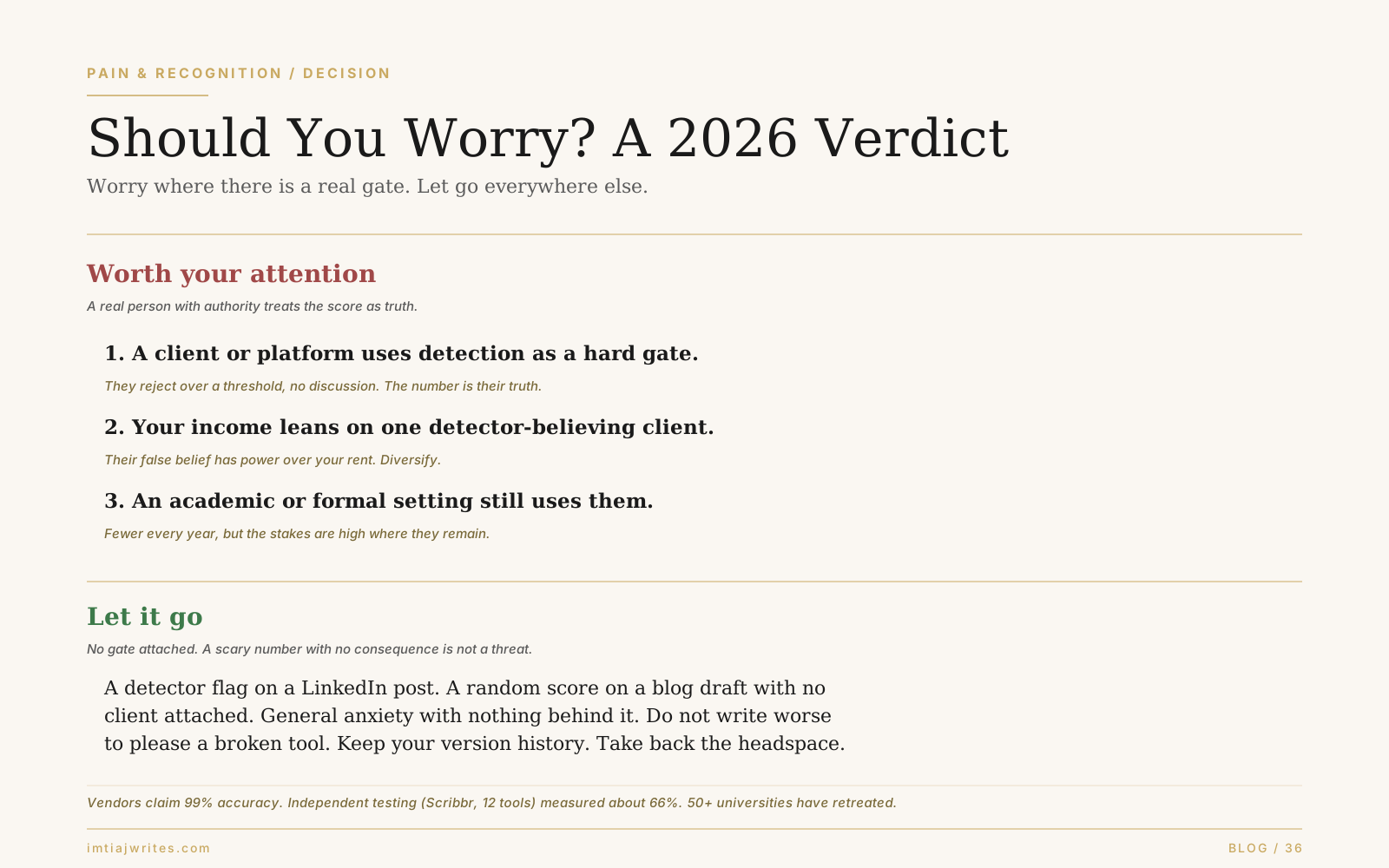
Not never. Here is the decision framework. Worry is warranted in exactly three situations, and wasted everywhere else.
Situation 1: A specific client or platform uses detection as a hard gate. Some content agencies and publishers run every submission through Originality.ai and reject anything over a threshold, no discussion. If you write for one of these, the tool is a real gate regardless of its accuracy, because the client treats the number as truth. Here the worry is rational, and the response is practical: know it upfront, document your process, and set the terms in your contract.
Situation 2: Your income depends on one client who believes in detectors. If a single client controls most of your income and trusts these tools, their false belief is your real risk. Not because you did anything, but because the relationship gives their mistake power over your rent. Worth attention, and worth diversifying so no one client’s misconception can end your month.
Situation 3: You are in an academic or formal setting that still uses them. Universities are abandoning detectors, but not all have. If you are a student or in any graded, credentialed context that still runs detection, the stakes are high enough to prepare for, even as the tools lose institutional support.
Outside those three, the honest answer is that worry is wasted energy. A detector flag on a LinkedIn post has no consequence. A random tool giving your blog draft a scary number, with no client attached, means nothing. Most of the anxiety non-native writers carry about detection is attached to no actual gate. It is the fear of a consequence that is not there.
What to do instead of worrying
For the situations that do warrant attention, the response is the same small, calm system, and it is worth more than any amount of worry.
Document authorship as you write. Use Google Docs with version history on, so the proof that you wrote the piece exists automatically, before anyone asks. This single habit neutralizes most of the real risk.
Set the terms in your contract. A short clause stating that detector scores are not reliable evidence and that authorship questions will be resolved by version history moves the fight to ground where you win. The full version of this is in the post on being falsely accused of using AI.
Do not damage your writing to beat a score. This is the important one. Some non-native writers, out of detector anxiety, deliberately make their writing worse, adding odd words, breaking clean sentences, inserting errors, to lower an AI score. One student quoted in a 2026 report said he leaves in misspellings and uses non-native sentence structures on purpose so his precise writing will not get flagged. Think about what that means. He is being pushed to write worse to satisfy a broken tool. Do not do this. Your clarity is your skill. Protect it.
❌ Writing worse on purpose so a detector rates you “human.”
✅ Writing well and keeping the version history that proves it is yours.
The honest limit of this verdict
I am not telling you detectors have no power. They have exactly as much power as a specific person with authority over your work chooses to give them. The tool itself is unreliable. The client who believes it is real. That is the thing to manage, and it is a relationship problem, not a writing problem.
I am also not telling you the situation is permanent. Detection may improve, or new rules may force disclosure, or the whole approach may be abandoned. This is a 2026 verdict based on 2026 evidence. Things may shift, and if they do, the framework still holds: worry where there is a real gate, and let go everywhere else.
But right now, today, the balance is clear. The tools are unreliable, the institutions are retreating, the research shows the flags are mostly measuring vocabulary, and the worry costs more than the threat for most writers most of the time. Keep your receipts. Watch the three real situations. And take back the mental space the worry was eating, because your writing needs it more than the detectors deserve it.
Frequently Asked Questions
Should I worry about AI detectors in 2026?
For most non-native writers in most situations, no. Independent testing shows real-world detector accuracy around 66% versus the 99% vendors claim, more than 50 universities have disabled or banned the tools, and OpenAI shut down its own detector for low accuracy. Worry is only warranted in three specific situations: a client or platform that uses detection as a hard gate, income concentrated in one client who trusts detectors, or an academic setting that still uses them.
Are AI detectors accurate in 2026?
Not reliably. Vendors advertise 98 to 99.5% accuracy, but Scribbr’s independent 12-tool test measured around 66% on a real-world corpus. Accuracy drops further on paraphrased text, shorter pieces, and non-native English writing. A 2023 Stanford study found a 61.3% false positive rate on non-native essays, and the tools catch newer AI models less reliably than older ones.
Why do AI detectors flag clean human writing as AI?
Because they measure vocabulary predictability, not authorship. In the Stanford study, enhancing the vocabulary of human non-native essays dropped the false positive rate from 61.3% to 11.6%, proving the tools score sophistication rather than origin. Clear, simple, professional writing registers as low perplexity, which detectors misread as an AI signal. Your clarity is what gets caught.
Should I run my writing through a detector before sending it?
Only if a specific client or platform uses detection as a hard gate, and even then, do not edit your writing to lower the score. Checking out of general anxiety usually backfires, pushing writers to damage clean copy to satisfy an unreliable number. Keep version history as proof of authorship instead, which addresses the real risk without harming your writing.
Is it worth paying for a tool to check my own work against detectors?
For most writers, no. If no client is running detection as a gate, a score has no consequence, and paying to generate your own anxiety is wasted money. The better investment is a documentation habit, writing in Google Docs with version history on, which costs nothing and provides the proof that actually matters if authorship is ever questioned.
Will AI detectors get more accurate in the future?
Possibly, but the trend through 2026 runs the other way. Each new generation of AI models produces output detectors catch less reliably, and each new evasion tool degrades detection further. Institutions are retreating rather than doubling down. Even if detection improves, the practical advice stays the same: document your authorship, and reserve your attention for situations where a real person with authority treats the score as truth.
Where to go next
👉🏼 For the mechanism behind why detectors flag clean writing, see why AI detectors flag your writing.
👉🏼 For the proof, see my field tests on GPTZero and Originality.ai, where both tools flagged genuinely human copy.
👉🏼 For the client playbook when someone accuses you based on a detector, see what to do when you are falsely accused of using AI.
👉🏼 For the diagnostic on your own writing, the Natural English Edit is the 15-pattern checklist with prompts to run on your own copy. Free.
Worry where there is a real gate. Let go everywhere else. In 2026, that is the honest verdict on AI detectors.
