
You wrote every word yourself. Then the email arrives: “Hey, I ran this through our detector, and it came back 82% AI. Can you explain?”
Your stomach drops. You feel accused of something you did not do, in a second language, by a client who holds your payment and your reputation in their hands. The instinct is to fire back a long, defensive message proving your innocence. That instinct is wrong, and it loses clients.
Being falsely accused of using AI is one of the most stressful things a working writer faces, and it is happening more every month. This post is not about why detectors are wrong. I covered the mechanism in detail in the post on why AI detectors flag your writing, and if you want to understand perplexity, burstiness, and why fluent non-native writing trips these tools, start there. This post assumes you already know the tools are unreliable. It is about the harder problem: what you actually say and do in the next twenty minutes after a client questions your work, so that you keep the client, the payment, and your name intact.
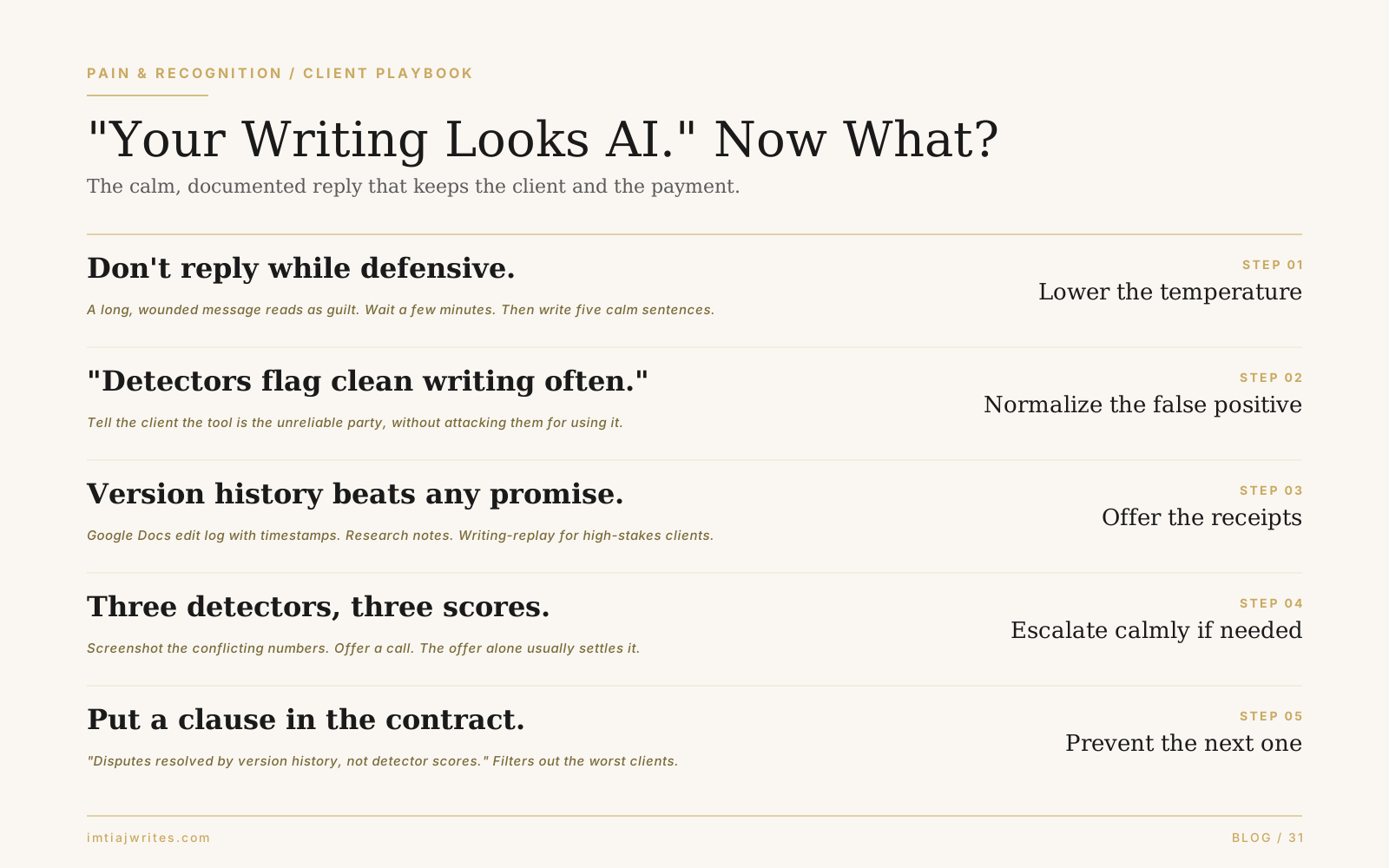
Why is your first reaction the dangerous one
The pattern I see most often when a non-native writer gets accused of using AI is an emotional over-correction. A long message. Too many exclamation points. A wall of explanation about how hard you worked. Sometimes, an apology for something you did not do.
All of these read as guilt to a client, even when you are completely innocent. A defensive flood signals panic. Panic signals something to hide. The client, who probably half-suspected the detector was unreliable anyway, now reads your reaction as confirmation.
The writers who keep the client do the opposite. They respond short, calm, and factual. They treat the accusation as a misunderstanding to be cleared up, not a fight to be won. The tone you want is the tone of someone who has been here before and is mildly, professionally puzzled that the tool got it wrong. Not angry. Not wounded. Just ready to show the receipts.
That tone is much easier to hold when you already have the receipts. Which is the real lesson of this post: the response starts long before the accusation.
The documentation system that makes the accusation harmless
The single best protection against an AI accusation is a writing process that produces evidence automatically. If you set this up once, the accusation stops being a threat and becomes a thirty-second reply.
Three layers, from easiest to most thorough.
Layer 1: Write in Google Docs with version history on. This is the baseline, and it costs you nothing. Google Docs keeps a complete version history by default. Every time you write, delete, pause, and rewrite, it is recorded with timestamps. A document that was genuinely written by a human shows hundreds of small edits over time. A pasted AI block shows up as one large insertion. The edit history is the difference, and it is visible to anyone you share it with.
Layer 2: Keep your research trail. Your notes, your outline, your browser tabs, the messy first draft before you cleaned it up. These are the natural byproducts of real work. AI-generated work has none of them. A folder with your research and drafts is a second, independent line of evidence that the work is yours.
Layer 3: Use a writing-replay tool for high-stakes clients. Tools like GPTZero’s Writing Report record your writing session as it happens, showing edits, pauses, and bursts. According to GPTZero, this kind of replay is “strong evidence if your work is ever questioned.” For a new client, a big project, or any relationship where a single accusation could cost you significant money, this layer is worth the small extra effort.
Most writers only need Layer 1. The point of all three is the same: you want the proof to exist before you are asked for it, not scrambled together after.
The reply that keeps the client
When the accusation arrives, your reply has one job: lower the temperature and offer evidence. Short. Calm. Factual.
Here is the structure that works.
❌ I would NEVER use AI! I am a professional writer and I take my work very seriously. I worked many hours on this article and I am very hurt that you would accuse me of this. These AI detectors are completely unreliable and you should not trust them at all. I can assure you 100% that every single word is mine and I am happy to prove it in any way you need because this is very important to my reputation.
✅ Thanks for flagging this. AI detectors produce false positives often, especially on clean, professional writing, so I am not surprised it came up. I wrote this from scratch and can show you the full version history with timestamps. Want me to share the Google Doc edit log? It shows the whole drafting process.
The first version is innocent and sounds guilty. The second version is innocent and sounds like a professional who has handled this before. The difference is not the truth of the claim. Both are true. The difference is the temperature.
A few specific moves inside the good version:
Lead with “thanks for flagging this.” It reframes the accusation as a shared problem you are solving together, not an attack you are defending against.
Normalize the false positive immediately. “AI detectors produce false positives often” tells the client, gently, that the tool is the unreliable party here, without you having to attack their judgment for using it.
Offer specific evidence, not vague reassurance. “I can show you the version history with timestamps” is concrete. “I promise it is mine” is not. Offer the thing they can actually look at.
Keep it under five sentences. Length reads as anxiety. Brevity reads as confidence.
What to do if they push back
Sometimes the version history is not enough, or the client is anxious about their own boss, or they are using the detector as cover for an unrelated doubt. If the first reply does not settle it, escalate the evidence calmly.
Run the same text through two or three different detectors yourself and screenshot the results. They will almost always disagree with each other. Three different scores on the same text are, by themselves, evidence that the tools are unreliable. Share the screenshots without commentary beyond “here is the same text on three detectors, three different scores.”
If you have a writing-replay record, offer to walk them through it on a short call. Most clients will not take you up on it. The offer itself usually settles the matter, because a person trying to hide AI use does not offer to screen-record their writing process.
Through all of this, keep returning to the same calm position: the work is yours, the evidence is available, and you are happy to help them feel confident about it. A writer who has been falsely accused of using AI is in a much stronger position when the evidence already exists. You are not fighting the client. You are helping the client win an argument with their own detector.
The contract clause that prevents the whole problem
The best time to handle an AI accusation is before you are hired, in the contract, or the project agreement.
A simple clause does most of the work. Something like: “AI detection tools have high false-positive rates and are not reliable evidence of authorship. Any concern about AI use will be resolved by reviewing version history, not by automated detector scores.“
This does three things at once. It signals that you already know the tools are unreliable, which is itself reassuring. It sets the rule for how disputes get resolved before any dispute exists. And it quietly filters out the worst clients, the ones who would rather trust a black-box score than a documented writing process. A client who refuses that clause is telling you something useful about how the relationship would go.
For non-native writers specifically, this clause is worth more than it is for native writers, because the false-positive rate is higher for fluent non-native writing. You are more likely to be flagged, so you have more reason to set the terms in advance. The clause is not defensive. It is professional, and it reads as professional.
The mindset that holds all of this together
The accusation feels personal. It is not. It is a tool malfunction landing in your inbox, and your job is to fix the malfunction calmly, the same way you would handle a broken link or a formatting error.
A client questioning your work is not, in most cases, calling you a liar. They are usually anxious about their own content, their own boss, or their own money, and the detector gave their anxiety a number to point at. When you respond with calm evidence instead of wounded defense, you are not just clearing your name. You are showing the client that you are the kind of professional who handles problems without drama. That impression often does more for the relationship than the original work did.
The writers who lose clients over AI accusations mostly lose them through the reaction, not the accusation. The accusation is survivable every time, if the evidence exists and the temperature stays low.
Frequently Asked Questions
What should I do first when a client says my writing looks AI-generated?
Do not reply immediately while you feel defensive. Take a few minutes, then send a short, calm message that thanks them for flagging it, notes that AI detectors produce false positives often, and offers specific evidence like your Google Docs version history. The goal of the first reply is to lower the temperature and offer proof, not to win an argument.
How do I prove I wrote something myself and did not use AI?
The strongest proof is version history. Writing in Google Docs with version history on creates an automatic, timestamped record of your drafting process: the writing, deleting, and rewriting that real work produces. AI-pasted text appears as a single large insertion instead. Keep your research notes and outlines as a second line of evidence, and consider a writing-replay tool like GPTZero’s Writing Report for high-stakes clients.
Should I apologize when a client accuses me of using AI?
No. Do not apologize for something you did not do, because an apology reads as an admission. Stay factual and calm instead. Acknowledge the flag, normalize the false positive, and offer evidence. You are clearing up a tool error, not confessing to a mistake.
What if the client does not accept my version history as proof?
Escalate the evidence calmly. Run the text through two or three different detectors yourself and screenshot the conflicting scores, which demonstrates the tools are unreliable. Offer a short call to walk through your writing-replay record if you have one. The offer itself usually settles the matter, because it is not something a person hiding AI use would propose.
Can I prevent AI accusations before they happen?
Partly, yes. Add a clause to your contract stating that AI detectors have high false-positive rates and that any concern will be resolved by reviewing version history, not detector scores. This sets the rule before any dispute, signals that you understand the tools, and filters out clients who would trust a black-box number over a documented process. Writing in Google Docs from the start also means the evidence always exists.
Why are non-native writers accused of using AI more often?
Because the statistical patterns AI detectors flag (clean grammar, controlled vocabulary, even sentence structure) appear more often in fluent non-native writing. The mechanism is covered in full in the companion post on why AI detectors flag your writing. The practical result is that non-native writers face these accusations more often and benefit most from a documentation system and a contract clause set up in advance.
Where to go next
If you have not set up your documentation system yet, do that this week. Move your drafting into Google Docs with version history on, and keep your notes in one folder per project. The system takes one hour to set up and makes every future accusation a thirty-second reply.
➡️ For the mechanism behind the false positives (why your writing gets flagged in the first place), read the companion post on why AI detectors flag your writing.
➡️ For the wider career context of how these accusations fit into the trust gap non-native writers face, read the country-of-origin trust gap post.
➡️ For the diagnostic that improves the writing itself, the Natural English Edit is the 15-pattern checklist with prompts to run on your own copy. Free.
Stay calm. Show the receipts. Keep the client. That is the whole playbook.
