
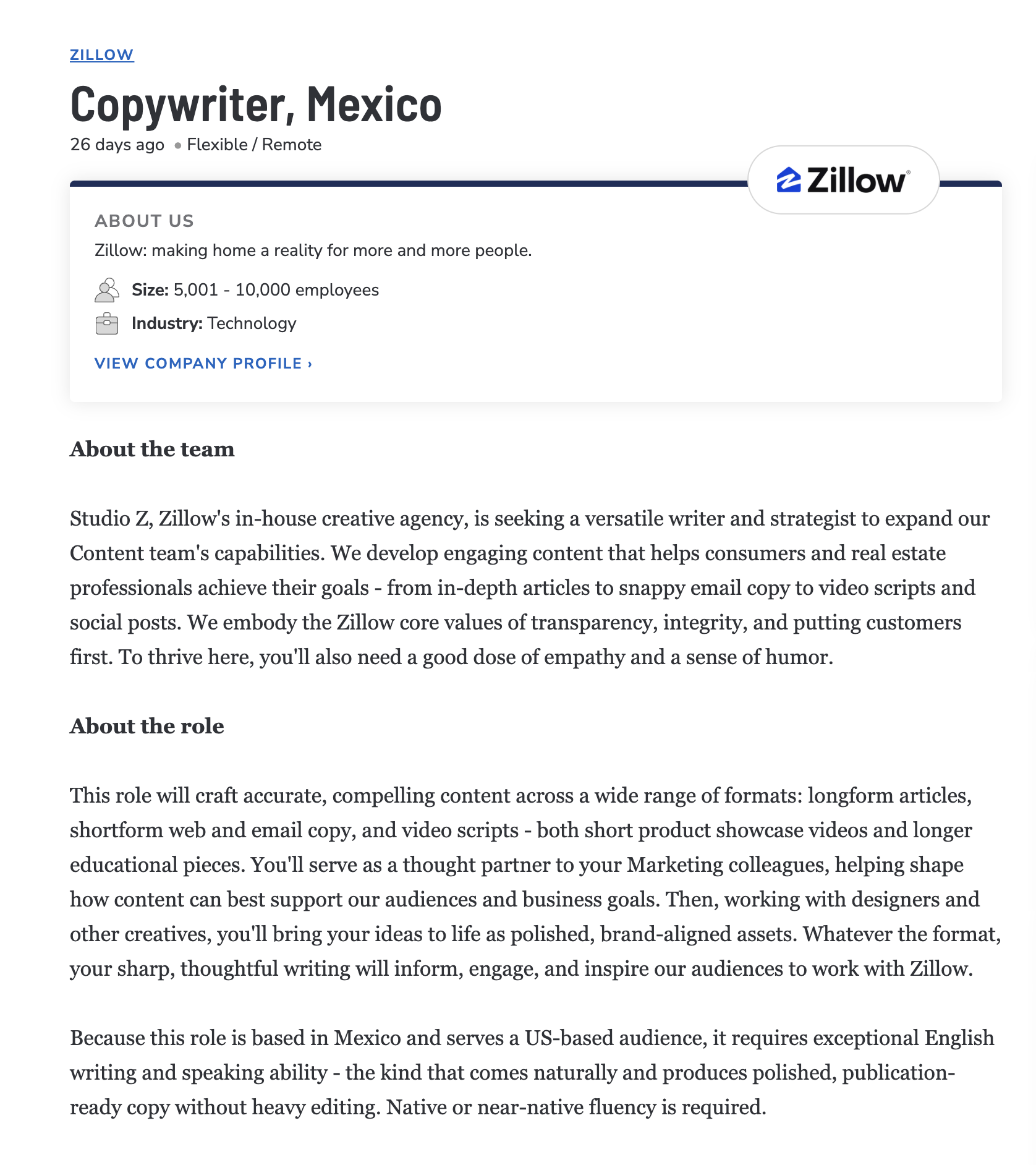
Zillow is hiring a copywriter in Mexico. The ad says: “Native or near-native English fluency required.” Galactic Fed is hiring a paid media copywriter. Its ad says native English is required, then adds two words: “No exceptions.”
Both are native English job posts. They do not ask for the same thing. One names an alternative. The other closes the door. And the Zillow ad asks for something its language line never mentions: “Applications without work samples will not be considered.”
That gap is what this post is about. It looks at 50 job ads that use “native English” wording and asks one question: what else do they ask for?
The short answer: In these 50 native English job posts, the language line was almost never the whole request. 31 of the 50 ads asked for existing work, a new test, or both. But the language wording itself varied a lot. 16 asked for a native speaker with no alternative. 12 named an alternative, such as near-native, C1 or C2. So read every ad as three separate parts: the language rule, the work, and the proof.
How This Audit Worked
Here is exactly what the 50 ads are, and what they are not.
What was collected: 50 public job ads for writing, editing, localization and communications roles. The wording includes “native English,” “native speaker,” “native-level,” and alternatives like “native or near-native.” It is not 50 copies of one exact phrase.
When: the ads were coded on 18 September 2026. The ads themselves date from 2023 to 2026. Their live status was rechecked on 10 November 2026, and several had closed by then.
How they were chosen: on purpose, not at random. The search looked for different roles and different kinds of wording. So the numbers describe these 50 ads, not the whole job market.
How the work was done: source discovery and first-pass coding were done with AI assistance (ChatGPT deep research). The five screenshots in this post were captured from the live pages in November 2026.
What was not done: no employers were interviewed. No applications were sent. No hiring results were tracked.
“What they actually want” in this post means what the ads say in writing. It does not mean what any employer thinks in private.
You can download the full dataset. It lists every ad, its wording, its source link, and how it was coded. Closed ads are kept in the data, because they still show what the ad said when it was live. In this post, closed ads are cited by their dataset ID (J01 to J50) without a link.
What the Language Labels Said
The first job was to sort the language wording itself. “Native” did not mean one thing across these ads.
| What the ad said | Ads | Share |
|---|---|---|
| Native speaker, with no alternative named | 16 | 32% |
| Native-level proficiency | 13 | 26% |
| Native, or a named alternative (near-native, equivalent, C1, C2) | 12 | 24% |
| Native speaker preferred, not required | 2 | 4% |
| Mixed or unclear wording | 7 | 14% |
Three things to keep in mind when you read this table.
First, “native-level” is not the same as “native speaker.” One describes a level of skill. The other describes a person. But a native-level ad does not promise it will accept every strong non-native writer either.
Second, the 7 unclear ads are not “flexible.” They are unclear. Some say “native speaker” in the opening and “native-level” in the requirements. You can’t know which one the employer means.
Third, these labels describe wording only. They are not a judgment about whether an ad is fair or legal.
What Sat Next to the Label
The language line is usually one sentence. The rest of the ad describes the job. Here is what else appeared across the 50 ads. One ad can appear in several rows.
| What else the ad asked for or valued | Ads out of 50 |
|---|---|
| Voice, style, audience or format skills | 43 |
| Delivery, teamwork or workflow | 43 |
| Clear, correct, well-edited writing | 40 |
| Experience in the role, sector or genre | 40 |
| SEO, marketing or digital publishing | 30 |
| Existing work, samples or a portfolio | 28 |
| Research, fact-checking or verification | 20 |
| A named market, English variety or culture | 17 |
| Another language | 11 |
| A new task, test or trial | 9 |
Look at the top of that table. Audience, format and delivery show up more often than any single language rule. The ads describe a professional job, not just a type of English.
That doesn’t mean language quality stopped mattering. 40 of the 50 ads still asked for clear, correct writing. It means the language line is the start of the ad, not the end of it.
Finding 1: Many Ads Asked You to Show the Work
28 of the 50 ads asked for, or valued, existing work: samples, a portfolio, or published pieces. 9 asked for a new task, a test, or a trial. 6 asked for both. That makes 31 ads with at least one kind of proof. (Don’t add 28 and 9 to get 37. The 6 overlap.)
The clearest example is an editing job. MDPI’s English Editor ad lists “Native English speaker” as an essential criterion. It also says: “Shortlisted candidates will be contacted and asked to complete two editing tests.”
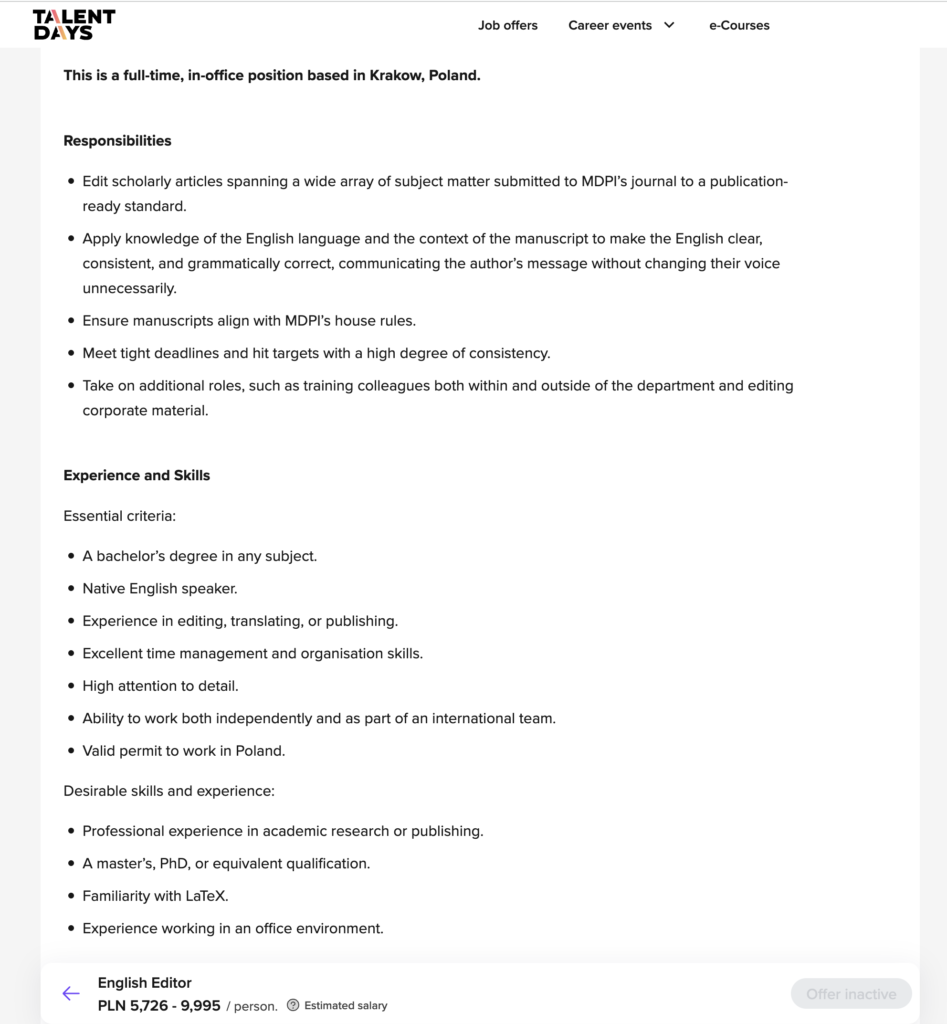
Notice what this means. Even an ad with a strict native-speaker rule did not treat being native as proof of editing skill. It tested the editing separately.
Some ads went further and asked for editing judgment, not just corrections. A children’s fiction editing brief (dataset J47) asked for a light final polish, and asked the editor to keep repetition the author had used on purpose. Knowing what to leave alone is a skill. It is also one you can show in a sample.
Finding 2: “Near-Native” Does Not Mean “Easier”
12 ads named an alternative to native. It would be easy to read those as the easy ones. They weren’t.
SearchApi’s writer ad is a good example. The language line is short: “Native or near-native English. Writing is the whole job.” The proof request is much longer. It asks for “a long-form technical piece you wrote, plus the code or data behind a benchmark or estimation in it.”
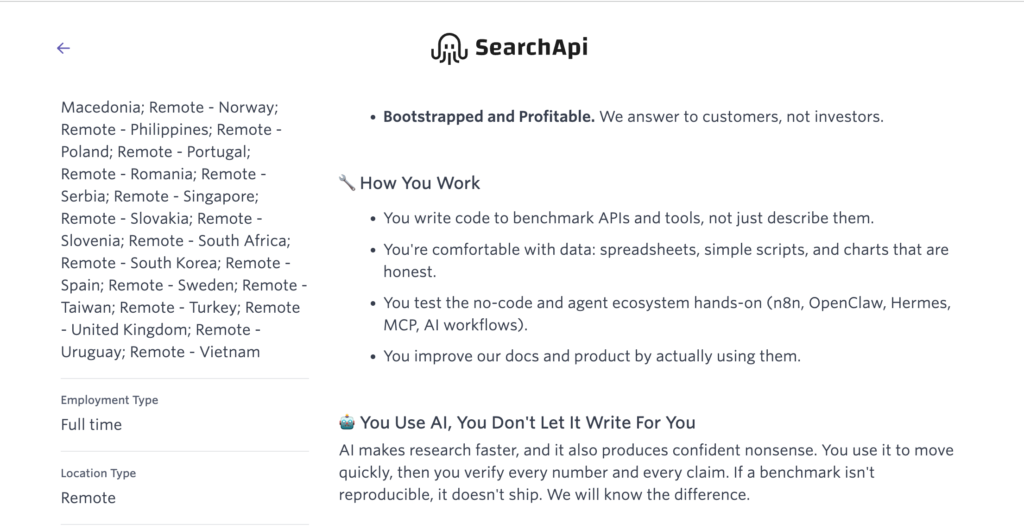
The door is open. The bar is still high. A near-native writer gets in only by showing the same research and the same writing a native writer would need to show.
Another ad in the set (dataset J30, now closed) listed its English level as “C1, C2, Native.” The same ad also required the writer to be in Latin America and to work US Eastern hours. An open language rule did not remove the other conditions.
Finding 3: The Market Is Not the Same as Where You Live
17 of the 50 ads named a market, an English variety, or a culture. It’s tempting to read “US English” as “must be American.” Some of these ads show that’s not how they work.
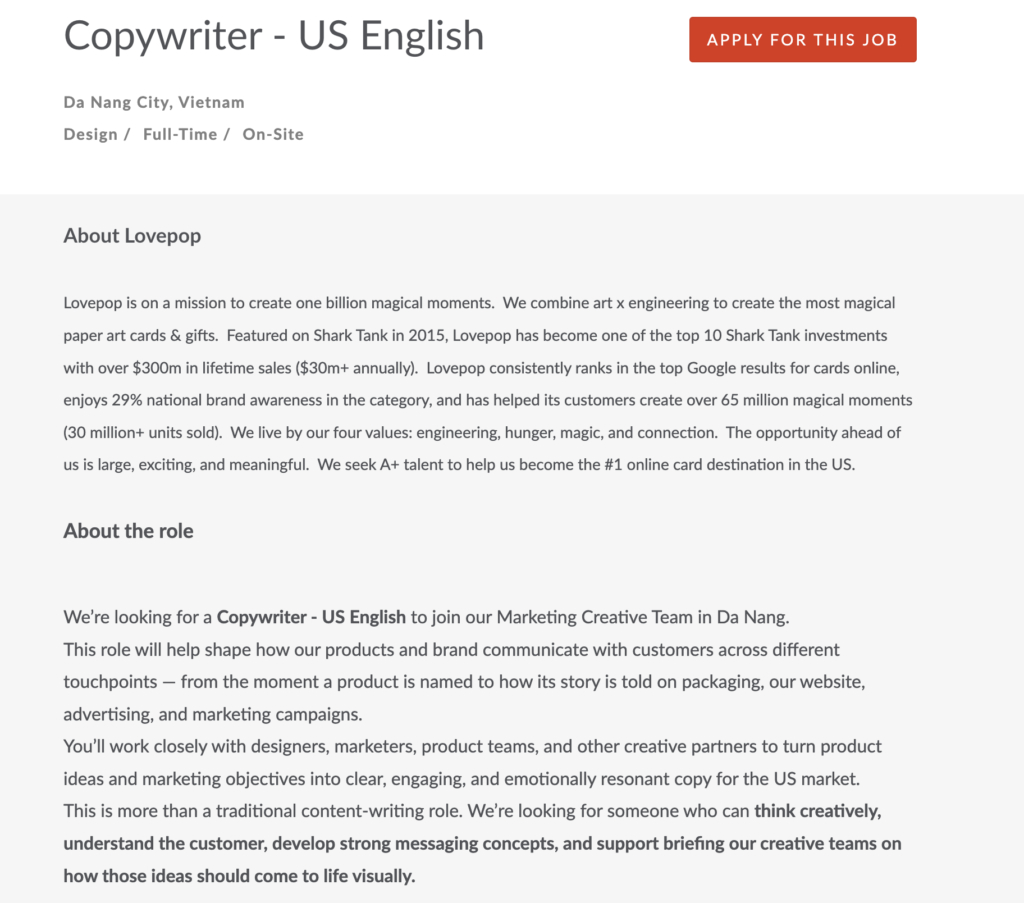
Lovepop’s copywriter ad asks for “Native-level US English writing proficiency with a strong understanding of US culture.” It also says the writer must be “Currently living in Da Nang, Vietnam, or willing to relocate to Da Nang.”
The Zillow ad from the top of this post works the same way. The role is based in Mexico. The readers are in the US.
So a US audience is not a US passport. But the reverse is also true. A US audience is not permission to work from anywhere. Lovepop still requires Da Nang. MDPI still requires a valid permit to work in Poland. And 11 of the 50 ads needed another language on top of English.
Read the market and the location as two separate lines. Then check both.
Finding 4: Some Gates Are Real
It would be nice to end with “native just means good.” The data doesn’t support that.
Galactic Fed’s “No exceptions” is a firm language rule. A strong sample doesn’t change what the ad says. Another ad in the set (dataset J48, now closed) described detailed B2B editing work, asked for examples and a paid trial, and still required a native speaker based in the US.
One count stands out. 9 of the 16 native-speaker-only ads also asked for samples or a test. So a strict language rule and a request for proof often sat in the same ad. That does not mean those 9 employers would drop their language rule for a good sample. Nothing in the data shows that. It only shows that the two things live side by side.
What you can do with a firm gate: read it as written. Don’t rewrite it in your head into something friendlier. And never misstate your first language, nationality, residence or work permit to get past it.
Finding 5: Read the AI Rules Line by Line
Only 13 of the 50 ads said anything about AI tools. Here’s how they split.
- 7 allowed, valued or expected AI tools
- 3 banned them
- 1 gave conflicting instructions
- 1 mentioned screening or disclosure
- 1 raised a style concern without a clear ban
- 37 said nothing
The conflicting one is the useful warning. In a Day Translations ad (dataset J37), the title banned AI at every step. The description valued productivity tools. When an ad contradicts itself, don’t pick the line you prefer. Ask before you start.
If a client later runs your work through a detector, it helps to know what happens when GPTZero flags human writing and how to answer it.
A Short Note on Fairness and the Law
This audit does not call any ad legal or illegal. It doesn’t have the facts to do that. Freelance contracts across borders also don’t fit neatly into one country’s employment law.
But two official sources are worth knowing. The US Department of Commerce’s guidance on national origin discrimination says: “Generally, an English fluency requirement is permissible if required for the effective performance of the job.” It adds that such rules should be “carefully tailored to the requirements of the specific job.” In the UK, the GOV.UK guidance for employers says: “You must not state or imply in a job advert that you’ll discriminate against anyone.”
The idea behind both is the same. A language rule should be about the skill the job needs. Wording that measures skill (“near-native,” “C2,” “a test”) tells you more about the job than wording that describes a person. This is general information, not legal advice.

The Gate, Task, Proof Method
Gate, Task, Proof is a three-question method for reading a job ad. Gate asks what makes you eligible. Task asks what work the job describes. Proof asks what evidence the ad wants you to show. You answer each one separately, so a language rule never hides the actual job.
1. Gate: Am I eligible?
Read the language line, the location, the work permit, the hours, and any second language. Mark each one as required, preferred, or unclear. “Native or near-native” is not “native only.” “US audience” is not “US resident.” “Remote” is not “any country.”
2. Task: What will I actually produce?
Look for the nouns and verbs. Ad copy? Technical explainers? Light editing? Research? Ignore the adjectives like “excellent” and “natural” for a moment. The task words tell you what the job really is.
3. Proof: What do they want to see?
One relevant article? A tracked edit? A test? A technical piece with its data? Match your proof to the request. If the ad asks for a cybersecurity sample, a well-written travel essay won’t do the job, however good the grammar is.
The method works because it moves your effort to the part you control. You can’t change a gate. You can always make your proof stronger.
Turn a Fluency Claim Into Proof
Most applications from non-native writers spend their best sentences defending their English. The ads above suggest that space is better used to show the work. Here are three common lines, and stronger versions.
❌ “Although English is not my first language, I am very passionate, hardworking and able to write just like a native.”
✅ “This sample explains cloud backup for small-business owners. I checked each price against the vendor’s own page. The note after it explains two editing choices.”
The first line asks the reader to trust you. The second gives them something to check. Swap in your own real topic and sources; never claim checks you didn’t do.
❌ “My native-level copy increases engagement by 40%.”
✅ “This is a self-initiated email sequence, not a client campaign. I’ve included the brief and the reason for each email. No performance result is claimed.”
A number with no source hurts more than it helps. A labelled practice sample is honest, and it still shows your thinking.
❌ “We will deliver on Friday.”
✅ “We can deliver the draft on Friday if the brief is approved by Tuesday.”
This one is an editing sample. The first version reads more smoothly, but it removed the condition and made a bigger promise. An editor who keeps the meaning while improving the sentence is showing exactly the judgment ads like MDPI’s test for.
Three Ways to Respond to a “Native English” Ad
When the ad names an alternative and you meet the other conditions: apply. Put your closest sample first. Don’t spend your opening defending your English. A sample doesn’t guarantee an interview, but it answers the question the ad is really asking.
When the wording is unclear: ask one short question. For example:
“Your ad mentions native English. Do you also consider writers with equivalent professional English? My attached sample is a [format] for [audience], close to the work you describe. I meet your other stated requirements.”
Only write that last sentence if it’s true.
When the gate is firm and you don’t meet it: let it go. Spend your time on the ads where your proof can be judged on its own. In this set, 12 ads named an alternative outright.
If you’re still asking whether this path is realistic at all, whether a non-native speaker can become a professional copywriter is a good place to start.
What This Means for Your Next Application
A label can’t tell you what kind of writer a job needs. The tasks and the proof request tell you much more. So read those carefully, and read the restrictions just as carefully.
The goal isn’t to sound like someone you’re not. It’s to show, in a sample someone can check, that you can do the exact work in the ad. If you want to sharpen that sample before you send it, start with what natural English actually means for writers, then check it for the patterns that make writing sound non-native.
Frequently Asked Questions
What do native English job posts actually ask for?
In this set of 50 ads, the language line was rarely the whole request. 43 asked for or valued voice, style or audience skills, 40 asked for or valued role or sector experience, and 31 asked for samples, a test, or both. The language rule tells you who is eligible. The rest of the ad tells you what the job is.
Does “native-level English” mean the same as “native speaker”?
No. “Native-level” describes a level of skill. “Native speaker” describes a person. In this set, 13 ads used native-level wording and 16 asked for a native speaker with no alternative. A native-level ad still doesn’t promise it will accept every strong non-native writer.
Should I apply to a native English job if I’m not a native speaker?
It depends on the wording. If the ad names an alternative like near-native or C2, and you meet the other conditions, apply with your closest sample first. If the wording is unclear, ask one short question. If the ad says native speakers only with no exceptions, read it as written and spend your time elsewhere.
Is it legal for a job ad to require native English?
It depends on the country and the type of work, and this audit doesn’t judge any ad. US Department of Commerce guidance says an English fluency requirement is generally allowed if the job needs it, and should be tailored to the specific job. UK guidance says a job ad must not state or imply discrimination. This is general information, not legal advice.
What should a non-native writer send with an application?
Send proof that matches the task. That means one relevant sample, a short note on your choices, and a clear line on whether it was client work or self-initiated. In this set, 28 of 50 ads asked for or valued existing work, and 9 asked for a new test or trial.
Where to Go Next
→ Can Non-Native English Speakers Actually Become Professional Copywriters?: what actually decides whether you get paid, and what doesn’t.
→ What Is Natural English? A Working Definition for Writers: what “natural” means in practice, so your samples aim at the right target.
→ Why polished English copy still sounds translated: the fixes to make before a sample goes out.
→ Or start here: Get the free Natural English Edit, 15 patterns that make copy sound translated, with the ChatGPT prompts to fix every one.
Data: 50 public job ads, coded 18 September 2026, status rechecked 10 November 2026. Selected on purpose, not at random. Source discovery and first-pass coding were AI-assisted. Download the dataset.
