
If you’ve ever pasted your draft into ChatGPT, asked it to “improve” the writing, and watched it return something that’s smoother but no longer recognisably yours — this is for you. The prompt framework to match your voice below is a four-layer structure that stops ChatGPT flattening your draft into the generic American business voice it produces by default. It is what I use, it is what I see working writers settle into after a few months of trial and error, and it is honest about what it can and can’t do.
Quick map: the problem (why default ChatGPT erases voice), the framework (four layers, stacked), worked examples (real prompts you can copy), and the limits (where the framework stops working).
Why ChatGPT erases your voice by default
Default ChatGPT output reads like a competent American mid-market consultant who has read a lot of LinkedIn. This is not an accident. The model was trained on a corpus weighted toward that register, and when you give it a vague instruction like “improve this” or “make it sound better,” it regresses to that mean. Your draft goes in. The mid-market consultant comes out.
This matters disproportionately for non-native writers. A native writer who uses default ChatGPT loses some texture. A non-native writer who uses default ChatGPT loses both their voice and the specific perspective that was the reason for hiring them. (I covered why your perspective is a situational asset rather than a thing to erase in your non-native perspective in copy.)
The fix isn’t a magic prompt. It’s a structure that gives the model enough constraint that “regress to consultant” stops being the easiest path.
A point worth naming on prompt quality: prompt engineering is a discipline focused on developing and optimizing prompts to effectively utilize large language models (Taylor & Francis Online), and recent peer-reviewed work has shown that different prompt styles produce significantly different output quality even from the same model on the same task. The framework below is one applied version of that finding for non-native professional writers.
The framework: The Four-Layer Prompt
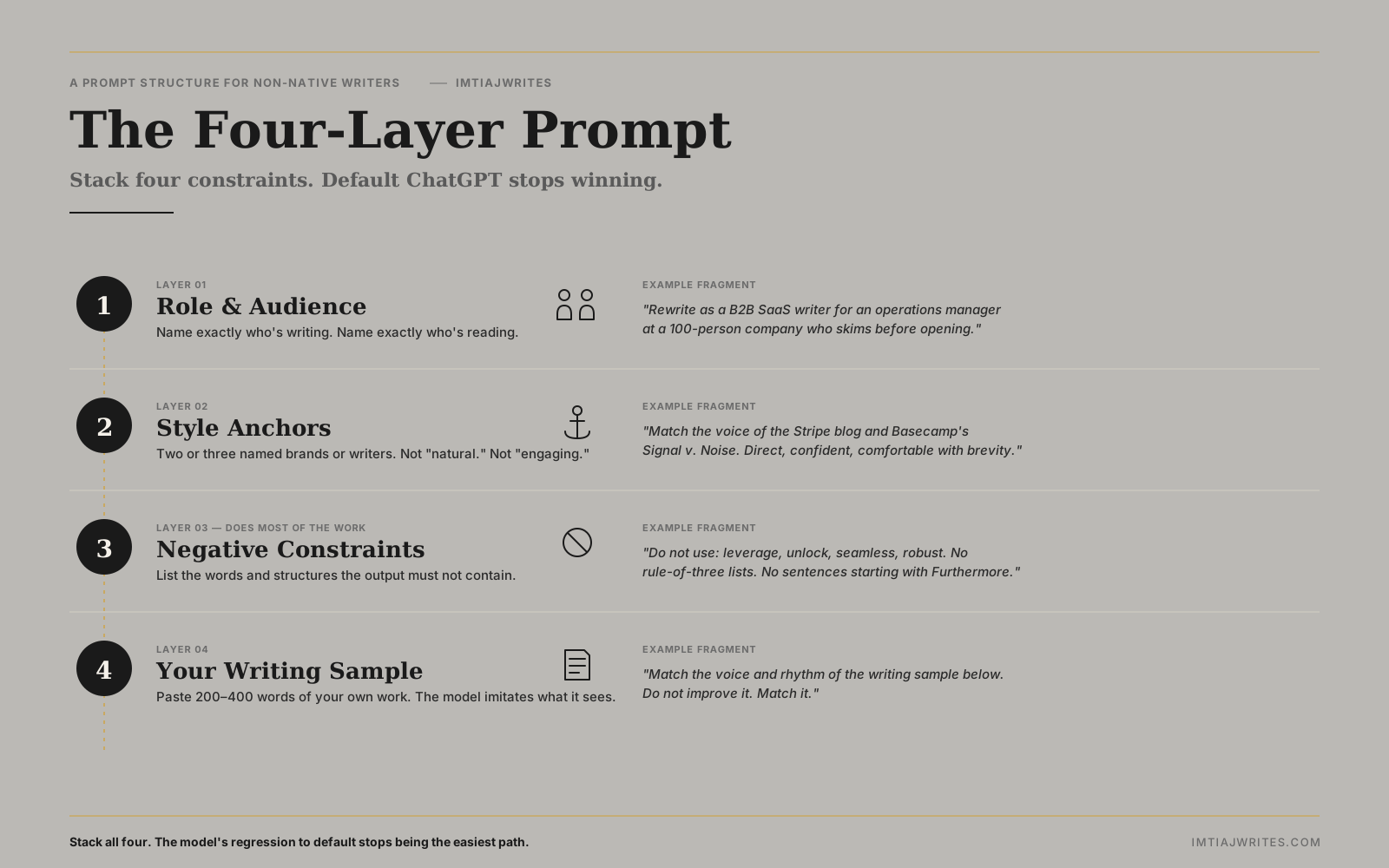
Each layer adds one type of constraint. Use them in order, stack them, and the model’s default register stops winning.
Layer 1 — Role and audience. Who the writer is, who the reader is.
Layer 2 — Style anchors. Two or three specific writers, brands, or pieces whose voice you want approximated. Concrete, named.
Layer 3 — Negative constraints. What the output must not sound like. This is the layer most non-native writers skip and the one that does the most work.
Layer 4 — A sample of your own writing. 200–400 words of something you wrote yourself, pasted in.
Each layer alone helps a little. Stacked, they shift the model out of consultant-default and into something closer to you.
I’ll work through each layer with examples, then show the four stacked together in a real prompt.
Layer 1: Role and audience
Default ChatGPT writes for “a general audience.” A general audience is no audience. You can lift output quality measurably by naming the specific reader the piece is for.
❌ Improve this email about our new feature.
✅ Rewrite this email for a B2B SaaS audience — operations managers at companies with 50–200 employees, who get six similar emails a day and skim before deciding if it’s worth opening.
The first prompt forces ChatGPT to guess. The second tells it exactly which mental model to write for. The output difference is large, and almost free.
For non-native writers, the role half of this layer matters too. “Write as a copywriter” is generic. “Write as a copywriter who works with global tech brands and writes English as a second language, with a slightly direct, slightly understated voice” gives the model permission to keep some of your texture instead of smoothing it away.
Layer 2: Style anchors
Two or three specific, named references. Not “make it engaging.” Not “keep it conversational.” Specific writers, brands, or pieces.
❌ Make it sound natural and engaging.
✅ Match the voice of the Stripe blog and the Notion product pages. Direct, confident without being loud, unafraid to use a short sentence on its own.
ChatGPT has read most published English on the internet. It knows what the Stripe blog sounds like. It does not know what “natural” sounds like, because “natural” means something different on a Stripe page than on a Tumblr post.
Pick references the model has actually seen — published brand voices, well-known writers, named publications. “Sound like my colleague Priya” will not work. “Sound like the Oatly cartons” will. (For why brands like Oatly are useful references, see your non-native perspective in copy — I broke down what makes their voice work earlier in this series.)
Layer 3: Negative constraints
This is the layer that does most of the work, and the one almost every prompt template online skips.
The default output failures are predictable. ChatGPT reaches for the same words, the same transitions, the same sentence structures. If you don’t tell it what not to do, it will do them. Every time.
For non-native writers specifically, the negative constraints I run on every voice-matching prompt:
✅ Do not use: leverage, unlock, seamless, robust, game-changer, navigate the landscape, in today’s fast-paced world, it’s important to note, delve into, revolutionize.
✅ Do not use rule-of-three lists (“clear, concise, and compelling”).
✅ Do not use “It’s not just X, it’s Y” constructions.
✅ Do not start sentences with “Furthermore,” “Moreover,” or “In addition.”
✅ Vary sentence length aggressively. Mix short sentences (under 10 words) with longer ones.
✅ Do not write a generic positive conclusion.
That list is roughly fifteen lines. It cuts about 60% of what makes default ChatGPT output sound like default ChatGPT output. (The list is a tactical version of the same patterns I covered in the non-native writer’s self-editing checklist — same patterns, different direction. There you scan your draft for them. Here you tell the model not to produce them.)
If you’re getting voice-flattening output and you’re only adjusting Layers 1 and 2, this is the layer you’re missing.
Layer 4: A sample of your own writing
This is the layer most writers feel weird about. They shouldn’t.
Paste 200–400 words of something you actually wrote — not a polished portfolio piece, a working draft you’re proud of — into the prompt with the instruction:
✅ Match the voice and rhythm of the writing sample below. Keep my sentence structures, my preferred connectors, and the way I move from idea to idea. Do not “improve” the voice. Match it.
ChatGPT is genuinely good at imitation when given enough material. 200 words is the floor; 400 is better; 600 hits diminishing returns. Below 200, the model doesn’t have enough signal and falls back to its default. Above 600, you’re paying for context window without proportional gain.
Pair this with Layer 3 and the output starts sounding like a slightly cleaner version of you, rather than a stranger. Slightly cleaner is the goal. Different is the failure state.
The four layers, stacked
Here’s what the prompt looks like with all four layers running at once. This is roughly the structure I use for most ChatGPT-assisted drafting:
[Layer 1] Rewrite the draft below as a [specific role: e.g.,
B2B SaaS product writer for a mid-market US audience].
The reader is [specific reader: e.g., an operations manager
at a 100-person company who skims].

[Layer 2] Match the voice of [reference 1: e.g., the Stripe
blog] and [reference 2: e.g., Basecamp's Signal v. Noise].
Direct, confident, comfortable with short sentences.

[Layer 3] Do not use: leverage, unlock, seamless, robust,
game-changer, navigate the landscape, in today's fast-paced
world, it's important to note, delve into, revolutionize.
Do not use rule-of-three lists. Do not start sentences with
Furthermore, Moreover, or In addition. Vary sentence length
aggressively — mix short (under 10 words) with longer. Do
not write a generic positive conclusion.

[Layer 4] Match the voice and rhythm of this writing sample.
Keep my sentence structures, preferred connectors, and the
way I move from idea to idea. Do not improve the voice.
Match it.

WRITING SAMPLE:
[paste 200–400 words of your own writing]

DRAFT TO REWRITE:
[paste the draft you want rewritten]
That’s a 250-word prompt. It’s not elegant. It is what works. If you’re using ChatGPT for voice-matched drafting and your prompt is shorter than this, you are paying for the difference in flattened output.
You can save this as a saved prompt or a Custom GPT and only swap the writing sample and draft each time. After a week the structure feels normal.
Before-and-after: the same draft through default vs framework
Here’s the same paragraph processed through default ChatGPT (“improve this”) and then through the four-layer prompt. Run this comparison yourself with any draft you have — it’s the fastest way to see the framework’s effect.
Original draft (mine, slightly raw): “Most non-native writers I know default to over-formal English when they’re unsure. It feels safer than getting casual wrong. The cost is that their copy reads like it was translated from a memo, even when it wasn’t.”
Default ChatGPT “improve this”: “In my experience, many non-native writers tend to gravitate toward a more formal register when faced with uncertainty, as it feels like a safer choice than risking a misstep with informal language. However, this approach often comes at a cost: their copy can read as if it were translated from a corporate memo, even when that wasn’t the writer’s intention.”
Four-layer framework output: “Most non-native writers default to over-formal English when they’re not sure of the register. Formal feels safer than casual gone wrong. The cost shows up in the reader: copy that reads translated even when nothing was translated.”
The default version smoothed the rhythm, doubled the word count, and added “in my experience” and “however” because those are consultant defaults. The framework version is closer to what I’d actually write on a second pass — tighter than my raw draft, but still mine.
What the framework won’t do
Three honest limits.
It won’t make ChatGPT write in your voice from a blank prompt. The framework works for editing or rewriting drafts you’ve already written, not for generating new copy from scratch. Generating-from-scratch is where ChatGPT regresses hardest to its default register, and no prompt structure fully fixes it.
It won’t replace the editing pass. The framework’s output is closer to your voice, not in your voice. You’ll still need to scan for the patterns from the self-editing checklist on the way out. Cut three or four ChatGPT defaults that slipped through, fix one or two rhythm flatlines, and the piece is publishable.
It won’t help if your raw draft was generic to begin with. The framework amplifies and preserves what’s in the writing sample. If the writing sample sounds like everyone else, the output will too. Voice is upstream of the prompt.
If you want a shortcut for the editing pass after ChatGPT runs, the Natural English Edit is the 15-pattern checklist with prompts attached — built for the post-framework cleanup specifically.
What this connects to in the rest of the blog
The four-layer prompt is the AI-side application of patterns I’ve covered from the writing side in earlier posts: the EF English Proficiency Index 2024 reports an ongoing softening of worldwide English proficiency across 116 countries PR Newswire, which means non-native fluent writers are increasingly competing with AI-generated English that reads more native than they do. The framework is one move in that fight. The other moves — the editing checklist, the register awareness, the perspective-as-asset framing — sit alongside it in the rest of this blog.
Voice is an asset. Default ChatGPT is the thing that erases it. A structured prompt is the thing that gets some of it back.
FAQ
How do I make ChatGPT match my writing voice instead of replacing it? Use a four-layer prompt: name the role and audience, give two or three specific style anchors (named writers or brands), list specific patterns the output must not contain, and paste a 200–400 word sample of your own writing. Stacked, these constraints stop ChatGPT regressing to its default mid-market American business register.
Why does ChatGPT flatten my voice when I ask it to improve my writing? Because “improve” is a vague instruction, and the model’s default response to vague instructions is to regress to the most probable register in its training data — which weights heavily toward generic American business writing. Without specific constraints, that’s what you get.
How long should a writing sample be when prompting ChatGPT for voice matching? Between 200 and 400 words. Below 200, the model doesn’t have enough signal and falls back to default. Above 600, you’re using context window without proportional gain. 200–400 is the practical sweet spot for most professional drafting.
What words should I tell ChatGPT not to use in voice-matched output? The reliable list: leverage, unlock, seamless, robust, game-changer, navigate the landscape, in today’s fast-paced world, it’s important to note, delve into, revolutionize. Plus structural bans on rule-of-three lists, “It’s not just X, it’s Y” constructions, and sentences starting with “Furthermore” or “Moreover.”
Can ChatGPT generate copy in my voice from scratch, not just rewrite? Less reliably. The framework works for editing existing drafts, where the model has structure to follow. From a blank prompt, ChatGPT regresses harder to its default register because it has no shape to imitate. For new copy, draft yourself first and run the framework on the rewrite.
Should non-native writers use ChatGPT at all if it flattens voice? Yes — used with the framework, ChatGPT is faster than self-editing for clearing the patterns most non-native writers default to. The risk is using it without structure, which trades visible non-native fingerprints for invisible generic-American ones. The framework is what makes the trade worth making.
Where to go next
⮕ Read the non-native writer’s self-editing checklist for the editing pass that runs after ChatGPT — the framework’s output still needs human cleanup.
⮕ Read why your English copy sounds translated for the underlying register problem the framework is trying to address from the AI side.
⮕ Or grab the Natural English Edit — the 15-pattern checklist with ChatGPT prompts attached, designed to run on a draft in under ten minutes.
