
Your grammar is clean. Your words are right. Your writing still sounds flat, and you cannot say why. The problem is often not in any single sentence. It is in the space between them, in the way they follow one another.
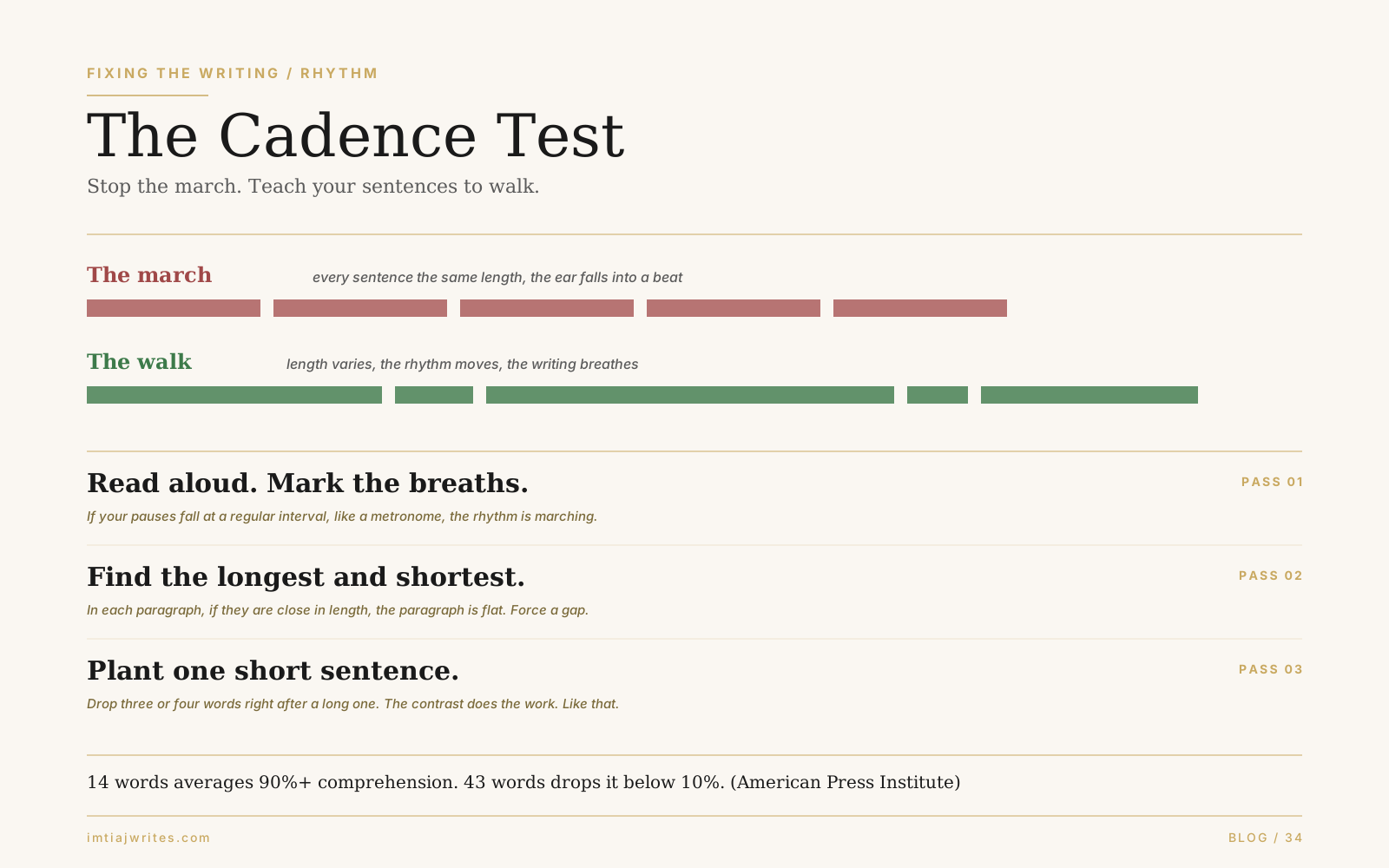
Sentence rhythm and cadence are the pattern your sentences make as a group: how long they run, where they pause, how they rise and fall. When every sentence is roughly the same length, the writing marches. Left, right, left, right. Correct, even, and lifeless. Good writing walks instead. It changes pace. It slows for a long thought and then stops short. That change of pace is what makes prose feel alive, and it is the single most overlooked skill in non-native professional writing.
This post is a deep dive on one specific cause of unnatural-sounding English, the rhythm problem. It is the fuller treatment of Cause 5 in the complete diagnostic guide, and it goes past diagnosis into the actual fixes.
Why rhythm is the hardest thing to self-diagnose
Rhythm is invisible on the page. You can see a grammar error. You can look up a preposition. You cannot see cadence, because it is not in the words, it is in the timing, and timing only reveals itself when the writing is heard.
That is why so many fluent non-native writers get stuck here. They have fixed the visible problems. Grammar, clean. Vocabulary, strong. Register, controlled. And the writing still sounds slightly off, because the one remaining problem is the one their eyes cannot catch. Rhythm is an ear skill, living in a job that is mostly done with the eyes.
There is also a reason non-native writers drift toward even rhythm specifically. When you write in a second language, you often build each sentence carefully and deliberately to a safe and familiar length. That care is good for correctness. It is bad for rhythm, because it produces sentence after sentence of the same shape, each one built to the same cautious template. The evenness is a side effect of writing carefully in a language you had to learn.
What the march sounds like
Here is the thing to hear. When sentences are all the same length, the reader’s ear falls into a beat, and a beat is fine for a march and wrong for a conversation.
❌ The product is easy to use. The design is clean and modern. The price is very reasonable. The support team is helpful. The whole experience is positive.
Read that aloud. Feel your voice drop at the same interval, five times. That is the march. Every sentence is five to seven words, subject-verb-object, full stop. Nothing is wrong with any single sentence. Together they are monotonous.
Now the same content, walking:
✅ The product is easy to use, with a clean, modern design. The price? Very reasonable. And when something goes wrong, the support team actually helps, which is rarer than it should be.
Read that one aloud too. Your voice moves now. It runs, then stops short at “Very reasonable,” then opens up again. Same information. Completely different feel. The difference is rhythm, and rhythm is entirely fixable once you can hear it.
What the research says about sentence length
This is not only an art question. There is measurement behind it.
Research compiled from the American Press Institute found that when the average sentence runs about 14 words, readers understand more than 90% of what they read. Push the average to 43 words and comprehension collapses to under 10%. The same source maps the full curve: sentences of 8 words or fewer are very easy, 17 words is standard, and 29 or more is very difficult. A separate peer-reviewed study on reading comprehension found that readers showed the highest comprehension and the lowest mental effort with sentences in the 16 to 20 word range.
But here is the part that matters for rhythm, and that the averages hide. An average of 16 words does not mean every sentence should be 16 words. The best writing hits that average by mixing a 4-word sentence with a 28-word sentence, not by making everything 16. The average is a target for the whole document. The individual sentences should vary widely around it. Evenness kills the very rhythm that makes the average readable.
That is the trap non-native writers fall into. They aim for the safe medium length and hit it every single time, which produces a correct average and a lifeless cadence.
Reading the rhythm of copy you already know
You do not need my examples to hear this. You can test it on copy you already know.
Look at Apple’s product pages. Read a paragraph aloud. You will hear very short sentences (“It’s fast.”) dropped between longer, flowing ones. The short ones land like a stop. That deliberate contrast is the whole effect, and it is why the copy feels confident rather than flat.
Now look at a typical corporate “About Us” page, the kind most companies publish. Read a paragraph of that aloud. You will usually hear the march: sentence after sentence of the same mid-length, each one professional, each one correct, the whole thing sounding like a treadmill. The company is not staffed by bad writers. It is staffed by careful writers who never learned to vary the beat.
The pattern is easy to hear once you listen for it, and once you hear it in other people’s copy, you start hearing it in your own.
The framework: The Cadence Test
Here is the method I use to fix rhythm in a draft. Three passes, all done aloud, because rhythm cannot be fixed silently. Call it The Cadence Test.
Pass 1: Read aloud and mark the breaths. Read your draft out loud at a normal speaking pace. Every time you naturally pause or take a breath, make a mark. When you finish, look at the spacing of the marks. If they fall at a regular interval, like a metronome, your rhythm is marching. Irregular spacing is what you want.
Pass 2: Find the longest and shortest sentence in each paragraph. In a paragraph with good rhythm, the longest and shortest sentences are very different lengths. If your longest and shortest are close in length, the paragraph is flat. Force a gap: cut one sentence to a fragment, or combine two others into a longer flowing line.
Pass 3: Plant one short sentence on purpose. In each paragraph, find one place to drop a very short sentence, three or four words, right after a long one. The contrast does the work. A long sentence that builds and turns and carries a full thought to its end, followed by a short one. Like that. The short sentence lands because the long one set it up.
The whole test takes about ten minutes on a normal draft. It is the only reliable way I know to fix rhythm, because it moves the problem out of your eyes, where it is invisible, and into your ears, where it is obvious.
Three specific moves that break the march
Beyond the full test, three small habits fix most rhythm problems.
Vary sentence openings, not just sentence lengths. The march is partly a length problem and partly an opening problem. If every sentence starts with the subject, the rhythm flattens even when lengths vary.
❌ We built the tool for speed. We tested it with real users. We shipped it in six weeks.
✅ We built the tool for speed. It was tested with real users first. Six weeks later, it shipped.
Use fragments on purpose. A sentence fragment is not always an error. Used deliberately, it is a rhythm tool. It creates the hard stop that a full sentence cannot.
❌ The result was a product that was much better than what we had before.
✅ The result was a better product. Much better.
Let one sentence run long. The fear of long sentences pushes non-native writers toward safe medium ones. But a single long sentence, one that gathers several ideas and rolls them together and builds toward a point that only arrives at the very end, creates a momentum that short sentences cannot, as long as you follow it with something short.
The trick is never many long sentences in a row. One long one, then a short one to release the tension. That is the walk.
The honest limit
Rhythm is the last thing to fix, not the first.
If your grammar still has gaps, or your register is wrong for the channel, fix those first. Rhythm is the polish layer, the thing you work on once the writing is already correct and clear. Working on cadence while basic grammar is still shaky is like tuning a guitar with a broken string. Get the string fixed first. For the grammar layer, see the three mistakes that mark non-native copy. For register, see why your English copy sounds translated.
There is also a limit to how much rhythm you can plan. Some of it only comes from reading a lot of well-rhythmed English and letting your ear absorb the patterns, the same way native writers absorbed it without noticing. The Cadence Test catches the obvious problems. The subtle music comes slower, from exposure. That part I cannot shortcut for you, and anyone who says they can is selling something.
But the march is fixable today. Read your draft aloud, hear the metronome, and break it. That alone moves most non-native professional writing from correct to alive.
Frequently Asked Questions
What is sentence rhythm and cadence in writing?
Sentence rhythm and cadence is the pattern your sentences make as a group: how long they run, where they pause, and how they rise and fall together. When every sentence is roughly the same length, the writing feels flat and mechanical, like a march. Good rhythm varies sentence length and structure so the prose moves like natural speech, which is what makes clean writing feel alive rather than merely correct.
Why does my writing sound flat even when the grammar is correct?
Usually because of even rhythm. Non-native writers often build every sentence to the same safe, careful length, which produces correct grammar and a monotonous cadence. The reader’s ear falls into a repeating beat, and the writing feels like a treadmill. The fix is not more grammar study but sentence variety: mixing very short sentences with longer flowing ones so the rhythm changes pace.
How do I fix choppy or monotonous sentence rhythm?
Use the Cadence Test: read your draft aloud and mark where you naturally pause, then look at whether the pauses fall at a regular interval. If they do, your rhythm is marching. Find the longest and shortest sentence in each paragraph and force a bigger gap between them, and plant one very short sentence right after a long one. Reading aloud is essential because rhythm is an ear skill, invisible on the page.
What is the ideal sentence length for readability?
Research compiled from the American Press Institute found that an average of about 14 words gives over 90% comprehension, while 43-word sentences drop comprehension below 10%. A peer-reviewed study found the highest comprehension and lowest mental effort at 16 to 20 words. But the average is for the whole document, not every sentence. Good writing hits that average by mixing very short and very long sentences, not by making them all the same length.
Why do non-native writers struggle with sentence rhythm specifically?
Because writing carefully in a second language pushes you toward safe, familiar sentence shapes, and you tend to build each one to a similar length. That care improves correctness but flattens rhythm, producing sentence after sentence of the same template. Rhythm is also an ear skill, and it is the hardest writing problem to catch by eye, so it survives even after grammar, vocabulary, and register are strong.
Can reading aloud really improve my writing rhythm?
Yes, it is the single most effective rhythm tool. Rhythm lives in timing, not in the words themselves, so it only reveals itself when the writing is heard. Reading aloud moves the problem from your eyes, where it is invisible, to your ears, where a repeating beat is obvious. Your own breathing will find the flat spots faster than any silent reading or grammar checker can.
Where to go next
👉🏼 For the full map of causes that make English sound unnatural, of which rhythm is one, see the complete diagnostic guide.
👉🏼 For the grammar layer that should be solid before you polish rhythm, see the three mistakes that mark non-native copy.
👉🏼 For the register layer, the other big driver of unnatural-sounding copy, see why your English copy sounds translated.
👉🏼 For the diagnostic on your own drafts, the Natural English Edit is the 15-pattern checklist with prompts to run on your own copy. Free.
Read it aloud. Hear the march. Break it into a walk. That is the whole skill, and your ear already knows how.
