
Most non-native English copy mistakes that survive into a final draft aren’t the dramatic ones. They aren’t the kind a reviewer circles in red and laughs about at the team retro. They’re the small, almost-invisible ones that no spell-checker flags and no AI tool reliably catches. The kind that pass through three rounds of editing and still leave a native reader thinking, “something about this doesn’t sound right.”
Three categories carry most of the weight: articles, prepositions, and verb tense. The reason they survive into final copy isn’t that you don’t know them. You do. The rules show up in every grammar textbook ever written. The reason they survive is that the choice happens at the speed of typing, and the rule isn’t reachable at that speed unless you’ve internalised it through years of native exposure.
This post gives you a faster way to reach the rule. One per category. Plus the kind of public copy where you can spot these mistakes happening in the wild right now.
How common are these three?
Common enough that researchers have been ranking them for two decades.
A 2020 study from Al-Hussein Bin Talal University in Jordan, published in International Education Studies, ranked the most frequent grammatical errors in the writing of 87 university-level English majors. Verb tense came first (mean 3.75), followed by article errors (mean 3.62), then word order (mean 3.57). The same paper cited an earlier study by Abushihab, El-Omari and Tobat (2011), in which preposition errors accounted for 26% of all written grammatical errors among Arab EFL students at Alzaytoonah private university in Jordan. Tech ExploristTech Explorist
Different student populations, different L1s, same ranking. Articles, prepositions, and tense are not your personal problem. They are the structural fault lines between English and almost every other major language on earth.
What the academic studies don’t tell you, but commercial copy reviewers will, is this: these three categories don’t disappear with fluency. They get quieter. They show up less often. They stop being errors in the strict sense and start being patterns. A native reader can’t always say what’s wrong, only that something is. That’s the ceiling this post is about.
The framework: The A-P-T Rule
When you finish a sentence in a draft, run it through three quick questions. Call this The A-P-T Rule (Article, Preposition, Tense).
1. A — Article. Did I make a deliberate choice between a, an, the, or no article at all? If the choice happened automatically, check it.
2. P — Preposition. Did I reach for the preposition that sounds right in my first language, or the one that collocates with this verb in English?
3. T — Tense. Is the time relationship between this sentence and the one before it consistent, or did I drift?
The check takes about three seconds per sentence after a week of practice. The fix takes another three. The cumulative impact on how your copy reads is hard to overstate.
Now let’s go category by category.
Mistake 1: Articles (when your first language doesn’t use them)
This is the single hardest category for writers whose first language has no article system. That includes Mandarin, Russian, Bengali, Hindi, Urdu, Japanese, Korean, Polish, and most Slavic languages. If you grew up speaking any of those, your brain was never trained to make the a / the / no article decision in real time. So under typing pressure, it skips the decision entirely.
The result is what I call the silent omission. Take a look at this kind of phrasing, which you’ll find on the homepages of plenty of non-native-built SaaS companies right now if you go looking:
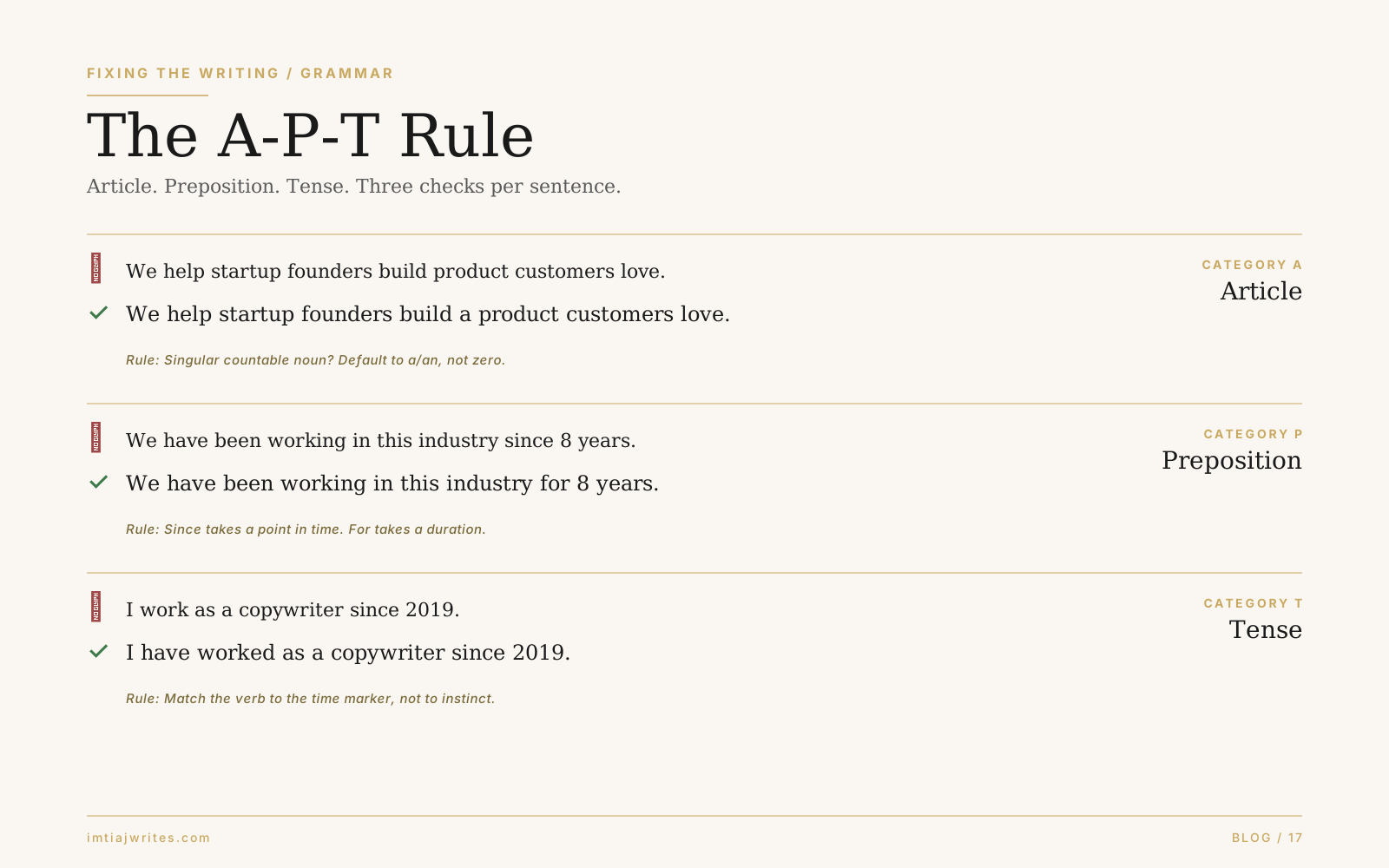
❌ We help startup founders build product customers love.
✅ We help startup founders build a product customers love.
The grammar isn’t broken in a way Grammarly will catch. The sentence is intelligible. But the missing a in front of product makes the line feel slightly off, and a native reader’s brain stalls for a half-second on the noun.
The reverse problem is overuse: adding the where English doesn’t want one.
❌ I love the music, especially the jazz.
✅ I love music, especially jazz.
This is the pattern speakers of Romance languages (Spanish, French, Italian, Portuguese) often carry into English, because their L1 uses the definite article in front of abstract or general nouns where English doesn’t.
The rule that actually works: Before any singular countable noun, the default is a or an, not zero. Before any uncountable or plural noun used in a general sense, the default is no article, not the. The is only correct when both you and your reader can point to the specific thing being referred to. If they can’t, it’s almost always wrong.
That single rule won’t make you native. It will catch about 70% of the article mistakes that survive into your drafts.
Mistake 2: Prepositions (the most invisible category of all)
Prepositions are where direct translation from your first language fails most often, because every language slices spatial and relational meaning differently. In, on, at, by, for, to, with, about don’t map cleanly across languages. They have to be learned as fixed pairs with the verbs and adjectives they attach to.
Look at what shows up in real B2B email outreach from non-native senders:
❌ I am writing for ask about a partnership opportunity.
✅ I am writing to ask about a partnership opportunity.
The “for” is borrowed from a first-language pattern (Spanish para preguntar, Bengali জিজ্ঞাসা করার জন্য, Hindi पूछने के लिए etc.) where the equivalent preposition does mean for the purpose of. In English, the preposition that goes with the infinitive to ask is just to. There is no purpose-marker in front of it.
Or this one, which is on the About page of more non-native-founded agencies than I can count:
❌ We have been working in this industry since 8 years.
✅ We have been working in this industry for 8 years.
Since takes a point in time (since 2018, since last March). For takes a duration (for 8 years, for three months). The L1 patterns of many European and South Asian languages use one preposition for both. English doesn’t.
The rule that actually works: Stop trying to memorise prepositions as standalone words. Memorise them in the verb-preposition pairs they live in. Apply for a job. Apply to a school. Worry about something. Suffer from something. Depend on someone. When you finish a sentence and the preposition came automatically, that’s the moment to second-guess it. Automatic usually means L1 transfer.
If you want to test yourself, paste any 200-word draft into ChatGPT with this prompt: “Identify any preposition in the following text that a native English speaker would use differently. Don’t fix anything else. Just flag the prepositions.” The output is uncomfortable to read for the first few weeks, and then it isn’t.
Mistake 3: Verb tense (the one that drifts)
Tense errors at the fluent level rarely look like the textbook examples. You aren’t writing I goed to the meeting yesterday. You’re doing something subtler: drifting between present and past inside the same paragraph, or reaching for present perfect when simple past is what the sentence needs.
❌ Last quarter, we launch three products and the team has worked very hard.
✅ Last quarter, we launched three products and the team worked very hard.
The first version mixes simple present (launch) with present perfect (has worked) inside a sentence anchored in a finished past time period (last quarter). Both verbs needed to be in simple past. This is the most common tense mistake in non-native business copy, and it survives almost every editing pass because the individual verbs are real English words used in real English ways. Just not in this combination, in this context.
A second pattern, this one specific to writers from languages without a present perfect tense (Mandarin, Bengali, most Slavic languages):
❌ I work as a copywriter since 2019.
✅ I have worked as a copywriter since 2019. (or I have been working…)
In English, an action that started in the past and continues into the present needs the present perfect. In many other languages, the same situation is expressed in the simple present. Your L1 isn’t lying to you. English is just structurally weirder than your L1 in this specific spot.
The rule that actually works: After you finish a paragraph, scan for time markers (last week, since, for, yesterday, in 2020, this morning). Each time marker has a specific tense it expects. Yesterday expects simple past. Since expects present perfect. In 2020 (a finished year) expects simple past. This week (an unfinished period) usually expects present perfect. Match the verb to the time marker, not to your instinct.
Why these three survive everything
Articles, prepositions, and tense are the three categories where your first language interferes most, and the three where the interference is most invisible to spell-check. That combination is why they’re the patterns that mark professional non-native English copy mistakes most reliably.
Three things make the A-P-T Rule different from “just be more careful”:
First, it tells you where to look (one of three specific categories) instead of asking you to scan for everything at once.
Second, it gives you one rule per category that catches the majority of cases, instead of asking you to memorise the full grammar tree.
Third, it makes the check post-draft, not mid-draft, which means you stop interrupting your own writing flow with grammar anxiety. You write fast, then you check three things slow.
If you’re already running The Layer Check from the last post on rewriting non-native English copy, the A-P-T Rule sits underneath it. The Layer Check fixes register, idiom, and rhythm, which are the macro-level signals. The A-P-T Rule fixes the micro-level signals that survive even after the macro is right.
For a longer diagnostic that runs across both layers, plus the ChatGPT prompts to automate the checks on your own copy, the Natural English Edit covers fifteen of these patterns end to end. Free.
A note on AI tools
Three honest observations from running the same drafts through GPT-4/5, Claude, Copilot and Gemini for the last 6-12 months:
AI tools catch tense drift well. Probably 90% reliable. They will fix your I work since 2019 without being asked.
AI tools catch preposition errors poorly. Probably 50% reliable. The model often substitutes one wrong preposition for another, because the training data contains a lot of non-native English alongside native English, and the model has no way to know which is which in a given context.
AI tools catch article errors almost not at all. Below 30% reliable. Articles are too local, too contextual, and too dependent on what the writer means rather than what the sentence says. This is the category where a non-native writer still has to do the work themselves, with a rule, by hand.
Knowing which category to trust the model on is half the leverage. The other half is knowing when not to.
Where to go next
If one of the three categories felt more familiar than the others, that’s where to start.
→ For register and idiom (the macro-level patterns that sit on top of these grammar fixes), read the Layer Check from the last post.
→ For why your writing sounds translated even when the grammar is correct, read this earlier post on the Register Gap.
→ For the full diagnostic, including the ChatGPT prompts that automate the article, preposition, and tense checks on your own drafts, the Natural English Edit is the longer version of everything in this post. Fifteen patterns. Free.
Three categories. One rule each. That’s the A-P-T Rule, and it’s where the next round of improvement in your copy lives.
Frequently Asked Questions
Why do non-native English speakers make more article mistakes than other grammar errors? Because many languages, including Mandarin, Russian, Bengali, Hindi, Japanese, Korean, and most Slavic languages, don’t have an article system at all. Speakers of those languages were never trained to make the a / the / no article decision automatically, so under typing pressure, the decision gets skipped. The fix is a single rule applied post-draft, not memorising the full article system mid-sentence.
What’s the most common preposition mistake in non-native English writing? Confusing for and since when expressing duration. Since takes a point in time (since 2018). For takes a duration (for 8 years). Many European and South Asian languages use one preposition for both, so the L1 pattern transfers directly into English and survives most editing passes.
Are verb tense mistakes common in fluent non-native English copy? Yes, but they look different at the fluent level. They aren’t textbook errors like I goed. They’re tense drift inside paragraphs, or simple present where present perfect is needed (I work as a copywriter since 2019 instead of I have worked as a copywriter since 2019). The drift is invisible because each individual verb is a real English word.
What is the A-P-T Rule? A three-step diagnostic for non-native English copy mistakes. After finishing a sentence, ask: Did I make a deliberate Article choice? Did the Preposition come automatically (which usually means L1 transfer)? Does the Tense match the time marker in the sentence? Three seconds per sentence after a week of practice. It catches the majority of small mistakes that spell-check doesn’t see.
Can AI tools fix article, preposition, and tense mistakes for me? Partially. Based on running drafts through GPT-4/5, Claude, and Gemini consistently: AI is roughly 90% reliable on tense, 50% reliable on prepositions (often substituting one wrong preposition for another), and below 30% reliable on articles. Articles especially still need a human rule applied by hand.
Do native English copywriters make these mistakes? Native writers make tense drift errors, especially in long copy, but rarely make article or preposition errors because both come automatically from a lifetime of exposure. Non-native writers have to do consciously what native writers do unconsciously. That’s a difference in process, not in skill.
