
Retainers vs projects is usually framed as a choice between stability and flexibility. I’d start with a less glamorous question: which one pays you first? A client agrees to pay $900 for a website rewrite, with 40% due before work starts. Another offers $1,500 a month for ongoing content, but the first month won’t begin until two months from now.
Which one builds income faster? If the first client pays the deposit as agreed, the project puts $360 in your account first. The retainer might give you more regular payments later. Both offers are fictional, but the difference is real: the contract that looks bigger is not always the one that pays sooner.
The usual debate skips that distinction. It treats recurring billing as income already secured and a one-off project as a temporary inconvenience. I’d rather look at what reaches your account, how many hours you give up to earn it, and how easily that money could disappear next month.
My answer: for a writer starting without recurring clients, a defined project with a deposit may be the faster route to first cash. A well-scoped retainer can help make later income steadier. A paid project that reveals an actual recurring need can connect the two. None of that is guaranteed by the name on the invoice.
A retainer is not a salary with a different name
The terms matter because two people can say “monthly retainer” and mean different things.
A project is a defined piece of work for a set fee. It might be a landing page, three email sequences, or a product launch. You can charge a deposit and collect the balance on agreed milestones. It doesn’t have to mean waiting until everything is finished to get paid.
A deliverable retainer is a recurring fee for a defined package, such as two researched articles and a planning call every month. A capacity retainer reserves some of your time or availability, even if the client doesn’t use all of it. Both need boundaries. “Help us with whatever comes up” isn’t a scope you can safely price.
And then there are repeat projects. A client may commission a case study in March and another in June without committing to monthly work. That can be a perfectly good relationship. Calling it a retainer doesn’t improve the economics.
This isn’t my invented distinction. ProCopywriters’ 2026 buyer guide describes project fees as the most common pricing approach and retainers as monthly payment for agreed work or availability. It specifically warns clients to be precise about unused capacity.
Its 2026 survey covered 573 UK commercial writers; the associated price guide uses a subset of 383 freelance copywriters and reports a £440 median freelance day rate. That’s a UK reference, not a rate card for a writer in Bangladesh, the Philippines or anywhere else. More importantly, neither source measures which contract type gets a comparable freelancer to $3,000 faster.
The sources I reviewed don’t offer an industry-wide winner. We have to compare the cash and work instead.
Follow the cash, not the invoice
Here’s what happens in the first three months of an illustrative twelve-month model. These are assumptions from a planning spreadsheet, not earnings from my clients or a survey of freelancers.
The project path assumes a $900 fee, 40% collected in the work month and 60% the next month, with one, two and three projects completed in months one to three. The retainer path assumes $1,500 per active client, paid at the start of each service month, with no client until month three.
| Collected cash | Project path | Retainer path |
|---|---|---|
| Month 1 | $360 | $0 |
| Month 2 | $1,260 | $0 |
| Month 3 | $2,160 | $1,500 |
| First 90 days | $3,780 | $1,500 |
(Illustrative scenario, not actual freelancer earnings. Both pipelines, client counts and payment dates are assumed.)
The project path wins the first-90-day cash test because it starts selling and collecting earlier in this model. Change the assumptions and the result changes. A retainer paid in advance tomorrow would beat a project whose payment is due 30 days after approval.
There’s an easily missed distinction if you work through a marketplace. On Upwork’s fixed-price contracts, a funded milestone sits in escrow. After you formally submit work, the client can take up to 14 days to review it, followed by a five-day security hold after release. Funded money is not yet money you can withdraw, and withdrawal to your bank is another step.
A scheduled invoice isn’t a bank credit either. “$3,000 recurring revenue” sounds reassuring until one payment is late and you still have rent to pay.
What happens over a full year?
The same illustrative model runs on for twelve months, including a retainer client leaving and another arriving. It assumes a 3% deduction from collected receipts and $80 of monthly business overhead for each separate path. Those costs are invented for comparison; taxes, real payment fees, refunds and living expenses aren’t modelled.
| Twelve-month measure | Projects | Retainers |
|---|---|---|
| Gross cash collected | $25,380 | $24,000 |
| Cash after modelled fees and overhead, before tax | $23,658.60 | $22,320 |
| All-in work, sales and admin hours | 510 | 388 |
| Cash after those costs per all-in hour | $46.39 | $57.53 |
| Months collecting at least $3,000 gross | 1 | 6 |
Neither path collects $5,000 in any month of this particular model. The project route brings in slightly more cash over the year; the retainer route uses fewer hours and hits the $3,000 monthly mark more often. Different questions, different winners. It would be dishonest to call either one the best business model from this table.
The monthly fee can hide a pay cut
Now hold the actual writing work steady. This is a second, simpler calculation, also hypothetical.
Two separate articles at $750 each bring in $1,500. Suppose they take 20 hours including pitching and admin. That’s $75 per all-in hour, before costs.
A client offers a $1,400 monthly retainer for the same two articles. It looks close enough, especially if you like knowing the client will come back. But the package includes a standing meeting, more coordination and extra revisions. If your total time rises to 23 hours, the effective return is $60.87 per hour.
Your fee is about 6.7% lower. Your hourly return is about 18.8% lower. The comforting word monthly did nothing to protect you.
That isn’t a reason to refuse retainers. If regular work genuinely removes repeated pitching and briefing, and the client keeps meetings and revisions inside the agreed scope, the maths may improve. But you have to count those hours rather than assume the savings.
I wrote earlier about why project pricing is my default for clearly defined copywriting work. My concern isn’t that monthly work is inferior. It’s that a freelancer can give away an awful lot of time in exchange for a feeling of stability.
When projects make more sense, and when retainers do
Projects are often the cleaner offer when the client has a one-time launch, a clear brief, a single decision-maker and a result they can approve. A paid landing-page rewrite is easier to define than “be our copywriter for the next six months”, especially when neither side knows how the working relationship will go.
The retainers vs projects question gets easier when you can see the client’s calendar. Is there another real job next month, or are you just hoping there will be?
Retainers make more sense when the buyer can name work that genuinely repeats. A B2B team that commissions researched content every month, sends briefs on time and has one reviewer might be a good fit. The package can reserve your capacity and reduce the cycle of selling yourself all over again.
There’s evidence that external content work remains a real part of business operations. A 2026 Contentful and Benchmarker survey of 321 B2B SaaS teams found that 47% of those teams outsourced between 26% and 50% of content production. It does not mean 47% of all content is outsourced or that those teams want monthly retainers.
The more useful opportunity may be in the work around AI-generated content. In the 2027 B2B Content and Marketing Trends study published in November 2026, 54% of the 861 surveyed B2B marketers cited accuracy as a challenge with AI content creation, 54% cited quality control and 52% cited brand voice and authenticity. Those are tasks a capable writer could offer: checking claims, interviewing subject experts, keeping terminology and tone consistent. They are not proof that buyers will purchase a retainer for them.
You still have to ask the client whether those jobs happen every month.
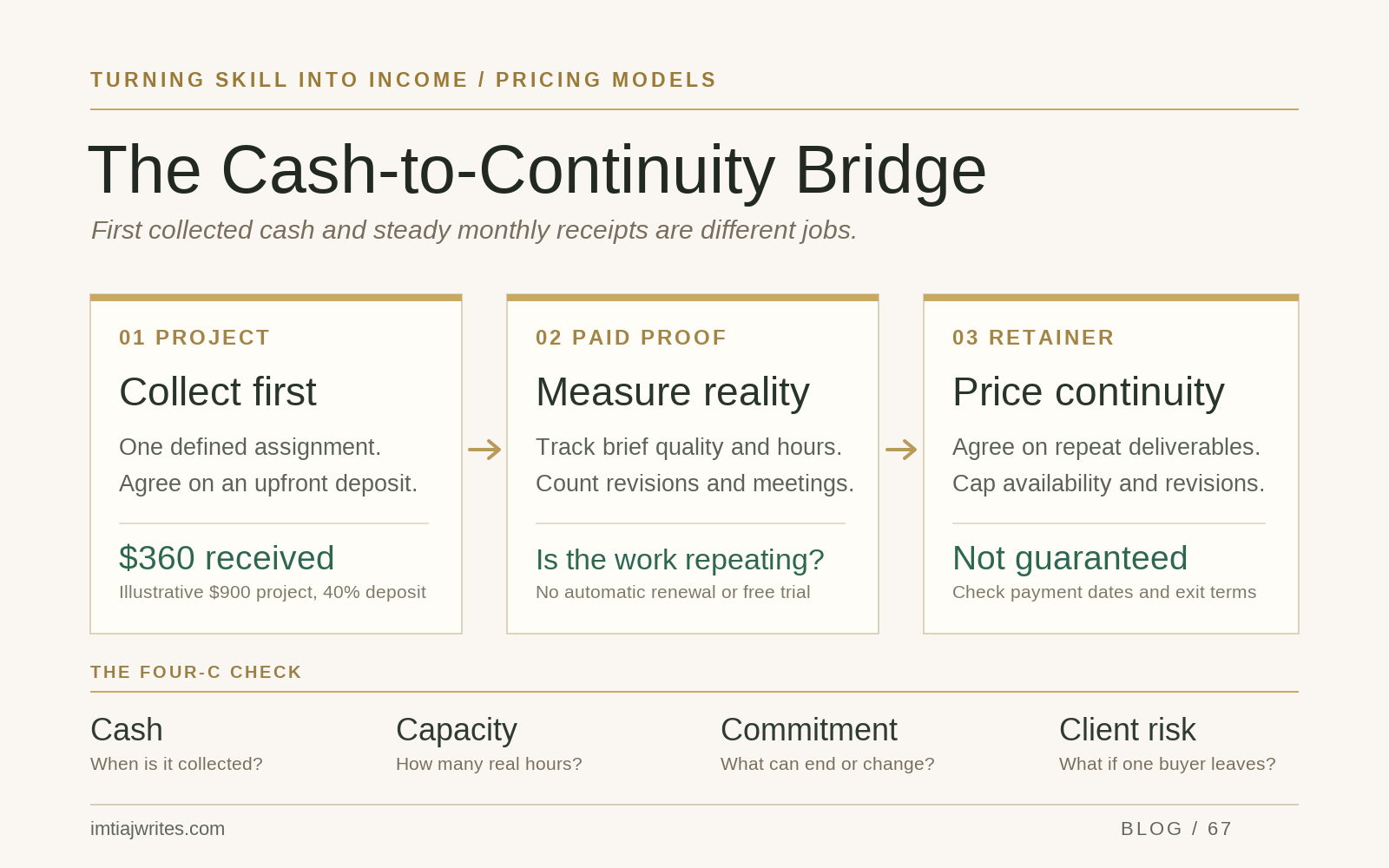
The bridge I’d test: project, proof, then recurring need
Rather than trying to sell a long commitment to a stranger, I’d begin with one paid assignment. A case study, an article with source checks, a short email sequence. Agree on what finished looks like, take a deposit if the arrangement allows it, and track the time you actually spend.
After delivery, you know things a sales call couldn’t tell you. Does the client send usable briefs? How many people approve the copy? Do revisions stay focused? Is there another real assignment on the calendar, or was this a one-off request?
Only then is a monthly proposal worth making. If the need is recurring, price a package that covers the work and the reserved time. If it isn’t, offer the next project when it comes. A good client doesn’t become a bad client because they don’t want a subscription.
This is the Cash-to-Continuity Bridge: collect for a defined piece of work, learn what the relationship actually costs, and offer continuity only when the demand exists. It’s a decision method, not a measured conversion funnel.
The four-C check before you quote
I would put four questions beside any proposed fee. They catch problems a polished proposal can hide.
Cash. When will I be able to use the payment? Write down the deposit, due date, acceptance step, bank or platform route and who pays transfer fees. If the client says “monthly billing”, ask whether that means payment at the start or after the work.
Capacity. What exactly will they receive? Count writing, source checks, research calls, meetings, revision rounds, urgent requests and the time you keep free for them. Calculate the fee against all those hours.
Commitment. Is this one month at a time or a fixed term? What notice ends it? What happens if briefs don’t arrive, the client pauses work or unused hours remain? Twelve monthly invoices are not twelve guaranteed payments.
Client risk. How much of your income comes from this one buyer? If a client contributes $2,700 of your $3,000 monthly receipts, losing them leaves $300. Three unrelated $1,000 buyers would leave $2,000 if one stopped. Neither structure is risk-free, but “regular” is not the same as “secure”.
The four Cs are simple enough to use before you send a quote. More useful than deciding in advance that you must become “a retainer copywriter”.
Your English can quietly change the deal
For a non-native writer serving overseas clients, this is the part I’d be especially careful with. You can write a perfectly polite proposal and accidentally give away a condition. AI can make it worse if you ask it to “sound more friendly” without telling it which obligations must remain.
The ❌ examples below are commercially weaker wording, not necessarily grammatical errors. All are invented examples.
❌ “You can send the deposit whenever it’s convenient.”
✅ “I can schedule the project once the agreed 40% deposit is received.”
❌ “I’m happy to revise the articles until you’re completely satisfied.”
✅ “The monthly fee includes two revision rounds per article. I can quote additional changes separately.”
❌ “I’ll be available whenever your team needs copy.”
✅ “The package includes replies within two working days. Rush requests can be quoted separately.”
❌ “We can continue working together every month after the first article.”
✅ “After the paid article, we can discuss a monthly package if you have recurring work.”
Notice how little the English needs to change. The point isn’t to become more formal. It’s to make the promise exact. “Friendly” shouldn’t mean removing the deposit, the revision limit, the response window or the client’s choice not to continue.
Here’s a short message you can adapt after a successful paid project:
If you’ll need this kind of content each month, I can put together a package for two researched articles, one planning call and up to two revision rounds per article. We’d agree on the brief deadline, turnaround and monthly payment date before starting. Extra work can be priced separately. If your needs are occasional, I’m also happy to quote each project as it comes.
It’s a proposal, not a contract. The final scope, payment, cancellation and usage rights still need to be written down. The Freelancers Union guide to getting paid recommends clear scope and payment terms, upfront or milestone payments, and signed changes when the job expands.
And check the receiving route before you send the invoice. For cross-border work, the advertised fee isn’t necessarily what reaches your bank. I covered the practical differences in Payoneer vs Wise for Asian freelancers. Don’t quote a payment method until you know it can legally and actually receive that client’s payment in your country.
What I’d choose
If I needed first cash and had a clear, paid project in front of me, I wouldn’t turn it down just because it isn’t recurring. I’d make the deposit and scope explicit, do the work well, and see what the client needs next.
If a client had ongoing work, a reliable review process and an agreed monthly payment schedule, I’d consider a retainer. But I would still calculate the hours and keep the exit terms visible. A monthly fee is only attractive if the work inside the month makes sense.
And if the buyer wasn’t sure what they needed, I’d offer a small paid project first. Not a free trial dressed up as an opportunity. A real assignment that gives both sides something useful, even if they never work together again.
That’s the answer I trust more than “retainers are the way to scale”. Projects can get you paid sooner. Retainers can make payments more regular. The better model is the one whose cash, workload and promises survive contact with an actual client.
Frequently Asked Questions
Do retainers or projects pay freelance writers faster?
A project with an agreed upfront deposit can produce usable cash sooner than a retainer that starts later. A retainer paid in advance can win if the project has delayed payment terms. The contract name doesn’t decide the timing; the agreed payment schedule and actual collection do.
Is a monthly retainer guaranteed income?
No. A monthly fee isn’t the same as a salary or a guaranteed year of payments. The agreement’s duration, cancellation terms, client budget and actual payment behaviour determine how reliable it is. A client can also delay a retainer invoice.
How should I calculate whether a retainer is worth it?
Divide the fee you expect to collect, after known business costs, by all the hours it requires: writing, research, meetings, revisions, admin and time reserved for the client. Compare that with the effective return from similar projects, not just their headline prices.
Should I offer a retainer to my first copywriting client?
Usually start with a small paid project when the client’s ongoing workload is still unknown. It shows how the briefing and review process works. Offer a clearly scoped retainer later if the buyer has a real monthly need. A one-off client can still be a valuable repeat buyer.
What should a freelance writing retainer include?
Define the deliverables or reserved hours, research depth, revision limit, response window, payment date, treatment of unused capacity, extra-work fees and cancellation rules. If the client asks for “ongoing support”, clarify exactly what that means before quoting.
Where to Go Next
👉🏼 If you’re still working towards your first paid assignment, read How to Get Your First Copywriting Client: A Realistic 30-Day Plan. The first sale matters before the recurring one.
👉🏼 For the pricing models behind a one-off quote, read How Much Does Copywriting Cost in 2026?. It explains why a clearly scoped project is often easier to price.
👉🏼 For reaching out without making your English the story, read Cold Outreach That Doesn’t Sound Translated.
👉🏼 For what actually reaches your account after a client pays, see Payoneer vs Wise for Asian Freelancers.
You don’t need a retainer to be taken seriously. You need an agreement that prices the work you’re actually going to do, and a payment schedule you can live with.
