
Imagine you’ve just invoiced a client in Chicago for $500. You’ve done the work, they’ve agreed the rate, and now you’re choosing where the money lands. You search Payoneer vs Wise, and every comparison says the same thing: Wise is cheaper, Payoneer is more widely accepted, pick your trade-off.
Here’s what none of them say. If you’re in Bangladesh, Wise won’t accept a business payment to your currency at all, so the “cheaper” option isn’t an option. If you’re in the Philippines, the same Wise account charges $0 or $6.11 to receive that $500 depending on whether your client sends ACH or a wire, which is a question about your client’s bank, not about Wise. And if you’re anywhere in Asia and that $500 sits in Payoneer, the amount that finally reaches an account you can spend from depends on a withdrawal leg most comparisons never model.
So this post doesn’t tell you which is cheaper. It can’t, honestly, and neither can anyone who hasn’t seen your quote. It does something more useful: it shows you the four stages between the invoice and your money, gives you the documented fees at each one for six countries, and hands you the one comparison method that actually holds.
Two things before the numbers. Every fee here was checked in mid-September 2026, and every one of them changes; treat this as a map, not a price list. And this is fee research, not financial or tax advice. It tells you what the services publish. It doesn’t tell you what to do.
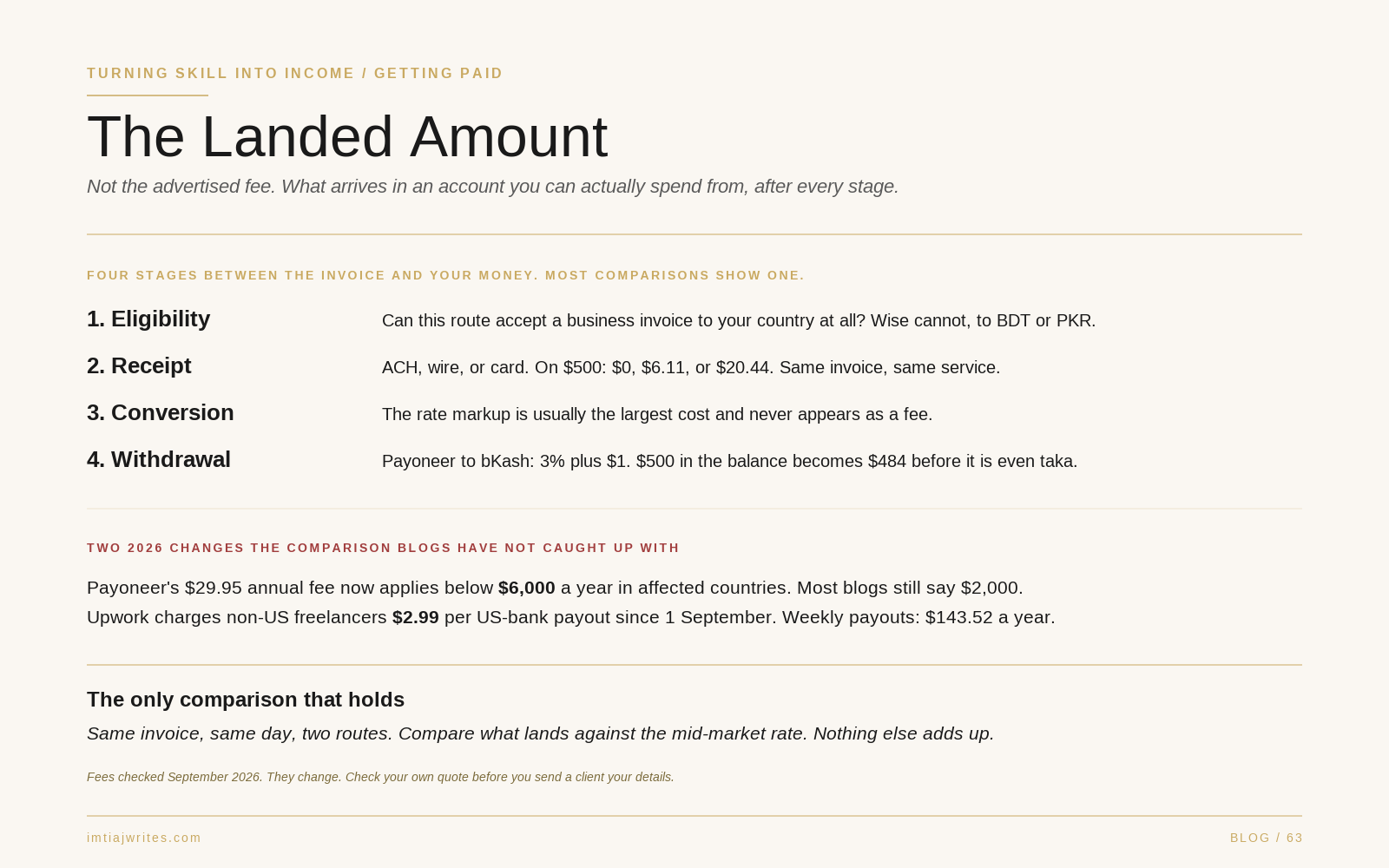
Stage one: eligibility, before any price
The single biggest error in Payoneer vs Wise comparisons is putting a route in the price table that you can’t use.
Two things get confused. Having a Wise account with receiving details is one thing. A client using Wise to send money to your ordinary local bank is another. A country can support one and not the other, and a personal remittance route doesn’t necessarily accept a business invoice.
Here’s what Wise’s own documentation says about the six countries this post covers:
Bangladesh. Wise’s BDT guide explicitly excludes business transfers to taka. A low personal-remittance quote isn’t an alternative for a writing invoice, however cheap it looks.
Pakistan. Wise’s currency directory excludes business payments to PKR. Same conclusion.
India. Wise offers a business receiving workflow with automatic INR settlement. It works, but it isn’t a foreign-currency holding balance, and it comes with documentation fees and tax I’ll get to.
Philippines. Wise publishes local business pricing with a setup fee and different receipt charges for domestic ACH versus wire. Fully available, with a startup cost.
Indonesia. Wise’s IDR guide supports transfers to individual and business accounts. The restriction is on business transfers from IDR, which is a different direction and irrelevant to receiving.
Vietnam. Transfers to individual and business accounts are supported, with some bank exclusions. That doesn’t establish eligibility for a resident holding account.
Payoneer’s coverage is broader across all six, but “available in your country” doesn’t mean every collection and withdrawal feature is active on every account. Check yours, not the country page.
The rule: if a route can’t accept your invoice, it doesn’t belong in your comparison, no matter how good its fee looks.
Stage two: receipt, where the client’s bank decides your fee
Once you’ve established what’s eligible, the next fee is set by how the client pays, and it’s larger than most people expect.
These are calculations from the published schedules, not test transfers, and they stop at receipt. No conversion, no withdrawal, no setup fee yet.
| Receipt method | On $100 | On $500 |
|---|---|---|
| Wise Philippines Business, domestic USD ACH | $0 | $0 |
| Wise Philippines Business, USD wire/SWIFT | $6.11 | $6.11 |
| Payoneer, non-local-currency receiving account, 1%, min $1 | $1.00 | $5.00 |
| Payoneer, client pays by card, up to 3.99% + $0.49 | $4.48 | $20.44 |
Read the last two rows together. Same service, same $500, and the difference between a receiving-account payment and a card payment is $15.44. That’s not a Payoneer-versus-Wise question. It’s a “which button did the client press” question, and it’s decided before you’ve touched the money.
Which is why the payment instruction you send is a fee decision. Better English is supposed to preserve the commercial agreement, not smooth it away:
❌ Please send a bank transfer for the invoice.
✅ Please pay invoice 0412 in USD using the ACH details on the invoice, rather than a wire. Include the invoice number as the reference.
The first sounds fine and removes the distinction that controls the fee. The second names the route. Only send it if your account details genuinely support that client’s ACH payment; a wrong instruction is worse than a vague one.
Stage three and four: the local examples the tables leave out
This is where a generic comparison stops and where the money actually goes.
Bangladesh: the Payoneer-to-bKash leg. bKash publishes the fee for withdrawing from Payoneer: 3% conversion plus $1 per transaction, within its limits. It also states that the 2.5% government remittance incentive does not apply to this route. Using that published fee:
| In your Payoneer balance | Withdrawal charge | Remaining, before conversion to taka |
|---|---|---|
| $100 | $4 | $96 |
| $500 | $16 | $484 |
| $1,000 | $31 | $969 |
Those are arithmetic from the published rate, not quoted receipts, and they don’t include whatever it cost to get the money into Payoneer in the first place. The distinction that matters: “I invoiced $500” and “I have $500 in Payoneer” are different starting points, and both are different from “I have taka.”
India: the documentation fee and the tax on the fee. Wise’s Indian business receiving documentation specifies a $2-equivalent settlement and e-FIRC charge. Its regional pricing states 18% GST applies to the conversion and e-FIRC fees, not to the invoice. With a hypothetical $7 conversion fee, that’s ($7 + $2) × 1.18 = $10.62. A fee model, not a universal price, and nothing to do with your income tax.
Philippines: the setup cost. Wise Philippines Business lists PHP 1,400 for setup and account details. Spread over 12 payments, that’s PHP 116.67 each; over 24, PHP 58.33. It’s a one-time cost you’re allocating for planning, not a deduction on every receipt. Whether it’s worth it depends entirely on whether you’re taking one overseas assignment or twelve.
Two 2026 changes, and the number the blogs got wrong
Payoneer’s annual fee moved, and the internet didn’t notice. Payoneer’s support page states that in affected countries, including all six here, a $29.95 annual account fee applies if twelve months pass with receipts below $6,000, effective 23 February 2026. Almost every third-party comparison I checked, including ones dated July and August 2026, still says the threshold is $2,000. That’s the old rule. A freelancer earning $4,000 a year through Payoneer who trusts a comparison blog thinks they’re clear and gets charged.
Here’s what $29.95 means at low volumes:
| Receipts over 12 months | Annual fee as share |
|---|---|
| $300 | 9.98% |
| $1,200 | 2.50% |
| $4,800 | 0.62% |
That’s the annual fee alone, before any transaction cost. The same support page notes a one-time $39.90 upgrade from Lite to Premium waives the fee for twelve months, which is worth knowing if you’re near the threshold, and worth checking against your own account, since plan exceptions apply.
Upwork’s US-bank payout stopped being free for you. From 1 September 2026, Upwork charges $2.99 per Direct to US Bank withdrawal for freelancers with a non-US tax address. A receiving service’s free ACH doesn’t remove that upstream charge. One payout a month: $35.88 a year. Four a month: $143.52. The $107.64 difference is real, but so is the delay in accessing your money if you batch. It’s a trade-off, not a rule.
The only comparison that holds
Everything above is stages. Here’s the method that puts them together, and it’s the opposite of what the comparison blogs do.
Don’t add up advertised percentages. Start from the end: the final amount in local currency, in an account you can spend from.
Take one real invoice. Get a quote from each eligible route on the same day. Note the final local credit, any extra destination charges, and anything the client paid on top. Then compare each landed amount against the mid-market rate at the time of the quote.
That single comparison captures fees and exchange-rate markup together, without counting conversion twice. It matters because the rate markup is usually the largest cost and never appears as a fee. Payoneer’s own withdrawal page says the applicable conversion fee is included in the rate it shows you, which means you can’t see it as a line item. You can only see it by comparing the landed amount against what the mid-market rate would have given you.
One trap in that comparison, and it’s the one that makes “cheaper” claims dishonest:
A $1,000 invoice. Route A lands $980 and the client pays nothing extra. Route B lands $990 and the client pays a $10 fee. You keep more under B. But the total cost is $20 either way. Part of the fee moved to the client. It didn’t disappear. That might be a perfectly good arrangement, and it’s worth negotiating, which is why the payment conversation belongs in the pricing conversation from how much copywriting costs. But describe it accurately. A fee you’ve shifted is not a fee you’ve saved.
Agree who pays before you invoice:
The fee for this project is USD [amount]. Could we confirm whether your team will cover the payment-processing fee, or whether it comes out of my invoice? I’ll note the agreed arrangement on the invoice.
That’s a question, not a surcharge, and the options available depend on the method and service.
The honest limit
I didn’t execute transfers for this post, and I didn’t obtain account-specific quotes, so nothing here is a measured saving. The tables are arithmetic from published schedules, and published schedules disagree with themselves: Payoneer India’s pricing page and its invoice-payment page list different card rates (2.90% and 3.20% plus $0.49), and Fiverr’s general withdrawal page and its Payoneer setup page list different payout fees ($1 and $3). Where the official sources conflict, I’ve recorded the conflict rather than picking a number. Unknown costs are unknown, not zero.
And the fees move. The Payoneer threshold changed in February. Upwork’s changed in September. Whatever you read here in three months, check it against your own account’s fee page before you send a client your details.
What survives all of that is the method. Eligibility first. Then the four stages. Then one real invoice, two quotes, same day, compared at what lands. That’s the comparison, and it’s the only one that’s ever been yours rather than a blog’s.
Frequently Asked Questions
Is Wise or Payoneer cheaper for freelancers in Asia?
It depends on the country, the payment method, and the withdrawal route, and in some countries only one is available for a business invoice. Wise excludes business transfers to Bangladeshi taka and Pakistani rupees. Where both work, the receipt method (ACH versus wire versus card) often changes the fee more than the choice of service does. Compare the final landed amount on a real invoice rather than advertised percentages.
Can I use Wise to receive freelance payments in Bangladesh or Pakistan?
Not for business invoices. Wise’s own documentation excludes business transfers to BDT and PKR. A personal remittance quote to those currencies is a different route and doesn’t apply to a writing invoice, so it shouldn’t be compared as if it were an alternative.
What is the Payoneer annual fee threshold in 2026?
In affected countries, including Bangladesh, Pakistan, India, the Philippines, Indonesia, and Vietnam, Payoneer charges $29.95 if twelve months pass with under $6,000 in receipts, effective 23 February 2026. Many comparison sites still cite the old $2,000 threshold. A one-time $39.90 Lite-to-Premium upgrade waives the fee for twelve months, subject to account and plan exceptions.
Why is the exchange rate markup not shown as a fee?
Because services like Payoneer build the conversion cost into the rate they display rather than listing it separately. Payoneer’s withdrawal page says the applicable fee is included in the shown rate. The only way to see the true cost is to compare the amount that lands against the mid-market rate at the time of the quote.
Should I ask clients to cover payment fees?
You can ask, and the conversation belongs alongside the rate discussion. But describe it accurately: if a client pays a $10 fee so you receive $10 more, the total transaction cost is unchanged. The fee moved; it didn’t disappear. Whether that’s acceptable is a commercial arrangement, not a saving.
Where to go next
👉🏼 For the rate conversation the fee conversation belongs inside, see how much copywriting costs in 2026.
👉🏼 For the payment-instruction language that preserves the agreement, see cold outreach templates and teardowns.
👉🏼 For pricing against the client’s market rather than your own, see copywriting rates by region.
👉🏼 For landing the client whose invoice this is, see your first copywriting client.
Eligibility, receipt, conversion, withdrawal. Compare what lands. The rest is a blog’s number, not yours.
