
The pattern I see most often when non-native writers ask about pricing is that they’ve already looked up copywriting rates by region, found a table showing their country near the bottom, and quietly set their rate to match it. Bangladesh: $8 to $15 an hour. Philippines: $8 to $18. India: $15 to $25. They read those numbers as a ceiling.
Here’s what almost nobody tells you about those tables. Most are estimates. Some say so in small print. The rest don’t say so at all.
Regional rate data does exist, but it’s uneven, and the important questions are ones the tables never answer: what did each source measure, when was the data collected, and whose work does it represent. A table without those details tells you less than it appears to. So this post shows you the benchmarks that have a real survey behind them, with those details attached, and is honest about the markets where nobody has measured anything. Then it explains the rule I actually price by, quoting my own freelance work from Shenzhen to clients in Europe and North America.
Copywriting rates by region: verified benchmarks available in 2026
Sources checked 15 September 2026. These are published survey benchmarks, not guaranteed quotes. Publication year and the period the data covers are shown separately, because they’re often different.
| Market | Type of writing | Published rate | What the figure is | Source and data period |
|---|---|---|---|---|
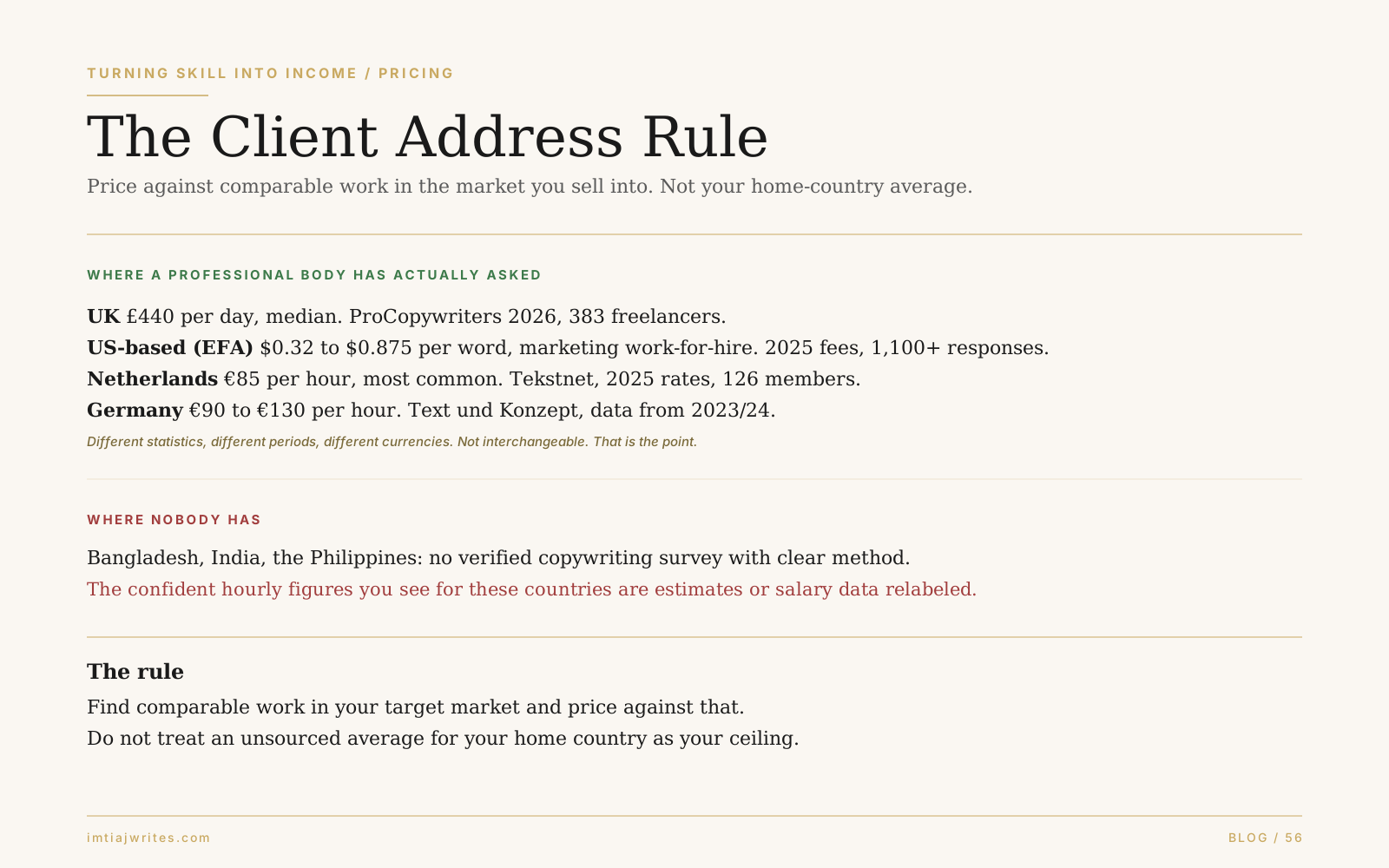
| United Kingdom | Freelance copywriting | £440 per day | Median day rate, not the mean | ProCopywriters Survey 2026, released July 2026, 383 freelance respondents |
| US-based (EFA) | Business/marketing writing, work-for-hire | $65 to $75 per hour; $0.32 to $0.875 per word | Published range for this category | EFA 2026 Rate Chart, fees charged in 2025, 1,100+ responses across editorial professions |
| US-based (EFA) | Business/marketing ghostwriting | $87.50 to $125 per hour; $0.50 to $1.00 per word | Separate category from work-for-hire | EFA 2026 Rate Chart, 2025 fees |
| US-based (EFA) | Ghostwritten blog posts | $75 to $100 per hour; $0.25 to $0.40 per word | Blog ghostwriting only, not a general commercial-copy benchmark | EFA 2026 Rate Chart, 2025 fees |
| Netherlands | Freelance text professionals incl. commercial writing | €85 per hour (most common); €83.37 mean | Most frequently charged rate, excluding VAT | Tekstnet Tarievenmonitor, 2025 rates, published 2026, 126 member responses |
| Germany | Freelance text and concept services | €90 to €130 per hour; €110 average | Association-reported range and average | Berufsverband Text und Konzept, Marktmonitor 2025, announced Feb 2025. Underlying data from 2023/24 |
These figures come from different surveys and are not interchangeable. A median day rate, a most-frequently-charged hourly rate, and a category-specific per-word range describe different things. Hourly and per-word figures are alternative ways respondents reported charging, not conversions of one another.
Two notes on what these sources are. The EFA is a US-based international association, so its chart is a benchmark of its members, not a representative survey of all American copywriters. And the sample sizes above are respondent counts, not market censuses. ProCopywriters had 573 total responses, of which 383 were freelancers. Tekstnet had 126. These are the best data available, and they’re still small.
Additional regional evidence, with the caveats attached
These add coverage but aren’t equivalent to association surveys of copywriters specifically.
France. Malt’s live rate barometer shows experienced copywriters active on the platform averaging €411 per day. That’s a platform benchmark of Malt users in the preceding three months, not a national survey.
Southern Africa. Safrea’s 2026 Rates Report, from 413 responses collected across 2025 and early 2026, gives the most common band for general nonfiction writing as R400 to R500 per hour, and R600 to R900 for technical or specialist content. Its categories are broader than copywriting, so neither figure is “the South African copywriting rate.”
Australia. Community-published rate recommendations exist, but the page doesn’t clearly date its polling, so I’m not presenting it as a 2026 survey just because it’s online today.
Bangladesh, India, the Philippines. I could not find a recent, publicly documented national copywriting rate survey with a clear method for any of these. That’s a limit of the research, not proof that none exists. But it means the confident hourly figures you see for these countries are estimates, or salary data relabeled as freelance rates, or one platform’s self-reported numbers. I’d rather leave the cell empty than fill it with a number I can’t source.
Where the estimates come from
Go looking for the country tables I opened with and trace them back. One widely copied index states that North American rates run about 4.2 times South and Southeast Asian rates, and adds in the next sentence that all figures are estimates. That honesty is rare. Most sites lift the table and drop the disclaimer.
Payoneer’s Freelancer Insights Report, the other source that gets cited everywhere, surveyed over 2,000 freelancers across 122 countries. It’s a real report, but it covers developers, designers, and every other freelance category. It isn’t a copywriting benchmark and shouldn’t be used as one.
So when someone hands you a confident rate for Bangladeshi or Indian copywriters, ask which survey it came from. Usually there isn’t one.
The rule that matters more than the table
Here’s the thing the table can’t tell you, and it’s the reason I’d rather you remember one sentence than six rows.
A regional average tells you what respondents in that region reported charging. It doesn’t tell you who they were charging, or what the work was, or whether the respondents’ clients were down the street or on another continent. A Dhaka average, even a rigorous one, is not a price for your work. It’s a summary of other people’s.
The Client Address Rule is what I price by: find comparable work in the market you’re selling into, and price against that. Don’t treat an unsourced average for your home country as your ceiling.
A client buying copy for a UK campaign is buying a deliverable in the UK market. That client can compare your landing page with other landing pages, which is the comparison you want. What it costs you to live is your business, not theirs, and your postcode isn’t on the invoice.
❌ I’m based in Bangladesh, so my rates are lower than you’d pay a UK writer.
✅ Landing page copy, up to 600 words with one revision round, is £X. Here are three I’ve done in your sector.
The first sentence hands the client a discount they didn’t ask for and a reason to expect less. The second prices the deliverable against comparable work and moves straight to proof. Same writer, same work, one of them has cut their own rate by half before the conversation started.
The discount you’re applying without noticing
There’s a line in a US employer-facing rate guide I want to quote, because your clients are reading it. It says rates below ten cents a word “generally reflect either very junior writers, content mills, or non-native English speakers writing for volume rather than quality.”
Read that as a non-native writer and notice what it does. It sorts you into the discount bin by birthplace, alongside content mills, before anyone has read a sentence you wrote. That framing exists in the market. Some clients carry it.
When you set your rate to a home-country estimate, you’re confirming it. Every regional anchor is a small act of agreement with the person who wrote that sentence.
The writers I see break out of this don’t argue with the framing. They price against comparable work in the target market and let the output refute it. A client who pays a UK median day rate and gets UK-standard work doesn’t care where the writer lives. A client who pays $12 an hour gets the attention $12 buys, and the guide’s prophecy fulfils itself. I laid out why hourly pricing punishes you in how much copywriting costs, and the regional trap is the same mechanism with a passport attached.
What to actually do with this
Anchor to the target market, using the surveys that exist. Selling into the UK, use ProCopywriters. The US, EFA’s category that matches your work, not the blog figure for everything. The Netherlands, Tekstnet. Germany, Text und Konzept, remembering its data is from 2023/24. For markets without a survey, find published rate cards from established writers in that market and price against comparable deliverables.
Don’t lead with location. Don’t hide it either. Your address is on your invoice and probably your profile. Concealing it looks like you think it’s a problem. Leading with it makes it one. It’s a neutral fact that surfaces when it surfaces, and by then the client has seen your work.
Price the deliverable, not the hour. Hourly rates invite the regional comparison directly, because a client can search “hourly rate Bangladesh” in ten seconds. A project price for a landing page gets compared against other landing pages.
Expect the occasional pushback, and don’t fold. Some clients, on learning where you’re based, will try to renegotiate. That’s a client telling you they were buying your postcode. Most aren’t.
Know what the arbitrage is worth, and don’t apologize for it. Target-market rates earned from a lower-cost location are a real advantage, and there’s nothing dishonest in it. The client pays what the deliverable is worth to them. That gap is the whole reason global freelancing works, and it’s the same gap a London writer would enjoy by moving to Lisbon.
The honest limit
All of this assumes your work can compete in the target market. If it can’t yet, if the English is still hitting the translated ceiling, then target-market pricing buys you a client who’s disappointed at target-market prices, which is worse than a cheap client who’s satisfied.
So the sequence matters. Fix the writing first, and most of what marks copy as non-native is a specific, learnable set of patterns, which I mapped in the three mistakes that mark non-native copy. Then price where you sell. The other way round is how writers get one expensive client and no second one.
The regional tables will keep ranking, and most will keep being estimates. The benchmarks above are the ones with a method behind them. The rule is the thing to keep.
Frequently Asked Questions
What are copywriting rates by region in 2026?
From sources that publish their method: UK freelance copywriters report a median day rate of £440 (ProCopywriters 2026, 383 freelancers). EFA members report $0.32 to $0.875 per word for marketing work-for-hire and $0.25 to $0.40 for ghostwritten blog posts (2025 fees). Dutch text professionals most commonly charge €85 per hour (Tekstnet, 2025 rates). German text and concept freelancers report €90 to €130 per hour (Text und Konzept, data from 2023/24). No verified copywriting survey with clear method was found for Bangladesh, India, or the Philippines.
Should I charge based on where I live or where my client is?
Price against comparable work in the market you’re selling into. A regional average for your home country summarizes what other respondents there reported, not what your deliverable is worth to a client in London or Amsterdam. Don’t treat an unsourced home-country figure as your ceiling.
Are freelance writers in Asia really paid four times less than in North America?
The widely cited 4x figure comes from an index that explicitly labels its numbers as estimates. Real gaps exist, but there’s no rigorous copywriting-specific survey comparing regions, and the comparison doesn’t tell you what an international client pays for the same deliverable.
Should I tell clients I’m based in a lower-cost country?
Don’t lead with it and don’t hide it. Your location is a neutral fact that surfaces on invoices or profiles. Volunteering it early invites a discount you didn’t need to offer. Concealing it signals you think it’s a problem. Let the work land first.
Is it fair to charge Western rates from a lower-cost country?
Yes. The client pays what the deliverable is worth in their market, which is what they’d pay a local writer for comparable work. Your cost of living is your business. The gap is the same one a London writer would gain by relocating somewhere cheaper, and nobody calls that unfair.
Where to go next
👉🏼 For the pricing models that matter more than any regional figure, see how much copywriting costs in 2026.
👉🏼 For which work commands target-market rates, see copywriting vs content writing.
👉🏼 For fixing the writing before you price it, see the three mistakes that mark non-native copy.
👉🏼 For landing the first client at the right rate, see your first copywriting client.
Four surveys with a method. Several markets with none. One rule: price against comparable work where you sell.
