
You’ve probably been told the same thing by every teacher, editor and productivity thread: read more. So you do. You read newsletters, long-form articles, the copy of brands you admire. You highlight the phrases that sound good. Some of them go into a notes file.
Then you open your own draft, and it reads exactly the way it did before.
That isn’t a reading problem. It’s an assignment problem. Most of us were taught to read for one task: understand the text, then prove we understood it. Learning to read like a writer means giving yourself a different task. Instead of asking what the text says, you ask how the passage does its job, and which of its decisions could help with yours.
This post is about that second task: what it looks like on real public writing, how to take a decision out of a passage without taking its facts, and how to tell whether you’ve actually learned something or just collected it.
What “read like a writer” actually means
The idea isn’t mine, and it isn’t new. Mike Bunn’s chapter How to Read Like a Writer, published in Writing Spaces in 2011, starts from a simple point: all writing is a series of choices, and a reader can learn to spot them, ask why they were made, and try them in their own work.
Bunn wrote that chapter for students. So the “not a student” in this title isn’t about who you are. It’s about the job you give yourself while reading.
A student’s assignment: What does this passage mean?
A writer’s assignment: How does this passage work for its reader, and which choice could I test in my own writing?
The second doesn’t replace the first. If you misread a condition or a pronoun, you can’t analyse what the sentence is doing. Understanding comes first. It just shouldn’t be where you stop.
Here’s the working definition this post uses:
Reading like a writer means understanding a passage, finding the choice that makes it work for its situation, and testing that choice on your own facts.
The difference shows up in your notes
A typical reading note looks like this:
❌ “Great flow. Sounds very native.”
✅ “The writer states the exception right after the promise, so I never have to revise what I thought the offer was.”
The first note is a feeling. You can’t act on it, and it quietly measures the text against a “native” standard nobody can define. The second note names something you can see, says what it does for the reader, and gives you something to try tomorrow.
When you read for writing, you’re reading at three levels at once:
👉🏼 Language: which words combine, and what the phrase means here. “Confirm the date in writing” is worth saving as a whole, because the combination has a clear professional job.
👉🏼 Function: what the sentence or paragraph is doing. It might define a term, state a condition, answer an objection, separate two options, or tell the reader the next step.
👉🏼 Situation: who is reading, what they already know, and what they need to do next. The same phrase can work in a project chat and fail in a first email.
Most of us only read at the first level, which is why a notebook full of nice phrases doesn’t change the draft. The phrases arrive without their jobs.
Four public examples, read like a writer
Here’s what the method looks like on writing you can open and check yourself. For each one: what’s visible on the page, what it does for the reader, and how the choice transfers to a different task. The transfers are my own invented examples, not quotes from the sources.
Stripe: give a technical term a consequence
Stripe’s API documentation explains idempotency as a way of safely retrying requests “without accidentally performing the same operation twice”.
What I can see: the unfamiliar term sits right next to a problem the reader already understands (charging someone twice).
What it does: the reader gets a reason to care before they get the mechanics.
How it transfers: in a fictional editorial workflow, “A version label tells reviewers which draft they’re approving, so feedback on an older file doesn’t become an instruction for the current one.”
The lesson isn’t “remove technical terms.” Stripe keeps the term. It just never leaves the term alone.
GOV.UK: Reassure by stating the facts, not the feeling
The GOV.UK Design System’s pattern for service-problem pages gives two versions of the same message. One says “We saved your answers. They will be available for 30 days.” The other says “We have not saved your answers. When the service is available, you will have to start again.”
What I can see: the wording changes depending on what actually happened to the user’s work.
What it does: it answers the one question an apology leaves open: did I lose everything?
How it transfers: this is where a lot of business writing in a second language goes wrong, because politeness gets treated as the safe default.
❌ “We are sorry for the inconvenience caused. Please be assured that we are working diligently to provide you with a smooth experience.”
✅ “Your submission didn’t go through. Your answers are saved for seven days, so you can come back and submit again before then.”
The first version sounds caring and tells the reader nothing. The second states what happened, what survived, and what to do. (The seven days is a fictional fact for this example. Never borrow a retention period you haven’t confirmed.)
Smitten Kitchen: tell the reader how they’ll know a step is done
A recipe from Deb Perelman’s baked feta with tomatoes and chickpeas doesn’t just give a time. It tells you to cook “until tomatoes begin to release some juices.”
What I can see: the instruction is paired with something the cook can observe.
What it does: the reader knows when the step is finished, even if their oven runs hot.
How it transfers: a recipe and a software tutorial share the same problem. How does the reader know the step is done?
❌ “Please wait for the export process to be finalized before proceeding further.”
✅ “Keep the export window open until the status reads Complete. Closing it earlier cancels the export.”
You’re borrowing the function of the cue, not the recipe’s words or timing. And the cue only works if the real system actually shows a status called Complete.
A writer who says “I try” instead of “you must”
Paul Graham’s essay Write Simply opens with a personal practice: “I try to write using ordinary words and simple sentences.” He doesn’t open with “all writers must.”
What I can see: a bounded first-person statement, followed by his reasons.
What it does: it lets the reader examine a position instead of being handed a rule.
When I’d reject it: in a procedure or an error message, nobody needs the writer’s philosophy. They need the next step. A reasoned “I wouldn’t use this here” is a successful exercise, not a failed one.
That last point matters more than it sounds. Learning a technique includes learning where it stops working.
Borrow the function, keep the facts
Here’s the trap a lot of before-and-after examples fall into: the “better” version quietly gains new information. A stronger offer, an invented deadline, a confident result. Then you can’t tell whether the improvement came from the writing or from the extra facts.
So when you test a choice you’ve borrowed, fix the facts first. Write down the actor, the action, the deadline, the conditions and what you don’t know. Then rewrite, and check that nothing on that card changed.
Take a simple handover note. The facts: there’s a deadline in the client’s brief, it may have changed, and any change must be confirmed in writing before the proposal goes out.
❌ “It is important to ensure that all the necessary considerations regarding the deadline have been taken into account before the proposal is sent.”
✅ “Before you send the proposal, check the deadline in the client’s brief. If the date has changed, confirm it in writing.”
Now the version that sounds even better:
❌ “Check the deadline and send the proposal immediately.”
It’s shorter, more confident, and wrong. It adds urgency nobody asked for and drops the written confirmation entirely. This is the version a fluent writer, or an AI tool, will happily produce, and it’s why fact-checking your own rewrite is part of the method.
The same check protects you when someone tells you to “sound more natural.” Here’s a request to a client who must send an approved outline by Tuesday:
❌ “I would be most grateful if you could kindly provide the duly approved outline by Tuesday.”
✅ “Could you send the approved outline by Tuesday?”
❌ “Send over whatever you have when you get a chance.”
The middle version changes the tone. The last one changes the deal: “whatever you have” drops approved, and “when you get a chance” drops Tuesday. Being able to say which words are courtesy and which words are the agreement is exactly the judgment that makes your English sound natural instead of just casual. (It’s also why correct English and natural English aren’t the same thing as formal and informal.)
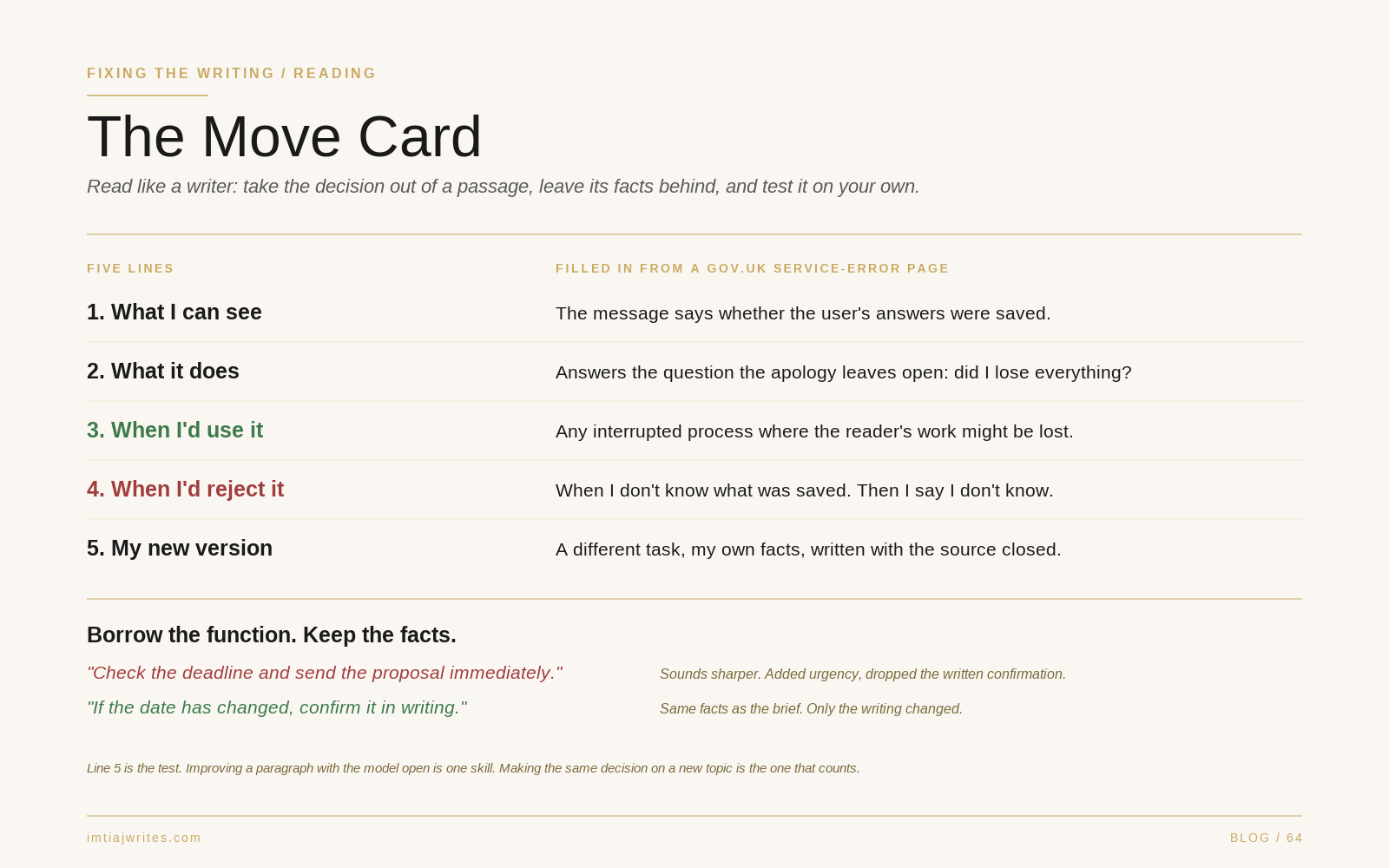
The Move Card: a reading note you can actually use
To read like a writer without turning every article into homework, keep one note per useful choice. Call it a Move Card. It has five lines:
1. What I can see: the words, order or omission, quoted or pointed to exactly.
2. What it does for the reader: a possible effect, not a guess about the author’s intention.
3. When I’d use it: the kind of task and reader it suits.
4. When I’d reject it: where it would mislead, delay or over-promise.
5. My new version: written on a different topic, with my own facts, with the source closed.
A filled-in card for the GOV.UK example:
| Line | Note |
|---|---|
| What I can see | The message says whether the user’s answers were saved. |
| What it does | Answers the question the apology leaves open. |
| When I’d use it | Any interrupted process where the user’s work might be lost. |
| When I’d reject it | When I don’t know what was saved. Then I say I don’t know. |
| My new version | A failed-upload notice for a client portal, written from the product brief. |
Line 5 is the one that matters. Close the source before you write it, then reopen it and compare. Improving a paragraph while the model sits next to you is one skill. Making the same decision on a new topic, without the model, is another. Only the second tells you the choice has become yours.
What the research supports, and what it doesn’t
Two findings shape this method.
First, wide reading still matters. A 2025 meta-analysis of extensive-reading research, “Learning a Language Through Reading”, found positive effects of sustained reading on second-language learning, writing included. So none of this means you should dissect every page you read. Keep reading for pleasure and information. Study a passage closely only when it’s solving a problem you have.
Second, guided attention beats “notice good writing.” A 2023 study of 60 Chinese university English learners, published in Frontiers in Psychology, found that model texts helped learners revise their writing, and that the benefit was still there a week later. It also found that learners mostly noticed vocabulary. That’s the gap the Move Card is built for. Collect the phrase if it helps, but also ask what the paragraph puts before the instruction, and why.
What the research doesn’t show is that this exact routine, used by working professionals, produces a measured improvement. These are classroom studies with defined tasks. The Move Card is my practical adaptation of what they point to, not a tested programme.
Where non-native writers trip up
Using a dictionary isn’t cheating. Look up a word when it blocks your understanding of the passage or matters to the choice you’re studying. Everything else can wait until after the first read.
Formal isn’t automatically wrong. Some situations need formal English: a first contact with an institution, a legal notice, a regulated message. The goal is the right register for the reader, not the most casual one.
Don’t pick models by who’s a native speaker. Pick them by the job they do well. A multilingual engineer’s clear technical explanation can be a better model for your product page than a famous native novelist. If you write for products, as I do in my second language for global tech brands, your most useful models are usually documentation, error messages and good product pages, not novels.
Don’t collect phrases without their jobs. A phrase written down without its sentence, its situation and its purpose is hard to use later. Pairings like “confirm in writing” or “applies to” are collocations, and they’re worth collecting because they come with a job attached.
Don’t confuse sounding confident with being accurate. A strong sentence from a famous brand isn’t evidence. Learn how it names the task. Don’t copy its claims.
Practising with AI without letting it do the reading for you
AI can help here, as long as you do the noticing first. If you ask a model to “rewrite this in the style of that article,” you’ll get a polished paragraph and learn nothing about why it works. This prompt keeps your own observation in the loop:
I’m practising reading like a writer for [your audience and task]. I’ll paste a short passage I’m allowed to share. First, ask me what it says and one choice I noticed. Wait for my answer. Then point to the exact words or order that support or challenge my observation, and separate what’s visible from what’s a guess about the author’s intention. Help me choose one decision to test in my own writing. Don’t write my example for me. After I write it, check whether I kept my facts, suited my reader, and applied the decision, or just copied the source’s style.
The model’s feedback can still be wrong. Treat it as a second opinion on your Move Card, not a replacement for it. If you want the structural side of this, how to edit AI copy so it sounds human covers the same “check the facts after the rewrite” habit from the other direction.
The honest limit
This method won’t make you sound native, and it isn’t meant to. It also won’t work on a passage you only half understand, which is why understanding comes first.
What it will do is change what you leave a reading session with: one decision you can explain, and one new paragraph that shows whether you can use it. If the paragraph doesn’t work, you’ve learned where the choice stops working. That counts too.
Pick one passage this week from writing you’d actually want to produce: a help page, a product email, a client proposal. Fill in one Move Card. Then close the tab and write line 5.
Frequently Asked Questions
What does it mean to read like a writer?
Reading like a writer means understanding a passage, finding the choice that makes it work for its reader, and testing that choice in your own writing. The idea comes from Mike Bunn’s 2011 chapter “How to Read Like a Writer,” which treats all writing as a series of choices a reader can learn to spot and borrow.
How is reading like a writer different from reading like a student?
A student usually reads to understand and remember what a text says. A writer reads to see how the text does its job and which decision could help their own work. The difference is the task you give yourself, not your status. Understanding still comes first.
Can reading like a writer help non-native English speakers write more naturally?
It can, if you read for more than vocabulary. Notice what a sentence does for its reader as well as which words it uses, then test that choice on your own facts. Naturalness comes from making the right decisions for the reader, not from copying phrases that sound native.
Should I copy sentences from writers I admire?
Copy the decision, not the sentence. Study how a writer states a condition, gives a completion cue or separates two options, then write your own version on a different topic with the source closed. Taking someone’s distinctive wording, ideas or personal experience still needs attribution, even if you change a few words.
Can AI help me read like a writer?
Yes, if you do the noticing first. Ask the AI to question your observation and check your new version, rather than rewriting your text in another writer’s style. Its feedback can still be wrong, so treat it as a second opinion.
Where to go next
👉🏼 For why the agreement words matter more than the tone words, see correct English vs natural English.
👉🏼 For a working definition of the target you’re reading toward, see what natural English actually means.
👉🏼 For the phrases worth collecting, and how to tell them apart, see collocations.
👉🏼 For editing your own draft in two separate passes, see the two-pass edit.
