
If you’ve ever applied for an in-house copywriting role and heard nothing back, the rejection probably wasn’t about your English. It was more likely about treating the application like a freelance pitch. The two processes look similar from the outside. They reward completely different things.
Most non-native writers rule out in-house copywriting jobs before applying. The reasoning sounds practical: “Native writers will get those roles anyway, so why bother.” That assumption is usually wrong.
In-house copywriting roles in 2026 pay anywhere from $40,000 to $130,000+ in the U.S., scale higher with seniority, and often care less about your accent than the average freelance client does. The catch is that companies hire differently from freelance buyers. They are not looking for someone who can write one good landing page. They are testing whether you can think inside a brand, work with a team, handle feedback, and communicate clearly over time.
The hiring process evaluates four specific things, and a generic application fails all four. Once you understand what each stage is testing, most of the disadvantage of being a non-native applicant disappears.
This post is the playbook. Four stages, in order, with the specific moves that work at each one.
Why in-house is worth considering
Before the playbook, a quick, honest take on the trade-off.
Freelancing gets a lot of attention because it sounds free. You pick your clients. You set your rates. You work from anywhere. All of that is true. So is the unpaid time chasing leads, the months when invoices stall, the lack of health insurance, and the lonely feeling of solving every problem alone.
In-house roles trade some of that freedom for things that matter when you are building a career. According to a 2026 industry analysis, in-house copywriter salaries in the U.S. range from $40,000 to $130,000+, depending on experience level, with senior roles regularly clearing six figures. Remote roles with U.S. and European companies pay similar rates to non-native talent in Latin America, South Asia, and the Middle East, often in the $1,500-$3,500 per month range for mid-level work, scaling higher with experience.
The bigger value, in my view, is the learning environment. You sit next to designers, marketers, product managers, and other writers. You see briefs land, and you see the campaigns that come out the other end. You get feedback on actual published work. The compounding of that exposure over two or three years usually exceeds what the same writer could absorb working alone, no matter how good the freelance clients are.
So if you have ruled out in-house because you assumed it was harder to get into as a non-native writer, the assumption is worth reexamining.
The pattern most non-native applicants fall into
The pattern I see most often when reviewing applications from non-native writers is this. The applicant treats the in-house hiring process the same way they treat a freelance pitch. They polish a portfolio, attach it to a CV, and apply through the company website / LinkedIn / job apps etc. Then they wait.
That approach works for freelancing because the freelance buyer is mostly one person making one decision. The in-house process is built differently. There are usually four people, four stages, and four different questions being asked. Sending the same generic application materials into all four stages is why most applications die at stage one or two.
The fix is to understand the four stages and prepare materials specifically for each one.
The framework: The Four-Stage Hiring Loop
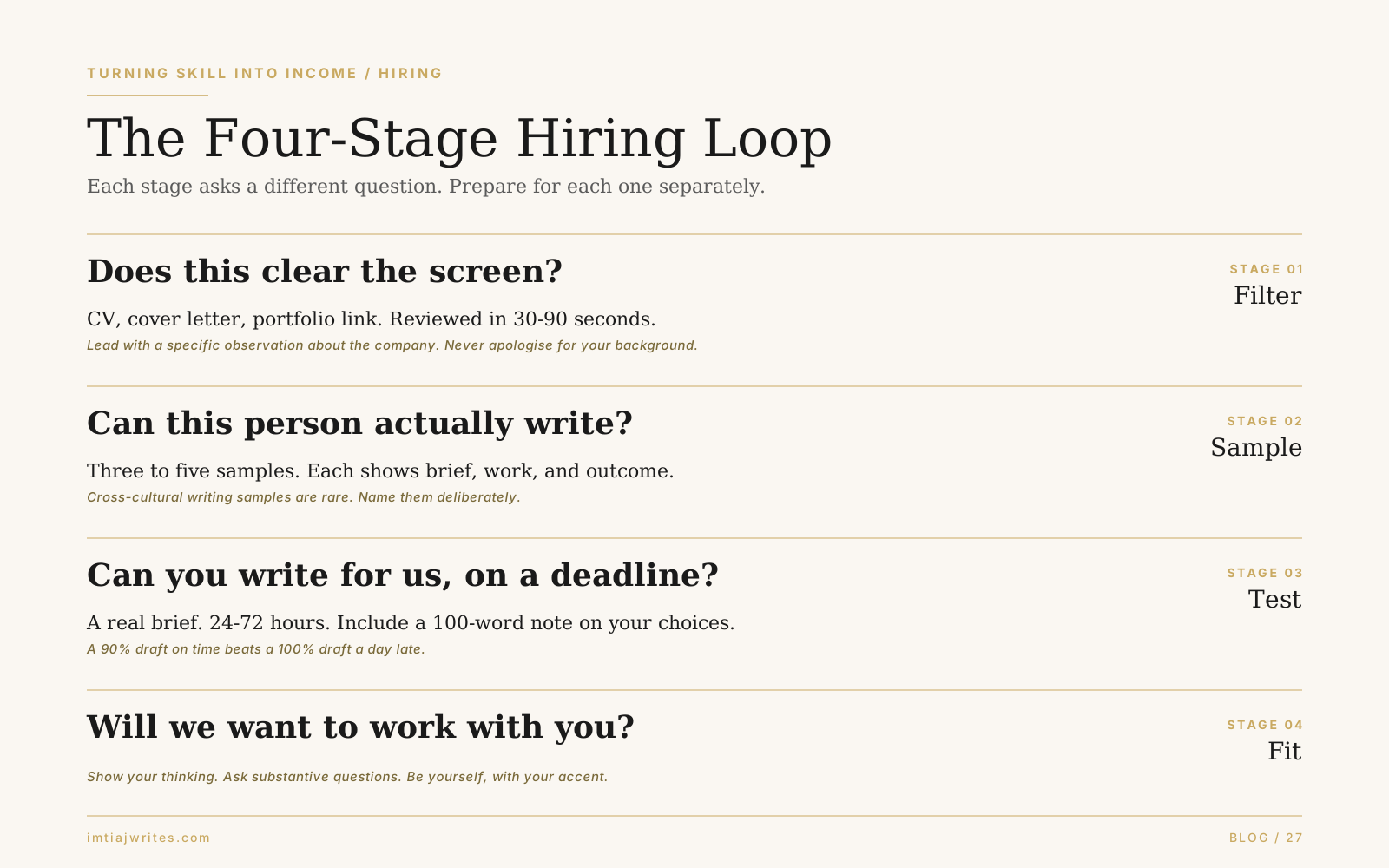
The in-house copywriter hiring loop has four stages. Every company structures them slightly differently, but the underlying questions being asked are remarkably consistent. Call this The Four-Stage Hiring Loop:
1. Filter. Does the application clear the initial screen?
2. Sample. Can the applicant actually write?
3. Test. Can the applicant write for us, with a brief and a deadline?
4. Fit. Will the applicant work well inside the team?
Each stage filters out a large percentage of applicants. The total funnel is brutal. A typical in-house posting might receive 200 applications, screen out 180 at the Filter stage, request samples from 20, give writing tests to 5-10, interview 3, and hire 1 or, sometimes, none! Knowing where in the funnel you are at each step changes how you prepare.
Stage 1: Filter (the application screen)
The first stage is mostly automated or semi-automated. A recruiter or an applicant tracking system reviews your CV, cover letter, and portfolio link or file in 30-90 seconds. The question is binary: does this application get a closer look or get passed over?
For non-native applicants, the Filter stage is where most rejection happens, and where the wrong assumptions cost the most. The instinct is to lead with origin, fluency claims, or apologetic language. All three hurt you here.
| ❌ Cover letter opening: As a non-native English speaker with five years of experience writing for Western clients, I am writing to apply for the Copywriter position at your company. Although English is my second language, I have worked hard to develop strong writing skills and would be honored to join your team. |
| ✅ Cover letter opening: I noticed your homepage copy targets enterprise SaaS buyers but your product page reads like it was written for indie developers. The disconnect probably costs you conversions on cold traffic. I have spent five years writing copy that holds register across exactly this gap, and I’d like to show you what a fix might look like. |
The first version asks for tolerance. The second demonstrates value. The recruiter scanning these in 60 seconds each will pass over the first one and pause on the second one. That pause is what advances you to Stage 2.
The Filter stage rewards three specific moves: lead with a real observation about the company, show one specific piece of evidence (a link, a metric, a sample), and never apologize for anything in your background. The evidence stage is where bias has the hardest time operating, because the work is right there to be evaluated.
For more on how to construct the kind of portfolio that survives this stage, see the post on the Proof Stack.
Stage 2: Sample (the portfolio review)
If you clear the Filter, a hiring manager (not a recruiter) opens your portfolio and reads three to five samples carefully. They are looking for two things: can this person write, and does the writing match the kind of work the role requires?
This is the stage where having a thoughtfully curated portfolio matters more than having a long one. Three strong samples beat ten mixed ones. Each sample should answer three questions in 30 seconds:
➡️ What was the brief?
➡️ What did you write?
➡️ What outcome did the writing produce?
Most non-native portfolios I see show only the second question. They are galleries of finished pieces with no context. The hiring manager reads the work, has no idea why it was written that way, and cannot tell whether the choices were strategic or accidental. That ambiguity is what kills the application at Stage 2.
The fix is small but consistent across every sample:
| ❌ Sample heading: Email Campaign for Client |
| ✅ Sample heading: Re-engagement email sequence that lifted dormant trial users to paid by 18%. The brief was to win back trials that had gone quiet for 30+ days. I led with a specific feature most users had never tried, instead of the generic “we miss you” opener. Three emails over five days. View the sequence here. |
The second version takes 90 seconds to write and 20 seconds to read. It tells the hiring manager you can think strategically, you understand outcomes, and you can communicate your reasoning clearly. All three are skills they need.
For non-native writers, this stage has one advantage worth using deliberately. If your portfolio includes work for Western brands targeting non-Western markets, name it. The hiring manager scanning your samples is mostly looking at native portfolios that all target the same audience. A portfolio that demonstrates genuine cross-cultural writing is rare and remembered.
Stage 3: Test (the assignment)
If you advance past the Sample stage, you usually get a paid or unpaid writing test. A real brief, a real deadline, usually 24-72 hours. This is where the actual hiring decision often gets made.
The Test stage tests four things at once: writing skill, brief comprehension, ability to ask the right clarifying questions, and judgment under time pressure. Most applicants focus only on the first one. The other three are where you can win.
Brief comprehension. Read the brief twice before writing. Mark anything ambiguous. The applicants who turn in beautiful copy that misses the brief are eliminated immediately. The applicants who turn in average copy that nails the brief often advance.
Clarifying questions. Most briefs have at least one important detail missing. Send 1-3 short, smart questions before you start writing. Ask things that show you are thinking about the audience, the channel, or the business goal. Do not ask questions you could answer yourself with five minutes of research. The questions you send signal how you will work on the team.
Judgment under pressure. Submit your draft on time, even if you would have liked another day. Late submissions get downgraded heavily, because the in-house environment runs on deadlines. A 90% draft delivered on time beats a 100% draft delivered a day late.
For non-native writers, there is one specific move that helps at this stage. After your draft, include a brief 100-150-word note explaining the choices you made. What angle did you choose and why? What you would test against this version. What you would change if the audience expanded or shifted. That note demonstrates strategic thinking and frames any small language imperfections in the draft as deliberate craft choices, not gaps in fluency.
For the prompting and editing workflow that produces stronger drafts under deadline pressure, see the AI writing stack post.
Stage 4: Fit (the interview)
The final stage is one or two interviews focused on cultural and team fit. By this point, the company has decided you can write. They are now deciding whether they want to work with you for the next two or three years.
This is the stage where many non-native applicants underperform, not because of language but because of mindset. The instinct is to perform a version of yourself that sounds maximally Western, maximally professional, maximally polished. Hiring managers see through this immediately, and it makes you forgettable in a stage where being memorable is the entire point.
Three things actually matter at the Fit stage:
Show your thinking. When asked about a past project, walk through the decision-making process, not just the outcome. The hiring manager wants to see how you approach problems. A specific story about a brief that went sideways and how you handled it is worth more than three generic success stories.
Ask substantive questions. The questions you ask are at least as important as your answers. Ask about how the team handles disagreement on copy decisions. Ask what the previous person in this role found hardest. Ask what success looks like in the first 90 days. These questions signal that you think like a colleague already.
Be yourself, with your accent. If the interview is on video, you will speak with your accent. That is fine. The hiring managers who care about that have already self-selected out of considering your application. The ones who got you to Stage 4 have read your work, seen your test, and want to know who you actually are. Pretending to be someone else at this stage is the most common mistake, and it is the one that loses offers most often.
The honest part about bias
I will not pretend bias does not exist. The 2022 Spence et al. meta-analysis on accent bias in hiring (cited in the personal branding post) found measurable effects, particularly at the interview stage. That research is real and the effects are not zero.
What I will say is that the four-stage process described here is structured in a way that minimizes the impact of bias at each step. Stage 1 (Filter) and Stage 2 (Sample) reward written evidence, where bias has less room to operate. Stage 3 (Test) is graded against the brief, not against the writer. Stage 4 (Fit) is the only stage where in-person bias has full surface area, and by then the company has already committed substantial time to evaluating you. Reaching Stage 4 means the company has decided your work is worth their time, which changes the dynamic of the conversation in your favor.
The companies most likely to hire non-native copywriters in 2026 are the ones that are themselves operating across markets: SaaS companies with global user bases, e-commerce brands selling internationally, agencies serving multinational clients. These companies have the most to gain from cross-cultural writing skill, and their hiring managers know it. Target them deliberately.
Where to go next
If you are preparing your application materials this week, focus on the Filter stage first. Rewrite the opening line of your cover letter to lead with a specific observation about the company instead of with your background.
➡️ For the portfolio structure that wins at Stage 2, see the Proof Stack post.
➡️ For the writing workflow that produces stronger Stage 3 test submissions under deadline, see the AI writing stack post.
➡️ For the personal branding sequence that supports your application copy, see the personal branding post.
➡️ For the diagnostic on the writing itself, the Natural English Edit is the 15-pattern checklist with prompts to run on your own copy. Free.
Four stages. Four different questions. One application loop you can prepare for, win, and turn into a real career. That is in-house, done deliberately.
Frequently Asked Questions
Can a non-native English speaker get hired as an in-house copywriter? Yes — I did! And the path is structured enough to be repeatable. The hiring process has four stages: Filter (application screen), Sample (portfolio review), Test (writing assignment), and Fit (interview). Each stage rewards different preparation, and three of the four reward written evidence over in-person impression. Companies operating across markets are the most likely to value a non-native writer’s cross-cultural skill set.
What in-house copywriter roles pay in 2026? According to industry data, U.S. in-house copywriter salaries range from $40,000 for entry-level to $130,000+ for senior roles. Remote roles with global companies typically pay $1,500-$3,500 per month for mid-level non-native talent in regions like Latin America, South Asia, and the Middle East, scaling higher with experience and seniority. Direct response and specialized writing roles often command premiums above the standard band.
Should I mention I am a non-native English speaker in my application? No. Lead with a specific observation about the company’s copy or business, not with your background. The Filter stage rewards evidence and specificity, not disclosure. Disclosure shifts the recruiter’s attention to your fluency before they have read your work, which is the wrong order. Your background can come up naturally in the interview if it is relevant.
What should my portfolio show for in-house copywriter roles? Three to five strong samples, each accompanied by a short brief, the work itself, and the outcome. Hiring managers reviewing portfolios at Stage 2 are looking for strategic thinking, not just polished writing. A portfolio that includes work targeting non-Western markets is particularly valuable for global companies, as that skill is rare.
How should I approach the writing test stage? Treat it as a brief, not a writing exercise. Read carefully, ask 1-3 smart clarifying questions before starting, submit on time even if you wanted longer, and include a brief 100-150-word note explaining your choices. The note demonstrates strategic thinking and is often the difference between two equally well-written submissions.
Does bias really affect non-native applicants at the interview stage? Yes, the research confirms it. A 2022 meta-analysis on accent bias in hiring decisions found measurable effects across 139 effect sizes. The four-stage process minimizes the impact at the earlier stages where written evidence dominates. By the time you reach the interview, the company has already committed time to evaluating you, which improves your odds significantly. Target companies operating across global markets, where cross-cultural writing skills are genuinely valued.
