
To find non-native writing patterns in your own work, you need to stop treating each mistake as a one-time slip. It’s not. Most of your “mistakes” are the same three or four patterns showing up in different sentences, week after week. Once you see which patterns are yours, you can fix them in one careful pass instead of twenty random ones.
That shift, from random fixing to pattern fixing, is the single biggest jump most non-native writers make once they leave the calibration phase. This post is the system for getting there.
Your patterns are not random. The data says so.
This is the part most non-native writers find hard to believe at first.
A 2018 paper by François Pichette and Justyna Leśniewska, published in the International Journal of Language Studies, updated a famous earlier finding by Rod Ellis. Looking at 34 separate studies of ESL writing errors, the authors found that 42% of all errors made by non-native English writers are caused by L1 transfer. That means the rules of your first language pushing into your English without your noticing.
The same paper points to a useful split (originally from Ferris, 1999) between two kinds of errors: treatable and untreatable. Treatable errors follow a rule. Once you spot the rule, you can apply it and fix every future case. Untreatable errors are deeper and need slow, gradual work. Most non-native writing patterns at the fluent level are treatable. They just need to be named first.
So the math is clear. Almost half of your “off” moments come from patterns you can identify and fix once. You are not making fresh mistakes every week. You are making the same five mistakes every week.
The Pattern Audit shows you which five.
A quick test using public copy
You don’t need a long client brief to see this. Pick any two paragraphs of professional English you know was written by a non-native speaker (a LinkedIn post, an About page, a product description from a non-Western tech company, anything publicly visible). Read it twice.
The first read is for meaning. The second read is for repetition. By the second read, you will almost always notice that the same kind of small wrongness shows up two or three times. The same preposition pattern. The same article skip. The same sentence rhythm that runs slightly long. Same small thing, different sentence.
That repetition is the pattern. And the same dynamic is happening inside your own drafts. The only reason it feels invisible in your own writing is that you read your drafts for meaning, not for repetition. The Pattern Audit fixes that gap.
The framework: The Pattern Audit
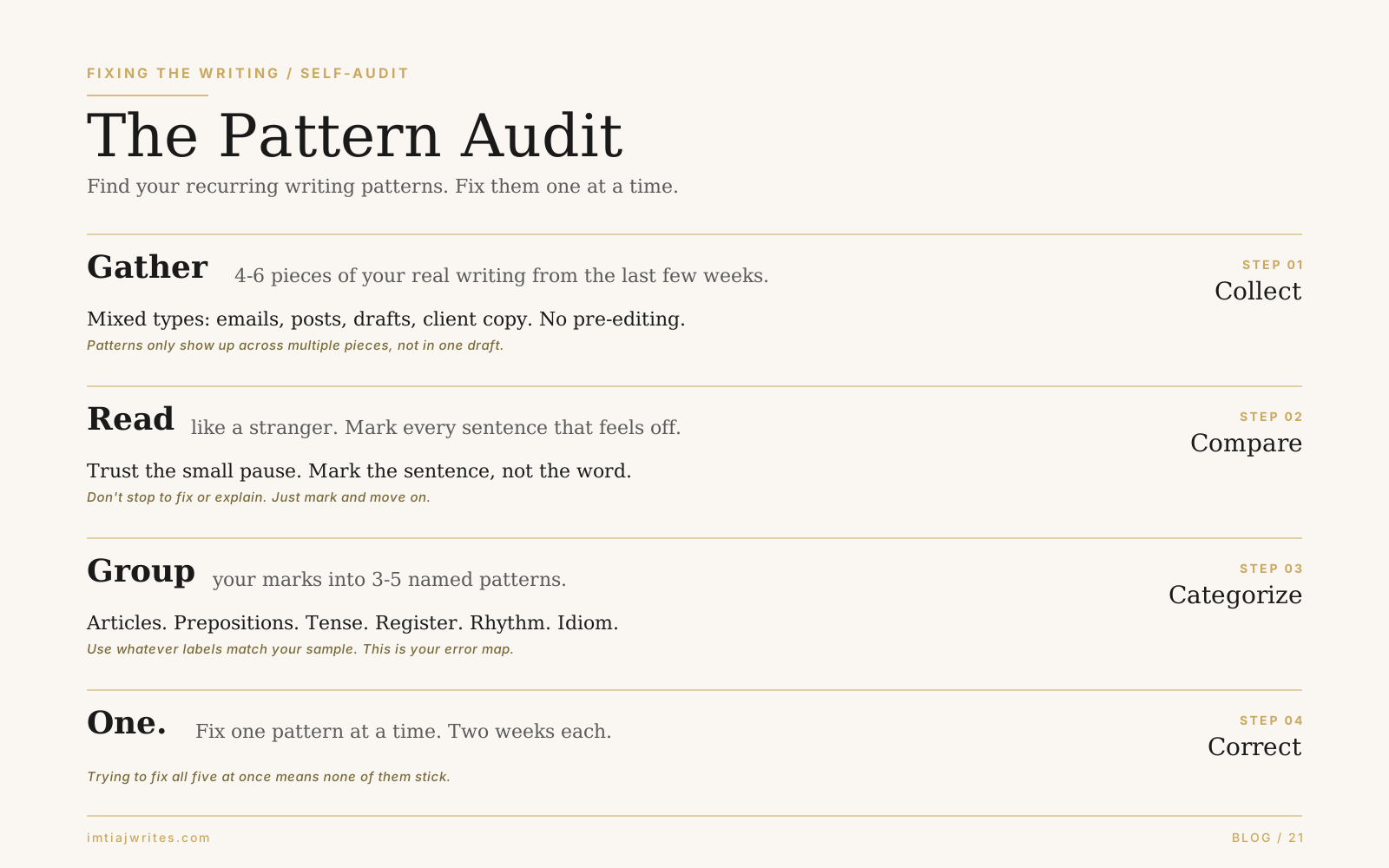
Four steps, in this order. Each step has a small job. Together they turn fuzzy “my English sounds off” feelings into a short, named list of recurring issues you can actually fix.
1. Collect. Gather a few weeks of your real writing in one place.
2. Compare. Read it back as a stranger would, marking every sentence that feels slightly off.
3. Categorize. Group those marks into 3-5 patterns by type.
4. Correct. Fix one pattern at a time across all your drafts.
The whole audit takes about two hours the first time. After that, a smaller version of it takes 20 minutes once a month and keeps you ahead of the patterns that try to creep back in.
Step 1: Collect
You cannot find patterns in a single draft. Patterns only show up across multiple pieces. So the first step is to pull together a small body of your recent work in one place.
You need three things:
➤ 4-6 pieces of your professional writing from the last four to six weeks
➤ Mixed types: emails, posts, blog drafts, client copy, anything written for a real reader
➤ Saved as plain text or pasted into one document, side by side
Don’t pre-edit. Don’t pick only the pieces you are proud of. The audit only works if the sample is honest. If you only audit your best work, you will only see the patterns of your best moments. The patterns you need to fix live in your average work.
Forty-five minutes of pulling these together is enough.
Step 2: Compare
This is the step that does the real work, and the one most non-native writers skip.
Read the collected pieces back to back, in order, with one specific instruction: read like a stranger. Not like the writer. Not like a friend who knows what you meant. Like someone who has never seen the work before and is judging it on the page alone.
Mark every sentence where something feels slightly off, even if you cannot say why. Use a simple symbol. A star. A highlight. A small “?” in the margin. Do not stop to explain or fix anything. Just mark.
Two rules for this step:
Trust the small reaction. If a sentence makes you pause for half a second, mark it. The pause is the data. Your brain has caught something even if your conscious mind hasn’t.
Mark the sentence, not the word. Patterns live at the sentence level more often than at the word level. Marking the whole sentence keeps you from narrowing in too fast.
By the end of this step, you will have somewhere between 15 and 40 marked sentences across your sample. That is the raw material.
For a more structured version of this read, the self-editing checklist post covers the 12-pass version most non-native writers use once they have built a pattern list.
Step 3: Categorize
Now you turn 30 marked sentences into 3-5 named patterns.
Read your marked sentences again, this time looking for what they have in common. Most non-native writing patterns fall into a small number of buckets. Common ones include:
➤ Article patterns. Missing or extra “a”, “an”, “the”.
➤ Preposition patterns. Using the preposition that fits your first language but not English.
➤ Tense drift. Past and present mixed inside the same paragraph, or simple present where present perfect is needed.
➤ Register patterns. Writing too formal for the channel, too academic for the audience.
➤ Sentence-rhythm patterns. Sentences that run slightly long, or follow a structure that translates from your first language.
➤ Translated idiom patterns. Phrases that work in your first language but read as old-fashioned or off in English.
You don’t need to use these labels. You need to use whatever labels actually describe what is happening in your sample. If three of your marked sentences all have the same problem of “I keep starting clauses with ‘which’,” that is a pattern, even if no textbook has a name for it.
The output of this step is a short list. Three to five patterns. Each one with a one-line description and two to three example sentences from your own work.
That list is your personal error map. It is more useful than any general grammar book, because it points at the patterns that actually appear in your writing, not the patterns that appear in some other writer’s writing.
Step 4: Correct
The last step is where most non-native writers go wrong by trying to fix everything at once.
Don’t. Pick one pattern. The one that shows up most in your sample. Fix only that one for the next two weeks of writing. Every time you finish a draft, run a single pass with one question: did this pattern show up here? Mark it. Fix it. Move on.
After two weeks, the pattern starts to fade on its own, because your brain has been trained to catch it before you finish the sentence. Now pick the next pattern. Same process. Two weeks. Fix it. Move on.
This sounds slow. It is also the only approach that actually works long-term. Trying to fix all five patterns at once usually means none of them stick, because your attention is split. Fixing one at a time means each pattern gets full attention until it is no longer automatic, which is the only point at which the fix is real.
The Pattern Audit becomes powerful in the third month. By then you have fixed three patterns, you have a clean error map for the next two, and your draft quality has shifted in a way readers can feel without being able to name.
For the deeper structural patterns that often show up in non-native English copy (idiom translation, register, rhythm), the post on the seven signs of non-native writing is the first place to look once you have your own pattern list ready.
A note on AI tools and the Pattern Audit
It is tempting to skip Steps 2 and 3 and just paste your sample into ChatGPT with the prompt “find my non-native writing patterns.”
Don’t, at least not on the first audit. Two reasons.
First, AI tools are not great at spotting patterns at the sentence level when the sample is mixed (emails plus blog posts plus client copy). They tend to flag surface grammar issues and miss the deeper patterns of register, idiom, and rhythm that the Compare step is built to catch.
Second, and more important, the value of the Pattern Audit is not the list. It is the act of reading your own work as a stranger. That act is the thing that builds the editor brain you actually need. If you outsource the read to a model, you get a list but you don’t get the editor brain. Six months later you still cannot self-diagnose, because you never practiced.
Once you have done two or three full Pattern Audits manually, then bring AI in as a second pass. By that point you can tell when its diagnosis is right and when it is reaching, which is the only state where the tool is actually useful.
For the prompts and structure that work best on a draft after the manual audit, the Natural English Edit is the 15-pattern checklist with the ChatGPT prompts to run on your own copy. Free!
Where to go next
If specific kinds of patterns kept appearing while you read this, the next step depends on which kind.
→ For grammar-level patterns (articles, prepositions, tense), see the post on the three mistakes that mark non-native copy.
→ For higher-level patterns (register, idiom, rhythm), see the post on the seven signs of non-native writing.
→ For the structured post-audit checklist to run on every new draft, the Natural English Edit is 15 patterns with the ChatGPT prompts to spot them. Free.
Patterns are not random. Yours are findable. Once you find them, the fix is much smaller than it feels.
Frequently Asked Questions
How do I find non-native writing patterns in my own drafts? Use the Pattern Audit, a four-step process: Collect 4-6 pieces of your recent work, Compare them in one read marking sentences that feel off, Categorize the marks into 3-5 named patterns, and Correct one pattern at a time over two-week cycles. The whole first audit takes about two hours. The result is a personal error map that is more useful than any general grammar book.
How many patterns should I expect to find? Most non-native writers find 3-5 recurring patterns in their first audit. Fewer than three usually means you didn’t mark enough sentences. More than five usually means you grouped too narrowly and need to combine similar marks. The goal is a short, fixable list, not a long inventory.
How long does it take to fix one pattern? About two weeks of conscious daily practice for a single pattern to start fading on its own. The first three days feel slow because you have to stop and check every sentence. By day ten, your brain catches the pattern before you finish writing the sentence. By day fourteen, the pattern still shows up sometimes but you fix it without thinking.
Should I use AI tools to find my patterns instead? Not on the first audit. AI tools are uneven at sentence-level pattern detection in mixed samples, and the real value of the Pattern Audit is training your own editor brain. After two or three manual audits, AI can be useful as a second pass to catch what you missed. The order matters: practice manually first, then add tools.
What is the difference between treatable and untreatable patterns? Treatable patterns follow a clear rule. Once you know the rule, you can apply it to every future case (for example, “use ‘for’ with duration, ‘since’ with a point in time”). Untreatable patterns are deeper, more about how your first language shapes your thinking, and need gradual exposure to fix. Most fluent non-native writers find that 70-80% of their patterns are treatable, which means most of the work is faster than it feels.
How often should I redo the Pattern Audit? The full audit takes two hours and is worth doing once every two or three months. A smaller version, where you reread the last week of your writing for one specific pattern, takes 20 minutes and is worth doing once a month. Old patterns sometimes return when you change channels (for example, when you start writing for a new client or in a new format), so the small monthly check catches them early.
