
Most writing advice for non-native English speakers focuses on getting the language right. Grammar. Register. Naturalness. All useful. But there is a separate problem that lives one layer up, and it is the one that decides whether a reader trusts you in the first three seconds of reading.
The problem is this: copy that sounds confident is read very differently from copy that just sounds correct, even when both versions say the same thing. Two writers can describe the same product, with the same accuracy, the same grammar, the same level of polish, and one will read as authoritative while the other reads as tentative. The difference is not in language quality. It is what I call authority signals, and they are mostly invisible until you know to look for them.
This post is not about fixing your English. Your English is probably fine. This is about the three signals readers unconsciously scan for to decide whether you sound like you know what you’re talking about. Once you can see them, you can switch them on in your own drafts in about ten minutes per piece.
Why is this different from “natural English”
A quick word to make sure this post earns its place in the series.
Earlier posts on this site cover related but different problems. The Register Gap is about whether your formality level matches the channel. The A-P-T Rule is about three specific grammar fingerprints that mark non-native writing. The Twelve-Pass Filter is a checklist for catching pattern-level issues in your drafts.
This post is about something narrower and earlier in the reader’s experience: the moment, before the reader has consciously evaluated anything, when their gut decides whether you sound like an expert or a novice. That decision is made on three specific signals, and it has very little to do with how natural your English is.
You can write perfectly natural English that sounds tentative. You can write slightly imperfect English that sounds completely authoritative. The signals are independent.
What “confident” actually means in copy
Let me be precise about what I mean, because “confident” gets used so loosely it stops meaning anything.
I do not mean loud. I do not mean salesy. I do not mean using exclamation marks or making big claims. Those are all the cheap, surface-level versions of confidence that mostly come across as the opposite.
What I mean is the quality readers describe when they say things like “this writer sounds like they know what they’re talking about” or “this feels like it was written by a senior person.” It is the absence of three specific weakening patterns that creep into copy when the writer is unsure of themselves. Remove those patterns, and the same copy reads completely differently.
According to a 2026 Grammarly analysis on hedging language in professional writing, “hedging language plays a central role in that tension. It shapes how certain or cautious a claim sounds and influences how readers perceive authority, credibility, and nuance.” That research confirms what working copywriters already know: the same claim, dressed in different language, signals very different levels of expertise to the reader. The Grammarly piece notes that academic writing values hedging while professional writing usually does not, and most non-native writers default to the academic mode they were trained in.
The pattern I see most often when reviewing copy from non-native professionals is exactly this. Their English is good. Their grammar is clean. The copy still reads as junior, because the three authority signals below are not switched on.
The framework: The Authority Check
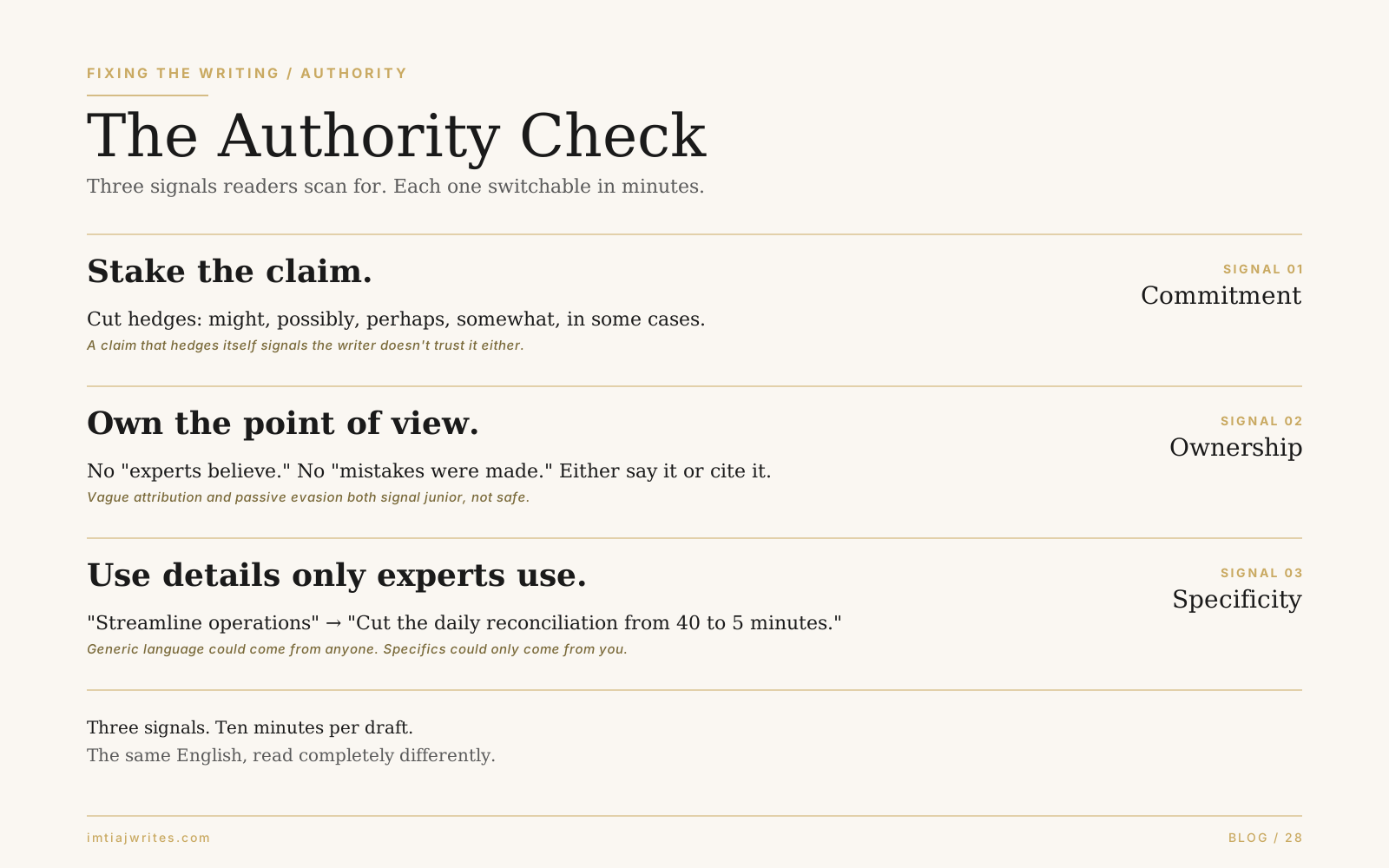
Three signals, in order of impact. The Authority Check is the diagnostic you run on a draft after you have already cleaned the grammar and the register. It takes about ten minutes per piece and produces a noticeable shift in how the writing lands.
1. Commitment. Does each sentence stake a clear claim, or hedge against possible disagreement?
2. Ownership. Does the writer take responsibility for the point of view, or hide behind passive constructions and vague attributions?
3. Specificity. Does the copy use concrete language that only an expert would use, or generic language that anyone could write?
Each signal below has the pattern to look for and the small edit that switches it on.
Signal 1: Commitment (the hedging problem)
The most common authority leak in non-native business copy is hedging. You add a small softener to a sentence because making a flat claim in a second language feels risky. The softener does not protect you the way it feels like it does. It signals to the reader that you are not fully sure of your own claim, which makes them less sure too.
❌ This approach might possibly help reduce customer churn in some cases.
✅ This approach reduces customer churn.
The first sentence has three hedges (might, possibly, in some cases) doing the same defensive work. A reader’s gut reaction to the first version is “the writer doesn’t really know if this works.” A reader’s gut reaction to the second is “the writer has seen this work.”
The same applies to softer hedges that sound polite:
❌ I think the homepage copy might benefit from a tighter headline.
✅ The homepage copy needs a tighter headline.
The first version is what most non-native writers default to in client emails because it feels less confrontational. It also signals to the client that you are not sure of your own recommendation. A client paying for your judgment wants the judgment, not a guess wrapped in cushioning.
The fix is to scan your draft for these specific words and remove all but the necessary ones: might, possibly, perhaps, somewhat, fairly, quite, rather, may, could, often, usually, generally, in some cases. Each one is a hedge. Most of them can be cut without changing the meaning. The ones that genuinely qualify the claim should stay. The defensive ones should not.
The Grammarly analysis cited above offers a useful test: “If a sentence sounds overly cautious, try swapping a hedging word for a stronger verb to see how it changes tone and clarity.” That swap is the smallest possible move with the largest possible impact on perceived authority.
Signal 2: Ownership (the passive voice and vague attribution problem)
The second signal is harder to spot because it hides inside grammatically clean sentences. Look for two specific patterns: passive constructions that remove the actor from the sentence, and vague attributions that put the claim in someone else’s mouth.
Passive without an actor:
❌ Mistakes were made in the original campaign.
✅ We got the original campaign wrong.
The passive version protects the writer by removing anyone who could be blamed. It also reads as evasive. The active version takes responsibility, which signals that the writer is senior enough to own a mistake. Counterintuitively, owning the mistake makes you sound more authoritative, not less.
Vague attribution:
❌ Many experts believe that mobile-first design is now standard.
✅ Mobile-first design is now standard.
If the claim is true, you do not need experts to back you up. Citing vague experts signals that you are not confident enough to make the claim yourself. If the claim genuinely requires evidence, name the specific source:
✅ According to Google’s 2024 Mobile UX report, mobile-first design is now standard for B2B sites.
Either own the claim directly or cite a specific source. Vague attribution is the worst of both worlds.
The same dynamic applies to phrases like it is widely thought that, some have argued, research has shown, studies suggest. All of these are hiding places. Either you stand behind the claim or you cite a real source. Pick one.
Signal 3: Specificity (the generic language problem)
The third signal is the hardest to switch on, and it is the one that most clearly separates expert copy from amateur copy.
Generic language is what writers reach for when they are uncertain or in a hurry. Specific language is what writers reach for when they know the subject deeply. A reader’s gut catches the difference instantly, even if they cannot articulate why.
❌ Our platform helps businesses streamline their operations and improve efficiency.
✅ Our platform cuts the daily reconciliation step from 40 minutes to under five.
The first sentence could describe a thousand products. The second sentence could only describe one. Specificity signals that the writer actually knows what the product does, in the same way that vagueness signals they do not. A reader looking at five competing landing pages will remember the specific one and forget the four generic ones.
For non-native writers, specificity is the signal where you have the most natural advantage. You probably notice details native writers miss, especially around cross-cultural use cases, edge cases, or the gap between marketing claims and how the product actually behaves. Putting those details into the copy is what makes you sound senior.
❌ We help global brands localize their content effectively.
✅ We catch the things automated translation misses, like the date format that reads as 7 March in London and 3 July in New York.
The second sentence is the same idea with one specific example. That single example is the difference between copy that sounds like a marketing brochure and copy that sounds like a working professional with real expertise.
Putting the three signals together
A draft that has all three signals switched on reads like the writer knows their subject and trusts the reader to follow. Imagine the brief lands in your inbox: rewrite the homepage of a B2B analytics company. Here is the same paragraph, written first by a non-native writer who has cleaned the grammar but not run The Authority Check, and then by the same writer after running it.
❌ Our analytics platform might help your team better understand customer behavior. We believe that data-driven decisions are important for modern businesses, and many companies have seen improvements after implementing analytics solutions. Our tool offers various features that could potentially streamline your reporting workflow.
✅ Our analytics platform shows you which customers are about to churn, three weeks before they do. We built it because the dashboards most teams use only show what already happened. Our reporting workflow saves your team about six hours a week, mostly by killing the Tuesday reporting meeting.
The first version has clean English. The second version has the same English with the three authority signals switched on. The reader’s gut response to the two paragraphs is completely different, and the difference has nothing to do with fluency.
The honest part
I should name the trade-off so this post does not oversell the move.
Confident writing is harder to produce than hedged writing. Hedging is the default in any professional culture that values caution, including most academic and corporate environments where non-native writers learned their professional English. Switching the signals on means writing things you can be challenged on, which is genuinely uncomfortable the first few months.
It also means you will sometimes be wrong, in writing, in front of clients. Confident copy that turns out to be incorrect is more embarrassing than hedged copy that turned out to be incorrect. That is real. The trade-off is worth it because the writers who make confident claims and occasionally apologize are read as senior, while the writers who hedge everything are read as junior, even when their actual judgment is the same.
The Authority Check is not about pretending you are sure of things you are not. It is about removing the defensive language that makes you sound less sure than you actually are.
For the diagnostic that runs on the writing itself once The Authority Check is done, the Natural English Edit is the 15-pattern checklist with prompts to run on your own drafts. Free.
Where to go next
If The Authority Check produced a noticeable change in your last draft, the next step is making it a habit. Run the three-signal pass on every piece of client work for the next two weeks before sending. After that the moves become automatic.
➡️ For the register layer that sits underneath authority (whether your copy is at the right formality level for the channel), see the Register Gap post.
➡️ For the grammar fingerprints that survive into final drafts even after The Authority Check, see the A-P-T Rule post.
➡️ For the full self-editing pass that combines all of these signals into one workflow, see the Twelve-Pass Filter.
➡️ For the diagnostic on the writing itself, the Natural English Edit is the 15-pattern checklist with prompts to run on your own copy. Free.
Three signals. Ten minutes per draft. The same English, read completely differently.
Frequently Asked Questions
What is the difference between correct and confident copy? Correct copy follows grammar rules and reads naturally. Confident copy stakes clear claims, takes ownership of points of view, and uses specific language. The two are independent. You can write perfectly natural English that sounds tentative, and you can write slightly imperfect English that sounds authoritative. The Authority Check focuses only on the second.
What are the three authority signals readers scan for? Commitment (does the sentence stake a clear claim or hedge against disagreement), Ownership (does the writer take responsibility or hide behind passive constructions), and Specificity (does the copy use concrete details only an expert would know, or generic language anyone could write). Together these make up The Authority Check.
How do I stop hedging in my copy as a non-native writer? Scan your draft for specific hedging words: might, possibly, perhaps, somewhat, fairly, quite, rather, may, could, often, usually, generally, in some cases. Most of these can be cut without changing the meaning. Keep the hedges that genuinely qualify a claim. Remove the ones that are defensive padding. According to Grammarly’s 2026 analysis on hedging, swapping a hedging word for a stronger verb is one of the highest-impact moves you can make on tone and clarity.
Does sounding confident mean making big claims or sounding salesy? No. Confident copy is not loud or salesy. It is the absence of three specific weakening patterns: hedging, passive evasion, and generic language. The shift readers respond to is from sounding tentative to sounding direct, not from sounding direct to sounding aggressive. Salesy copy and confident copy are different things.
Is confident copywriting harder for non-native writers specifically? Yes. Most non-native English speakers learned the language in academic and corporate environments where hedging is rewarded. Those defaults transfer into business copy and read as junior, even when the writer is senior. Switching them off requires conscious work for the first few months and becomes automatic after that.
Can I use AI tools to make my copy sound more confident? Partly. AI tools can flag obvious hedging words, but the harder work (turning generic claims into specific ones, taking ownership of judgments) requires the writer’s actual expertise. AI can help with Signal 1, partially with Signal 2, and almost not at all with Signal 3. Specificity has to come from you.
