
On 8 June 2026, I had 150 LinkedIn followers. On 18 September I had 370. In between, I published about forty posts, left roughly three hundred comments, took an eleven-day break, and was contacted by in-house recruiters about four or five senior copywriter roles and one marketing director position.
Every 100-day LinkedIn post I’ve ever read ends with a graph going up and to the right. This one doesn’t, and I nearly didn’t write it, because 370 followers is not a number anyone brags about. Then I looked at the export properly and realised the follower count was the least interesting thing in it.
Here’s the whole thing, including the parts that embarrassed me, because the parts that embarrassed me turned out to be the evidence.
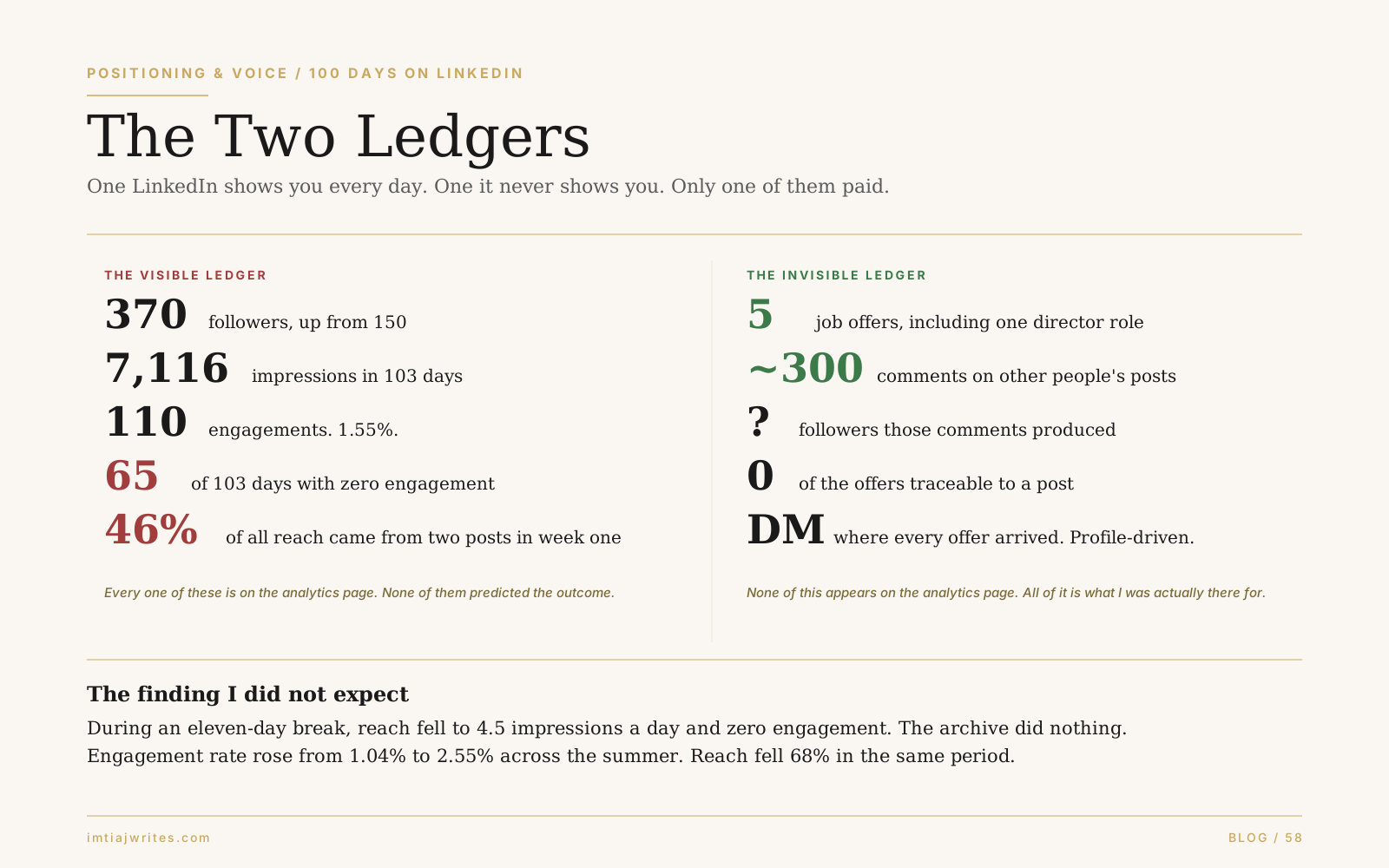
The visible ledger
This is what LinkedIn’s analytics page showed me for 103 days, 8 June to 18 September.
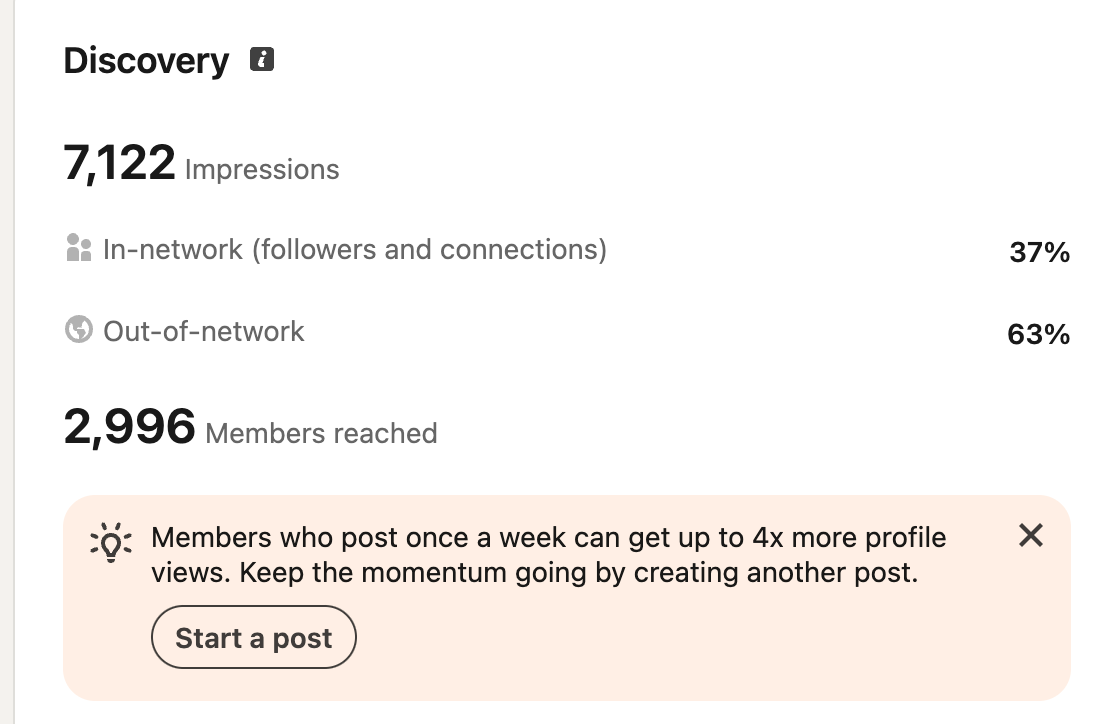
7,116 impressions. 2,992 members reached. 110 engagements, which is a 1.55% engagement rate. 220 new followers, 150 to 370. About forty posts, roughly three a week, and somewhere between 250 and 350 comments on other people’s posts, most days two or three.
Now the numbers that don’t make it into anyone’s 100-day post.
Sixty-five of those 103 days had zero engagement. Not low. Zero. Nearly two-thirds of the window, nobody reacted to anything.
Two posts in the first three weeks produced 46% of my entire reach. A post on 9 June about non-native writers getting flagged as AI did 1,860 impressions and 22 engagements. One on 25 June did 1,446. Between them, 3,306 of the 7,116. Nothing since has come within a third of either, and my best post in September did 118.
My engagement rate more than doubled while my reach collapsed. June: 4,225 impressions, 1.04% engagement. August: 1,335 impressions, 2.55% engagement. I got measurably better at writing posts people responded to, and the platform showed those posts to 68% fewer people.
I expected more. Everyone does. What I didn’t expect was to watch the two lines go in opposite directions on my own screen.
The invisible ledger
Here’s what the analytics page didn’t show, and it’s where everything that actually mattered happened.
Four or five in-house recruiters messaged me about senior copywriter roles. One reached out about a marketing director position at an electronics company with a real trajectory. All by DM. All, as far as I can tell, from my profile rather than from any specific post. They arrived clustered, not spread evenly across the hundred days, and I cannot connect a single one to a post, an impression, or a follower.
That’s the disconnect the title is about. The thing I was measuring and the thing I wanted were running on separate ledgers, and only one of them was visible.
The comments are on the invisible ledger too. Roughly three hundred of them, more effort by volume than my posts. I know they produced followers, because I watched it happen. I don’t know how many, because LinkedIn doesn’t attribute followers to comments, and neither can I. So the largest single activity in my hundred days is unmeasurable, and I suspect that’s true for most people who’ve done this.
What didn’t happen is worth listing too, because the omissions are honest. No client enquiries, and none should have been expected, because I had no offer prepared and nothing on my profile that told anyone I was for hire. No newsletter subscribers, because I didn’t have a newsletter. You can’t attribute results to channels you never built. That sounds obvious written down. It wasn’t obvious while I was refreshing the analytics page.
The finding I didn’t expect: the archive does nothing
In early September, I stopped for eleven days. Brain refresh, nothing strategic. I assumed my forty posts would keep working while I was gone, because that’s the promise: build a library, and the library builds you.
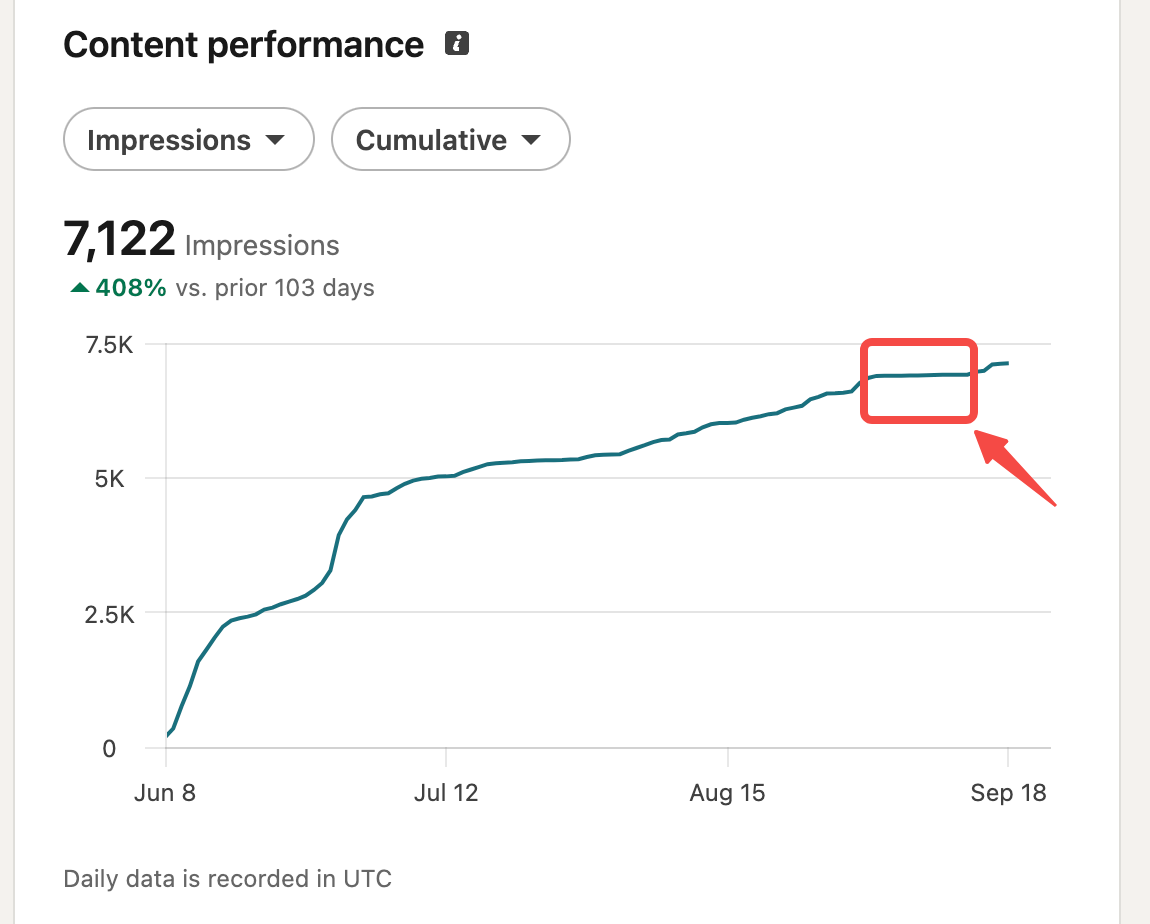
Here’s what the export shows for 3 to 13 September. Impressions per day: 2, 3, 0, 3, 1, 2, 4, 7, 0, 0, 1. Average 4.5. Engagements across all eleven days: zero.
Then I posted on the 14th. That day: 52 impressions, 3 engagements. On the 16th: 118 impressions and 6 engagements.
So reach didn’t decay. It went to near nothing within two days of silence and came back within a day of posting. That means my impressions were almost entirely new post impressions, with no residual reach from anything older. Forty posts in the archive, and during eleven days they generated fewer impressions combined than one mediocre new post.
I’d been told the opposite by everyone. If your experience is different, I’d like to see the export. Mine says the library doesn’t work while you’re not adding to it.
And when I did come back, reach recovered to 60 to 100 impressions on a good day, which is better than the 10 to 20 I was getting in late August before the break. I don’t know why. It might be the break. It might be the two posts. It might be noise, which brings me to the part I can’t measure.
The part I can’t separate from the platform
Here’s my honest read on the falling reach, and it’s the least satisfying section of this post.
I improved. The engagement rate proves it. And reach fell anyway. One explanation is that I plateaued and the algorithm noticed. Another is that during the exact same months, people with tens of thousands of followers and large newsletters were posting publicly about the same collapse in impressions. I read a lot of those posts. They don’t prove anything about my account, but they make “it’s just you” harder to believe.
I can’t distinguish the two from my data, and I’m not going to pretend I can. What I can say is that if you’re a small account watching your reach fall in 2026, the falling reach is not, by itself, evidence that you’re doing it wrong. The metric you can see moved for reasons you can’t see. Which is the whole lesson of this post, arriving from a different direction.
The one place being non-native showed up
I expected my English to be a factor. It wasn’t. No comment on any of my forty posts mentioned it, nothing was reported as AI, and the engagement rate climbing suggests the writing landed.
Where it showed up was in my comments on other people’s posts, and it showed up as an accusation. A couple of times, early on, someone replied to a comment of mine saying it looked AI-generated.
I answered both times calmly and moved on. But looking back at those early comments, they were right to wonder. Not because I’d used AI, but because the comments were polished. Full sentences, careful structure, no loose ends. I was writing comments the way I’d been trained to write everything: correctly. And correct, careful, complete prose is exactly what reads as machine-made now, which is the entire argument I’d already made in a post about why AI detectors flag careful writing. I’d written the diagnosis and then walked into it in the comments section.
So I changed. Comments now are peer-to-peer, looser, sometimes a fragment, sometimes just a question back. The accusations stopped. That’s a sample of two, and I’m not building a theory on it. But it’s the one concrete adjustment the hundred days forced, and it’s the one I’d tell any non-native writer starting on LinkedIn: your posts can be careful. Your comments can’t, or they’ll read as a bot, and the fix is register, not vocabulary.
What I’d actually tell you
Not a growth strategy. I don’t have one that worked, and the export proves it. Four things the data supports.
Fix the profile before you post. Every offer came through the profile. Not one traced to a post. If you’re on LinkedIn to be found for work, the profile is the product, and the posts are, at best, what makes someone click through to it. I spent a hundred days optimising the wrong page.
Build the channel before you expect the result. No offer prepared, no client enquiries. No newsletter, no subscribers. I was disappointed by outcomes I hadn’t built a path for, which is a mistake I’ll only make once.
Measure the invisible ledger yourself. LinkedIn will never tell you which comment produced which follower or which profile view became a DM. Keep your own log: date, what you did, what arrived. The analytics page is a partial record dressed up as a complete one.
Stop reading the follower count as a verdict. Mine is 370. I have five job offers. If the number were 3,700 and I had none, which would you rather have? The count measures something. It doesn’t measure that.
The honest limit
This is one account, one hundred days, and one non-native copywriter with a full-time job. It’s not a study, and n=1 doesn’t generalise. The job offers may have arrived without any posting at all, purely from a searchable profile, and I have no way to test that counterfactual. The reach recovery after the break might be noise. The AI accusations are two data points.
What I’ll stand behind is narrower. The numbers LinkedIn shows you did not predict, explain, or produce the outcome I wanted. That outcome came through a channel the numbers can’t see. And the thing I nearly didn’t publish because it looked like failure turned out to be the most useful thing I learned all summer.
If you’re at 370 followers wondering whether to keep going, check the other ledger first. Mine was full.
Frequently Asked Questions
Does LinkedIn follower count matter for getting job offers?
Not directly, based on my hundred days. I received four or five recruiter approaches for senior copywriter roles plus one for a marketing director position at 370 followers, all by DM, all profile-driven, and none traceable to a post. Recruiters search profiles, not follower counts. The count is a visible metric; offers arrive on a ledger the analytics page never shows.
Why is my LinkedIn reach dropping even though engagement is going up?
Mine did the same: engagement rate rose from 1.04% in June 2026 to 2.55% in August, while impressions fell 68%. I can’t fully separate my own plateau from platform-wide changes, but during the same months, accounts with tens of thousands of followers reported the same collapse. Falling reach on a small account in 2026 is not by itself proof you’re doing it wrong.
Does a content archive on LinkedIn keep generating reach when you stop posting?
In my data, no. During an eleven-day break, forty existing posts averaged 4.5 impressions a day with zero engagement across all eleven days. Reach returned within a day of posting again. Impressions were almost entirely from new posts, with no residual reach from older ones.
Do non-native English writers get flagged as AI on LinkedIn?
On my posts, never in a hundred days. In comments, twice, early on, when my comments were polished and complete. Careful, correct prose reads as machine-made now. Switching to a looser, peer-to-peer comment register stopped the accusations, though that’s a sample of two.
Should I keep posting on LinkedIn with a small following?
Depends on what you’re there for. If it’s to be found for work, fix your profile first, because that’s where offers come from, and treat posts as what gets people to click through. If it’s reach, expect most days to show zero engagement and a couple of posts to carry the total. Keep your own log of what arrives, because LinkedIn’s analytics won’t attribute it.
Where to go next
👉🏼 For why my careful comments read as AI, see why AI detectors flag careful writing.
👉🏼 For the data behind detector false positives on non-native writing, see the false positive problem.
👉🏼 For what to say when someone accuses your work of being AI, see when a client says your writing is AI generated.
👉🏼 For the register shift that fixed my comments, see unlearning school English.
Two ledgers. Check the one LinkedIn doesn’t show you before you judge the one it does.
