
I quote my own freelance work, which means I’ve had to answer this question with an actual number, to an actual person, who was deciding whether to pay it. That’s a different exercise from summarizing a rate survey.
So this post has two halves. First, the published 2026 benchmarks, with an honest note about which sources have a financial stake in the numbers they publish. Then the part that matters more: the pricing model you choose affects your copywriting cost more than any benchmark does, and I learned that the slow way.
Let me start with the numbers, since that’s what you came for.
The 2026 benchmarks, and who’s telling you
Something worth mentioning, the single most-quoted copywriting rate figure in 2026, roughly $0.70 per word as an average professional rate, traces back to AWAI’s annual survey, as reported by Mediabistro. AWAI is the American Writers and Artists Institute, and their business is selling copywriting courses and training to people who want to become copywriters.
That doesn’t make the number false. But an organization whose customers are aspiring copywriters has an obvious interest in the earning potential looking strong. When you see $0.70 per word repeated across a dozen sites, you’re usually seeing one survey by an interested party, laundered through aggregators that don’t mention the source’s business model. Treat it as a ceiling-flavored figure, not a median.
The most methodologically solid benchmark I could verify is the Editorial Freelancers Association’s 2026 Rate Chart, released in March 2026 and built from 2025 data reported by its members. The EFA is a professional association founded in 1970 with nearly 3,300 members, and it doesn’t sell you a course at the end. Its chart covers editorial services in detail, with copy editing sitting around $0.03 to $0.06 per word, and it publishes a rate estimator and converter alongside it. If you want one reference to anchor against, that’s the one I’d use.
For hourly and project benchmarks specifically, SoloPricing’s 2026 guide puts US mid-level freelance copywriters at $85 to $160 per hour, with conversion and B2B SaaS specialists at $200 to $300. That’s a commercial pricing site rather than an association survey, so weight it accordingly, but its ranges are consistent with what the other sources report.
Below that tier, most of what circulates is aggregator content citing other aggregators. You’ll see confident statistics about what percentage of writers earn under ten cents a word, sourced to surveys nobody links to. I left those out, because a number you can’t trace isn’t a benchmark, it’s a rumor with a decimal point.
The honest summary: published copywriting rates in 2026 span roughly $0.10 to $1.00+ per word depending on experience and copy type, with hourly figures commonly quoted from around $50 at junior level to $200 or more for specialists. Those ranges are so wide that they tell you almost nothing about what you should charge. Which brings me to the part that actually decides it.
Why the model matters more than the rate
The pricing model you use has a bigger effect on your income than the specific number attached to it. I know this because I picked the wrong model for years and I had no idea that it capped me.
I used hourly pricing for a long time in my earlier writing days. It felt safe, and I want to be honest about why: as a non-native writer, hourly let me hide a lack of confidence behind a clean formula. If someone asked why the work cost that much, I had an answer that didn’t require me to defend my own value. These are the hours. This is the rate. Nobody argues with arithmetic.
Then I noticed the problem, and it’s a structural one that no amount of skill fixes.
The better and faster I got, the less I could charge for doing the same job well.
Sit with that for a second, because it’s the trap. Hourly pricing means every improvement you make transfers value to the client. You spend three years getting sharper, you cut a job from eight hours to four, and your reward is being paid half as much for the same finished piece. The pricing model was punishing exactly the thing I was working hardest to build.
The three models, and when each one fits
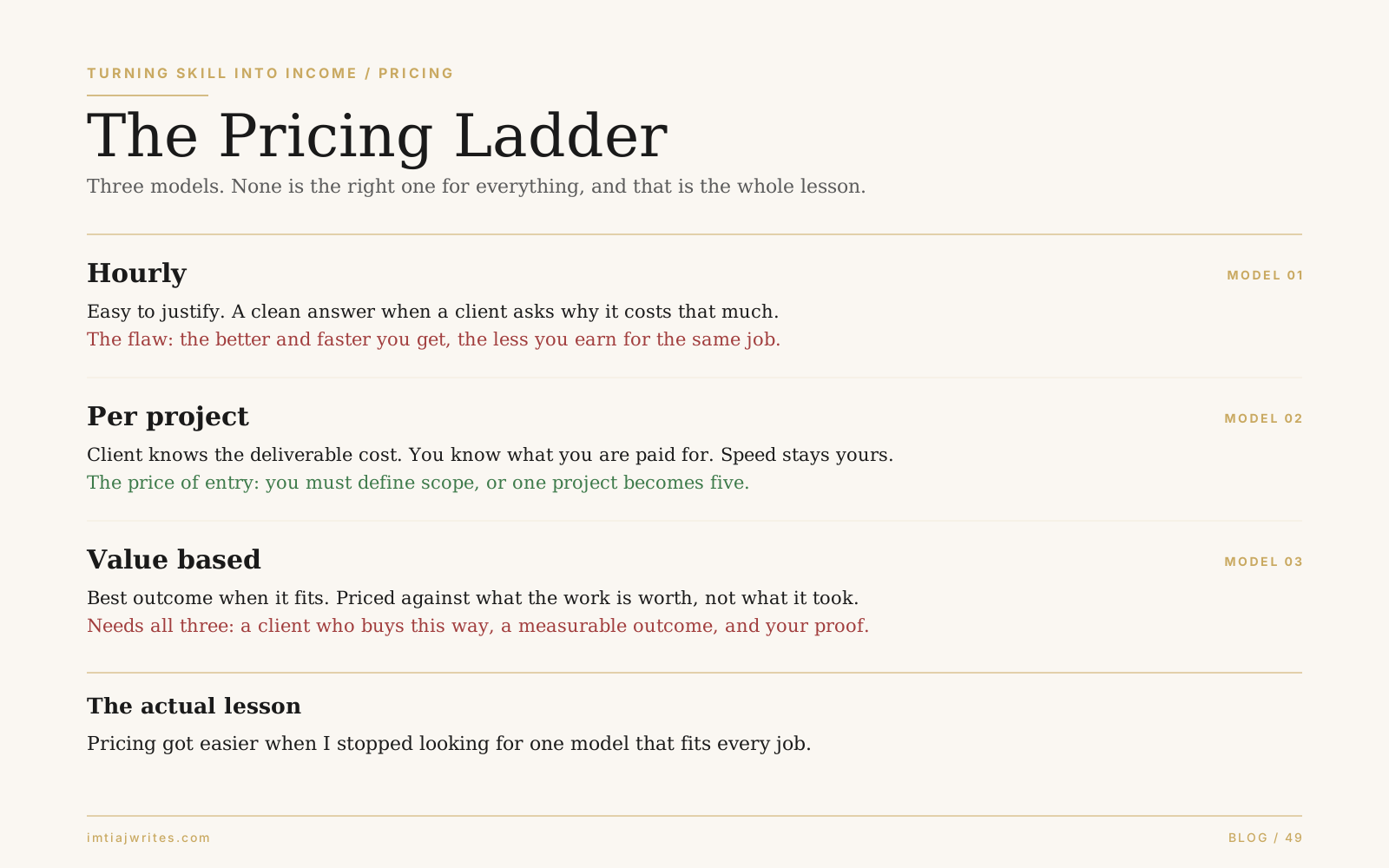
Hourly. Easy to justify, easy to explain, and it penalizes skill. It has a place, mostly for open-ended or unpredictable work where scope genuinely can’t be defined in advance, like ongoing consulting or ad-hoc edits. As a default for deliverable-based copywriting, it works against you.
Per project. This is my go-to, and I think it’s the most practical model for most copywriting work. The client knows what the deliverable costs. I know what I’m being paid for. Neither of us needs to care whether a piece takes four hours or eight, which means my speed stays mine.
The price of entry is scope discipline. You have to define what’s included with real precision, or a flat-fee project quietly becomes five projects while you’re still charging for one. That’s the failure mode, and it’s on you to prevent it, not the client.
❌ Landing page copy, with revisions.
✅ Landing page copy, up to 600 words, one round of revisions within 14 days. Additional rounds quoted separately.
The first invites scope creep because it defines nothing. The second is the same job with the edges drawn, and it’s the difference between a profitable project and a resentful one.
Value based. When it fits, I think it produces the best outcome for both sides, because the price reflects what the work is worth rather than what it cost to produce. But I don’t tell every copywriter to just “charge based on value,” because that advice ignores three conditions that all have to be true at once.
Not every client buys that way. Some have procurement processes that need a line item, not a share of upside. Not every project has a measurable enough outcome to price against; a brand awareness piece has no conversion number to point at. And not every writer has enough proof yet to make the conversation convincing, because value pricing is a negotiation you win with evidence of past results.
When those three line up, use it. When they don’t, forcing it makes you look naive rather than premium.
The real lesson took me years: pricing got easier once I stopped treating one model as a one-size-fits-all solution. Project pricing is my default. Value pricing is what I reach for when the work and the client actually make sense for it. Hourly is mostly behind me.
How to actually raise your rate
The mechanic that worked for me is simpler than most advice suggests, and it isn’t a negotiation script.
I raise my rate after I’ve made a strong impression on that client through the work itself, through professionalism and quality delivered consistently. By that point they already know what I’m worth, so the increase lands as a confirmation of something they’ve observed rather than a demand they have to evaluate. I’ve had almost no pushback doing it this way.
The sequence matters more than the wording. Most rate-raise advice focuses on how to phrase the ask. In practice, the phrasing barely matters if you’ve spent six months demonstrating value, and no phrasing saves you if you haven’t. Deliver first, raise second.
For non-native writers specifically, there’s an extra layer worth naming. The temptation is to discount because of English anxiety, to price low as insurance against someone questioning your language. That’s the same impulse that made hourly feel safe to me, and it has the same cost: you’re paying a permanent tax to avoid a conversation that probably won’t happen. If your work is good, price it as good work. If you’re worried the English isn’t there yet, that’s a skill problem to fix directly, not a discount to apply forever, and most of what marks non-native copy is fixable in a season of deliberate work.
What to do with all this
Ignore the published averages as a target. Use the EFA chart as a sanity check on whether you’re wildly out of range, and treat AWAI’s figures as aspirational marketing until proven otherwise.
Then do the thing that actually moves your income: get off hourly for deliverable work, learn to define scope tightly enough that project pricing is safe, and raise your rate after you’ve earned the client’s confidence rather than before. That sequence has done more for what I charge than any benchmark ever did.
The published copywriting cost is a range so wide it’s nearly meaningless. The model you price with is a decision you control completely, and it compounds.
Frequently Asked Questions
How much does copywriting cost in 2026?
Published rates span roughly $0.10 to over $1.00 per word depending on experience and copy type, with hourly rates commonly quoted from around $50 for junior writers to $200 or more for specialists. The ranges are wide because they mix experience levels, niches, and copy types. The Editorial Freelancers Association’s 2026 Rate Chart, built from member-reported 2025 data, is the most methodologically solid public reference.
Why do copywriting rate guides disagree so much?
Partly because rates genuinely vary, and partly because of who publishes the data. The widely quoted $0.70 per word average comes from AWAI, an organization that sells copywriting training, which gives it an interest in strong earning figures. Many other statistics circulate through aggregator sites citing each other without a traceable original survey. Check the source’s business model before trusting a number.
Should I charge hourly or per project for copywriting?
Per project for most deliverable-based copywriting. Hourly pricing penalizes skill, because as you get faster at producing the same quality, you earn less for identical work. Project pricing keeps the value of your speed with you, but it requires defining scope precisely or the project expands while the fee does not.
When does value-based pricing work?
Only when three conditions hold at once: the client buys that way, the project has a measurable enough outcome to price against, and you have enough proof of past results to make the case convincing. When those align it produces the best outcome. When they do not, attempting it reads as inexperience rather than confidence.
How do I raise my rate without losing the client?
Raise it after you have consistently demonstrated quality and professionalism with that client, not before. At that point the increase confirms something they have already observed rather than asking them to take a risk. The sequence matters far more than the wording of the request.
Where to go next
👉🏼 For which type of writing commands higher rates, see copywriting vs content writing.
👉🏼 For the skill gaps that hold non-native rates down, see the three mistakes that mark non-native copy.
👉🏼 For defending your work when a client questions it, see when a client says your writing is AI generated.
👉🏼 For the tools that support professional output, see the AI writing tools I actually use.
Published averages tell you the market. Your pricing model tells you your income. Only one of those is yours to decide.
