
You have probably had a native editor delete a “the” from your sentence, add one three lines later, and been unable to explain either change. Not because you do not know the rules. Because the rules only cover about half of what is actually happening.
English articles are the last mistake standing for most non-native professionals. Everything else gets fixed first. Your vocabulary is strong, your sentence structure is clean, your register is right for the channel. And still, somewhere in every draft, a “the” is missing or an “a” is doing work it should not be doing. This is not a sign that you are behind. It is a sign that you have reached the hardest layer.
This post explains why articles resist learning even at an advanced level, and gives you a three-question test that resolves most cases in your own drafts. Articles are one leg of the A-P-T Rule covered in the post on the three mistakes that mark non-native copy. This one goes much deeper into the article system alone.
Why articles are the last thing to go
Three mechanical reasons, and none of them are about effort.
They are everywhere. “The” is the most frequent word in written English. In the Brown Corpus of American English, it accounts for close to 7% of all word occurrences, roughly 69,971 out of just over a million words. That frequency means a small error rate produces a lot of visible errors. If you get articles right 92% of the time, which is a strong score, you are still leaving a mistake every dozen or so noun phrases.
Half the time, the answer is “no article at all.” This is the part most learners never get taught. Research published in Studies in Second Language Acquisition notes that bare nominals, meaning nouns with no article in front of them, account for approximately 50% of all nominals in native English. So you notice articles constantly, then notice they are often missing, and the pattern refuses to resolve. You are trying to learn a three-way choice while most textbooks teach it as a two-way one.
The errors cluster in one direction. In that same Cambridge study of 660 learner scripts, 81% of article errors in obligatory contexts were omissions, not wrong choices. You are far more likely to leave an article out than to pick the wrong one. That matters for how you edit, and we will come back to it.
The scale of the problem is measurable. Han, Chodorow, and Leacock analyzed 668 TOEFL essays from Chinese, Japanese, and Russian students and found that one in eight noun phrases contained an article error. These were students who had already cleared a serious English proficiency bar.
Why your first language decides your specific error
If your first language has no article system, Mandarin, Russian, Japanese, Korean, Hindi, Bengali, or Polish, you are not missing a rule. You are missing a category. Your language expresses the same ideas through word order, demonstratives, or context, and none of those map cleanly onto “a” and “the.”
If your first language does have articles, Spanish, French, German, Portuguese, or Arabic, you have a different problem. You have the category, but the boundaries sit in different places. French requires an article where English forbids one. Arabic marks definiteness but not indefiniteness. Your instinct fires confidently and lands slightly off.
The Cambridge research confirms both patterns: learners from article-less first languages show significantly lower overall accuracy, but learners from article languages still make systematic errors where the two systems disagree.
This is why generic article advice fails. “Use ‘the’ when the noun is specific” is true and nearly useless because your definition of “specific” was built by a different language.
The framework: The Article Ladder
Most article advice starts with definiteness. That is the wrong first rung, and it is why so much of it does not stick.
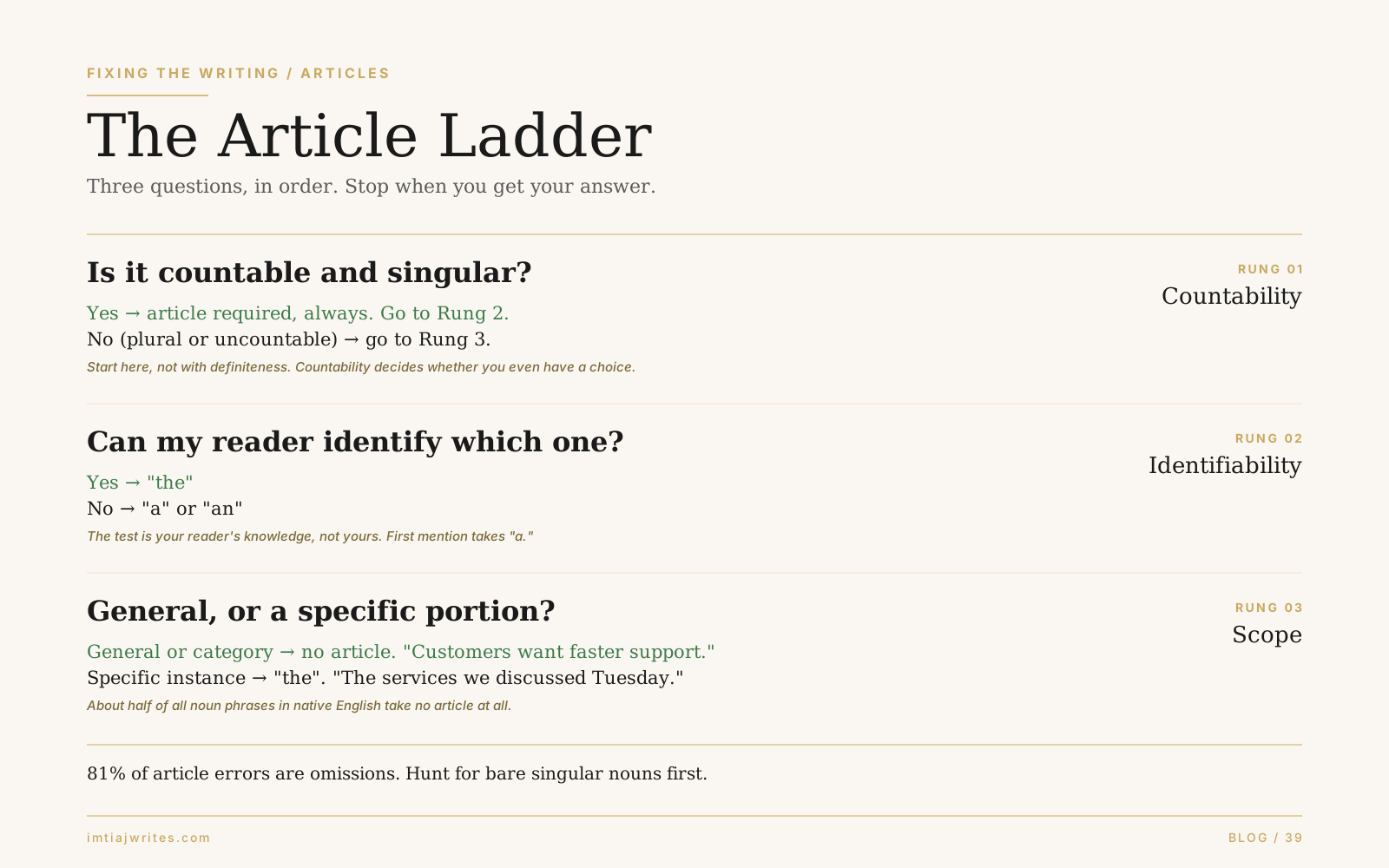
The Article Ladder runs the decision in the order English actually resolves it. Three questions, in this order. Stop when you get your answer.
Rung 1: Is this noun countable and singular?
If yes, it must have an article or a determiner. Always. No exceptions in standard professional English. “I sent proposal” is never right. Go to Rung 2.
If it is plural or uncountable, no article is often correct. Go to Rung 3.
Rung 2: Can my reader identify exactly which one?
If yes, use “the.” If no, use “a” or “an.”
The test is not whether you know which one. It is whether your reader can pin it down from what has already been said or from shared context.
Rung 3: Am I talking about this in general, or about a specific portion?
General or category-level: no article. “We provide consulting services.”
A specific instance or portion your reader can identify: “the.” “The services we discussed on Tuesday.”
Rung 1 first, because countability decides whether you even have a choice. Most non-native writers start at Rung 2, which is why the mass-noun cases keep going wrong.
Rung 1 in practice: the countability trap
Countable singular nouns are non-negotiable. This is the single highest-value rule in the whole system, because it turns a judgment call into a mechanical check.
❌ I attached document for your review.
✅ I attached the document for your review.
❌ She is copywriter with six years of experience.
✅ She is a copywriter with six years of experience.
The trap is nouns that shift between countable and uncountable depending on meaning.
❌ We need to do a research before launch.
✅ We need to do research before launch.
❌ He gave me good advices.
✅ He gave me good advice.
Research, advice, feedback, information, equipment, software, and content are uncountable in English even when your first language treats them as countable. They take no article in general use.
Rung 2 in practice: the reader’s knowledge, not yours
This is where the classic error lives. You know which project you mean, so “the” feels right. But your reader has not been told yet.
❌ I finished the report you asked about. (first mention, reader has not heard of it)
✅ I finished a report on Q3 churn. The report shows three clear patterns.
The second version does the handoff properly. First mention gets “a” because the reader cannot identify it yet. Second mention gets “the” because now they can.
Some cases feel definite but are not.
❌ We are looking for the writer with SaaS experience.
✅ We are looking for a writer with SaaS experience.
You have a type in mind, not a person. “The writer” would mean you already know who they are.
The reverse error is real too, and it comes from over-correction.
❌ Please review attached invoice and send to accounting team.
✅ Please review the attached invoice and send it to the accounting team.
“The accounting team” is definite because there is only one, and your reader knows which. Dropping it to sound efficient produces telegram English.
Rung 3 in practice: general versus specific
Plural and uncountable nouns are where the “no article” answer lives, and where over-use of “the” gives non-native writing away fastest.
❌ The customers want faster support. (if you mean customers as a category)
✅ Customers want faster support.
❌ We help companies improve the customer retention.
✅ We help companies improve customer retention.
❌ The data shows that the users abandon the checkout at step three.
✅ The data shows that users abandon checkout at step three.
Notice “the data” survived in the last one. That is a specific dataset your reader knows about. “Users” and “checkout” are general categories. Same sentence, both answers, decided by Rung 3 each time.
The editing pass that catches most of it
Since 81% of errors are omissions, your edit should hunt for missing articles first, not wrong ones.
Run this pass on any draft that matters. It takes about five minutes on a 500-word piece.
Find every singular countable noun. Check that each one has an article or a determiner in front of it: a, an, the, my, our, this, each, every. If one is bare, it is almost certainly wrong. That single sweep catches the largest share of your errors.
Then, for anything still uncertain, run the Ladder in order. Countable and singular? Then article required. Reader can identify it? Then “the.” Otherwise “a.” Plural or uncountable? Then ask general or specific, and let that decide.
One honest caution about AI tools here. They are genuinely good at articles, better than at register or rhythm, because articles are closer to a rule-based problem. Use them. But ask for the correction and the reason, or you will fix this draft and make the same error next week. The point is to build the instinct, not to rent it. The voice-preservation prompt framework covers how to get corrections without letting the tool flatten everything else.
The honest limit
Articles will not become fully automatic. Not for most non-native writers, not even after twenty years.
There is a residue of cases where usage is idiomatic and no rule reaches: “go to hospital” versus “go to the hospital,” “in future” versus “in the future,” “play the piano” but “play football.” These are memorized, not derived. Native speakers absorbed them through exposure, and the only path there is more exposure in the register you write in.
What the Ladder gives you is the systematic 90%. The remaining 10% is a list you build slowly, the same way you build a personal collocation list. That is covered in the post on collocations, which is the natural companion to this one, since both are conventions rather than rules.
Articles being your last remaining error is a reasonable place to be. It means everything above them is already working. Fix the mechanical majority, keep a list for the rest, and stop reading a missing “the” as a verdict on your English.
Frequently Asked Questions
Why are English articles so hard for non-native speakers?
Three reasons. Articles are extremely frequent, with “the” alone accounting for close to 7% of all words in written English, so even a small error rate is highly visible. About half of all noun phrases in native English take no article at all, making it a three-way choice rather than the two-way one most textbooks teach. And if your first language has no article system, you are missing an entire grammatical category rather than a single rule.
What is the difference between “a” and “the”?
“A” introduces something your reader cannot yet identify. “The” refers to something they can. The test is your reader’s knowledge, not yours. First mention usually takes “a,” and later mentions take “the,” because by then the reader knows which one you mean. Saying “the report” before your reader has heard of any report is the most common version of this error.
When should I use no article in English?
With plural and uncountable nouns used in a general sense. “Customers want faster support” refers to customers as a category, so no article. Uncountable nouns like research, advice, feedback, information, and equipment also take no article in general use, even though many languages treat them as countable. Add “the” only when you mean a specific instance your reader can identify.
What is the most common article mistake in ESL writing?
Omission. In a Cambridge study of 660 learner scripts, 81% of article errors in required contexts were missing articles rather than wrong ones. Research by Han, Chodorow, and Leacock across 668 TOEFL essays found one in eight noun phrases contained an article error. This is why an editing pass should hunt for bare singular countable nouns first.
Can AI tools fix my article errors?
Yes, and better than they fix register or rhythm, because articles are closer to a rule-based problem. The risk is dependency. Ask the tool for the correction and the reason behind it, so you build the instinct instead of renting it. A tool that silently fixes your articles leaves you making the same error in the next draft.
Will article use ever become automatic for me?
The systematic majority will, usually within a few months of deliberate practice with a decision framework. A residue of idiomatic cases like “go to hospital” or “in future” stays memorized rather than derived, because no rule generates them. Native speakers absorbed those through exposure, and that is the only route. Aim for the reliable 90% and keep a running list for the rest.
Where to go next
👉🏼 For the broader set of grammar fingerprints that articles belong to, see the three mistakes that mark non-native copy.
👉🏼 For the companion convention problem, which words pair with which, see the post on collocations.
👉🏼 For the full map of what makes English sound unnatural, of which articles are one cause, see the complete diagnostic guide.
👉🏼 For the diagnostic on your own drafts, the Natural English Edit is the 15-pattern checklist with prompts to run on your own copy. Free.
Countable and singular? Article required. Can the reader identify it? Then “the.” That is most of the system, and it is learnable this week.
