
Every few weeks, another post appears with the same title: “the best AI writing tools for X.” Most of these lists are useless. Not because the tools are bad. Because a list of tools is not a workflow, knowing that hammers exist does not teach you to build a house.
The AI writing stack non-native professionals actually need is a different question. It asks: given that you think in one language and write for readers in another, what is the sequence of steps that produces consistent, natural-sounding professional English? The answer is not “GPT-5 plus Grammarly plus Claude.” Those are parts. The answer is a four-stage workflow where each stage has a specific job, uses a specific kind of prompt, and feeds directly into the next.
This post is that workflow. The four stages, the prompts that make each stage work, the mistakes that break it, and the one rule sitting underneath all of it.
Why most non-native writers get flat results from AI
The pattern I see most often when reviewing AI-assisted drafts from non-native writers is the same.
You open ChatGPT or Claude. You type something like “write me a 500-word email pitching my copywriting services to SaaS founders.” You get back a clean, grammatically perfect email. You read it. It sounds like nobody. No specific detail, no real voice, no reason for the person on the other end to think a real human wrote it. You send it anyway. It does not get a reply.
That is not the model failing. That is the workflow failing. The prompt had no anchor, no specific person behind it, no actual angle. So the model gave you the statistical average of every “pitch email” in its training data. Generic in, generic out.
The same dynamic produces the most common complaint about AI writing: “It makes my drafts sound polished but not like me.” Polished is the default when there is no anchor. To get something that sounds like you, you have to build the anchor into the workflow on purpose.
According to HubSpot’s 2025 State of Marketing report, 86% of marketers edit AI-generated content before publishing. The Stack Overflow Developer Survey 2025 found that 51% of professional developers use AI tools daily. The people getting real value from AI are not running it as a vending machine. They are treating it as a drafting assistant whose output always needs a human pass. The workflow below is what that human pass actually looks like when it is done well.
The framework: The Four-Stage Writing Stack
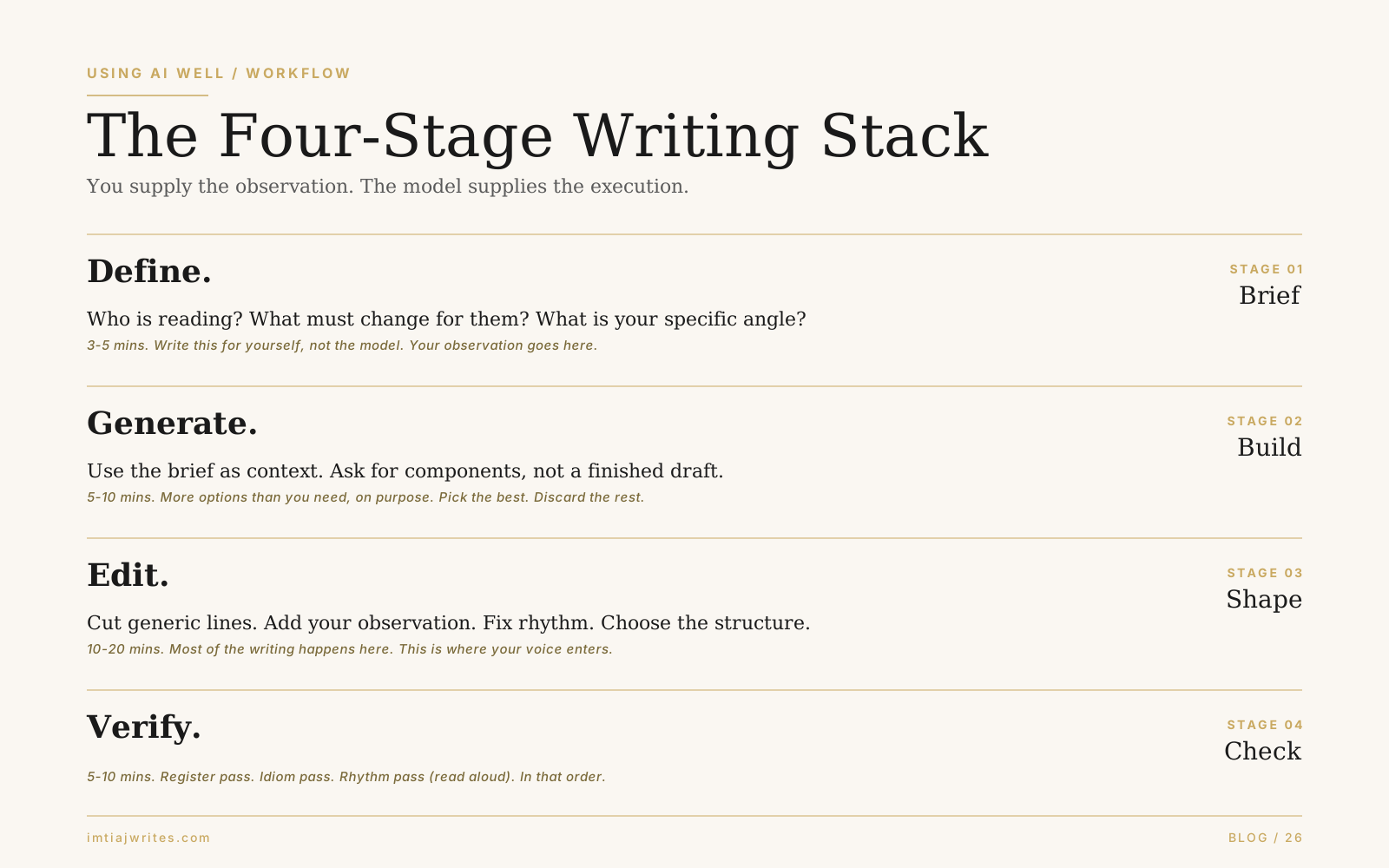
Four stages. Each one has a single job. Each feeds the next. Once you have the habit, the whole cycle takes 25-45 minutes for a piece of 400-1500 words, and the output is in a different category from what a single prompt produces.
Call this The Four-Stage Writing Stack:
1. Brief. You define what the piece must do, in your own words.
2. Build. You generate raw material with AI, using the brief as context.
3. Shape. You edit and restructure that material into your voice.
4. Check. You run a final pass for the patterns that quietly mark non-native writing.
Each stage below has the prompt logic and the most common mistake to watch for.
Stage 1: Brief
This is the stage most non-native writers skip, and it is the source of most flat output.
Before you type a single prompt, you write a short brief. Not for the model. For yourself. Three minutes, three questions:
➡️ Who is reading this, and what do they already believe?
➡️ What do I want them to think, feel, or do after reading?
➡️ What one specific thing makes this piece different from a generic version of itself?
The third question matters most. The “specific thing” is usually a detail from your real experience, a cultural angle you bring, or a strategic observation no one else on the brief would make. It is your contribution. Everything else the model can do. This part, only you can do.
Then you give the brief to the model. Not as the prompt. As context for the prompt.
❌ Write me a LinkedIn post about why non-native writers are undervalued.
✅ Here is the brief: The reader is a non-native English professional currently undercharging because they assume native writers are worth more by default. I want them to finish the post and question that assumption. My specific angle: I work inside a tech company in Shenzhen, writing copy for Western audiences, and the register gap I catch every day is something my native-speaking colleagues genuinely don’t see. Write three short LinkedIn posts using this brief.
The second prompt produces dramatically different output because the model now has a person, a reader, a goal, and a real angle to work from. The model writes the post. You wrote the brief. That is the right division of labour.
For the deeper version of how to use your first language to generate angles before switching to English, see the post on prompting in your first language.
Stage 2: Build
The Build stage is where you generate raw material. Not a finished draft. Material.
The mindset shift here is important. You are not asking the model to write your piece. You are asking it for building blocks. Sentences, openings, ways to phrase one specific idea. You pick the ones that fit. You discard the rest.
Which means: ask for more than you need, on purpose.
❌ Write a 400-word introduction for a blog post about AI tools for non-native writers.
✅ Give me 8 different ways to open a blog post about AI tools for non-native writers. Each opener should be three sentences or fewer. Take different angles: one starts with a frustration, one with a surprising observation, one with a before/after comparison, one starts in the middle of a scene. Don’t connect them. Just list them.
Eight options is not eight times the work. It is eight options from which you keep one and throw seven away. The one you keep is almost always better than anything a single-output prompt would have produced.
Prompt for components, not finished pieces. Openings. Transitions. Closing lines. Three different ways to phrase a difficult technical idea. You assemble the pieces. The assembly is where your voice enters the draft.
Stage 3: Shape
This is where the real writing happens. It is also the stage most non-native writers underinvest in.
Shaping does four things, in order:
Cut the generic. AI defaults to the most statistically likely version of any phrase, which is the version 10,000 other writers have already written. “In a world where…” “Whether you’re a beginner or a pro…” “At the end of the day…” Any line that could appear in any post on any topic gets replaced with a line that could only appear in this one.
Add your observation. The specific angle from your Brief goes in here. A sentence from your real experience. A cultural observation. A disagreement with the obvious take. The model cannot supply this. You wrote it down in Stage 1. Now it goes into the draft.
Fix the rhythm. AI output drifts toward even, medium-length sentences. Real writing varies. A short sentence. Then a longer one that takes its time getting where it is going. Mix them. The rhythm is part of the voice.
Choose the structure. AI often follows a predictable pattern: introduce problem, offer solution, end with call to action. Your piece does not have to do this. If the most interesting thing is the observation, lead with the observation. The structure is your decision, not the model’s.
Stage 3 is where the draft stops being AI-assisted and starts being yours. It takes the most time. It produces all the quality.
Stage 4: Check
The final stage is a targeted pass for the patterns that specifically mark non-native English in professional copy. Not basic grammar. Those got caught in Stages 2 and 3. The patterns Stage 4 catches are quieter.
Three passes, each focused on one category:
Register pass. Read each sentence and ask: is this too formal for the channel? A product page is not an academic paper. A pitch email is not a legal brief. Most non-native writers default to higher formality than the channel needs, because high formality was the target in school English. Catch it here.
❌ I am writing to inquire whether you might be available to discuss a potential collaboration at your earliest convenience.
✅ Would you be open to a quick call this week? I have a specific idea I think is worth ten minutes.
Idiom pass. Read for any phrase that you translated structurally from your first language. Not a literal word-for-word translation. A structural one. The kind of phrase that works perfectly in Bengali, Spanish, or Tagalog but reads as slightly unusual in English. If you are not sure, read the phrase aloud. If it sounds even slightly off, change it.
Rhythm pass. Read the whole piece aloud. Not in your head. Aloud. The sentences where you slow down, hesitate, or take a breath in the wrong place are the sentences that need restructuring. Your ear catches what your eye misses.
For the twelve-category version of this check with detailed examples, see the self-editing checklist post.
The one rule that holds the whole stack together
The Stack has one meta-rule that runs underneath every stage. Without it, the workflow produces clean mediocrity. With it, the workflow produces something that sounds like a specific human being.
The rule is: you supply the observation, the model supplies the execution.
Every piece worth reading has at least one thing in it that only you could have written. An observation from your actual experience. A disagreement with the standard take. A detail so specific it could only come from someone who was there. That is your contribution. It goes in the Brief. It surfaces in Stage 3. It is the thing the reader remembers.
The model’s contribution is everything else. The clean sentences. The correct grammar. The smooth transitions. The eight options instead of one. That is real value. It is not the value that makes the writing yours.
When you start a session without a specific observation to put in the Brief, the output will be generic no matter how clever your prompt. The leverage is in the observation, not the prompt technique. Most writers focus on the prompt technique. They are looking in the wrong place.
A note on which model to use
The Stack works with any major current model. GPT-5, Claude Opus 4.7, and Gemini 3 are all capable across all four stages. There are real differences in how each handles each stage.
Claude Opus 4.7 follows the Stage 1 context most carefully. If you give it a brief with specific constraints, it is the least likely to drift away from those constraints during drafting. For Stage 2 (Build), that reliability is genuinely useful.
GPT-5 produces the widest variety when you ask for multiple options in Stage 2. The eight openers it generates tend to span a wider range than the other models. For ideation, the variety helps.
Gemini 3 has improved on idiom detection over the last year and is useful in Stage 4 (Check) when you ask it to specifically flag phrases that might read as non-native to a Western professional reader.
You do not need all three. Pick one. The Stack works with any of them. The model is not where the quality lives. The quality lives in your Brief, in your Shaping, and in the rule above.
How long does this actually take?
Rough times once the habit is in place:
➡️ Stage 1 (Brief): 3-5 minutes
➡️ Stage 2 (Build): 5-10 minutes, including some prompt iteration
➡️ Stage 3 (Shape): 10-20 minutes depending on length
➡️ Stage 4 (Check): 5-10 minutes, including the aloud read
Total: 25-45 minutes for a 400-800-word piece. Add 15-20 minutes to Stage 3 for a 1500-word post.
That is slower than typing one prompt and accepting the output. The output is also in a different quality category, which is the only thing that matters when a client compares your work to the next writer’s.
Where to go next
➡️ If Stage 1 (the Brief) is the bottleneck, see the post on prompting in your first language for how to use your native language to generate sharper angles before switching to English.
➡️ If Stage 4 (the Check) is where your drafts are weakest, the self-editing checklist post has the full 12-pass version with specific examples.
➡️ For the prompt structure that protects your voice specifically at Stage 3 (Shape), see the voice preservation prompt framework post.
➡️ For the diagnostic that runs on your copy outside any AI workflow, the Natural English Edit is the 15-pattern checklist with prompts to run on your own drafts. Free.
Four stages. One rule. That is the Stack, and it is the difference between AI that flattens your writing and AI that amplifies it.
Frequently Asked Questions
What is the AI writing stack for non-native professionals? A four-stage workflow: Brief (define what the piece must do and your specific angle), Build (generate raw material with AI using the brief as context), Shape (edit and restructure the material into your voice), and Check (a targeted pass for register, idiom, and rhythm patterns). The Stack treats AI as a drafting assistant, not a vending machine. You supply the observation; the model supplies the execution.
Why do non-native writers get generic AI output? Because the prompt has no anchor: no specific person, no specific reader, no specific angle. The model fills the gap with the statistical average of the requested piece, which is generic by definition. The Brief stage of the Stack fixes this by giving the model real context before any drafting begins.
Which AI tool works best for non-native English writers? Any current major model (GPT-5, Claude Opus 4.7, Gemini 3) works for the full Stack. Claude follows brief-stage context most reliably. GPT-5 produces the widest variety of options at the Build stage. Gemini handles idiom passes well at the Check stage. None of the differences matter more than the workflow itself. Pick one model and build the habit.
How is this different from using a grammar checker? Grammar checkers address correctness. The Stack addresses naturalness, voice, and register, which are the problems grammar checkers do not see. The Check stage of the Stack overlaps slightly with grammar tools, but the Brief and Shape stages do work that no grammar tool addresses.
How much does this speed you up or slow you down? The Stack takes 25-45 minutes for a 400-800 word piece, which is slower than accepting a single AI draft. It is faster than writing from scratch without AI. The relevant comparison is not speed but quality: a draft produced by the Stack is consistently closer to publishable than a single AI draft, which means fewer revision rounds and fewer client comments.
Can I use the Stack in languages other than English? Yes. The Brief stage works best in your first language. Stages 2 and 3 work in whichever language the final output lives in. Stage 4 (the Check) applies only to the final output language.
