
AI writes more natural English than most non-native writers do, and pretending otherwise is the wrong place to start. You have probably already noticed. You finish a draft, run it through ChatGPT, and the rewrite that comes back reads smoother than your version. The grammar is cleaner. The rhythm is more native. The sentences land in places yours did not.
That observation sits in the chest like a small panic. If a tool can produce more natural English than you can, after years of work to reach where you are, what exactly are you being paid for?
This post is the answer to that question. The honest version, not the motivational one. Two things are true at once. AI does write more natural English than most non-native writers. And fluency was never the real value you were selling. The first fact does not threaten the second. You just have to understand why.
Why the model wins on fluency
Two numbers worth knowing first.
GPT-3, the foundation model behind early ChatGPT, was trained on roughly 400 billion tokens of text, most of it English, drawn from web pages, books, and Wikipedia. Newer models like Llama 3.1 were trained on around 15 trillion tokens, which is roughly 11 trillion words. A literate person, across an entire lifetime of heavy reading, processes somewhere between 100 million and 900 million words. The model has read between 12,000 and 100,000 lifetimes of English text.
You did not lose a fair fight. You were never in one.
When the model produces a smoother sentence than you do, it is not being more talented. It is doing pattern completion across a corpus larger than any human could read in twenty lifetimes. Of course the patterns it returns sound more native than yours. The patterns it returns are an average of millions of native writers, served back at the speed of a search query.
If your reaction to that feels like inadequacy, it is the wrong feeling for the wrong reason. The model’s fluency is not a measurement of your skill. It is a measurement of dataset size.
The real bias non-native writers do face
The fluency gap is real. The bias around it is also real, and worth naming so you can stop blaming yourself for things that are not about you.
A 2023 Stanford study by James Zou and colleagues tested seven AI detector tools against essays written by non-native English students. The detectors were “near-perfect” at identifying essays by U.S.-born eighth-graders as human-written. They flagged 61% of TOEFL essays from non-native English students as AI-generated. Across the same set, 97% of the essays were flagged by at least one detector. These were real students. Real human writing. Tagged as machine output by the tools meant to police machine output.
The reason is mechanical. The detectors score “perplexity,” which roughly tracks how predictable a piece of writing is. Native writers score higher on lexical richness and syntactic complexity by default. Non-native writers, even fluent ones, often write with cleaner, simpler structures, which is exactly the pattern the detectors flag as machine-like.
Read that gap carefully. The same tools that say AI writes “more natural” English are also flagging your real human writing as AI. The market is sending you two contradictory signals about your work, and both of them are wrong about who you are.
For more on that specific dynamic, see the post on AI detectors and non-native writing.
What you were actually being paid for
Now the harder question. If fluency is not the real value, what is?
Imagine the brief lands in your inbox. The product is a financial wellness app for first-generation immigrant professionals in major Western cities. The brand voice is “warm, direct, lightly humorous.” The deadline is Friday.
A native English copywriter can write that brief. So can ChatGPT, in seconds, with smoother surface English than either of you. So what does the actual hire come down to?
It comes down to four things, none of which fluency alone can deliver:
Strategic angle. The decision about what to say, not how to say it. Why does a financial wellness app for immigrants need a different opening than one for native-born professionals? What pain point is real for that audience and invisible to a writer who has not lived inside it? That is judgment, not vocabulary.
Cultural calibration. The instinct to know which idioms will land in Toronto and which will misfire in London or Singapore. Native fluency does not equal cross-cultural fluency. Most native English copywriters write for one English-speaking culture. You write across several without thinking about it.
Voice consistency. The discipline to keep a brand sounding like itself across 200 pieces of copy over two years. AI flattens voice toward a generic mean unless guided carefully. Holding a voice steady is a craft skill, not a fluency skill.
Editorial judgment. Knowing when the smoother version is the worse version. When a piece of copy needs friction, awkwardness, a deliberate stutter. When polish kills the line. AI defaults to polish. Knowing when to override that default is the actual job.
None of these are fluency. All of them are what clients pay for, even when they cannot articulate that fluency is not what they are buying. The smoother sentence does not win the brief. The better strategic call does.
For the deeper version of this argument, applied specifically to portfolio strategy, see the post on proof over polish.
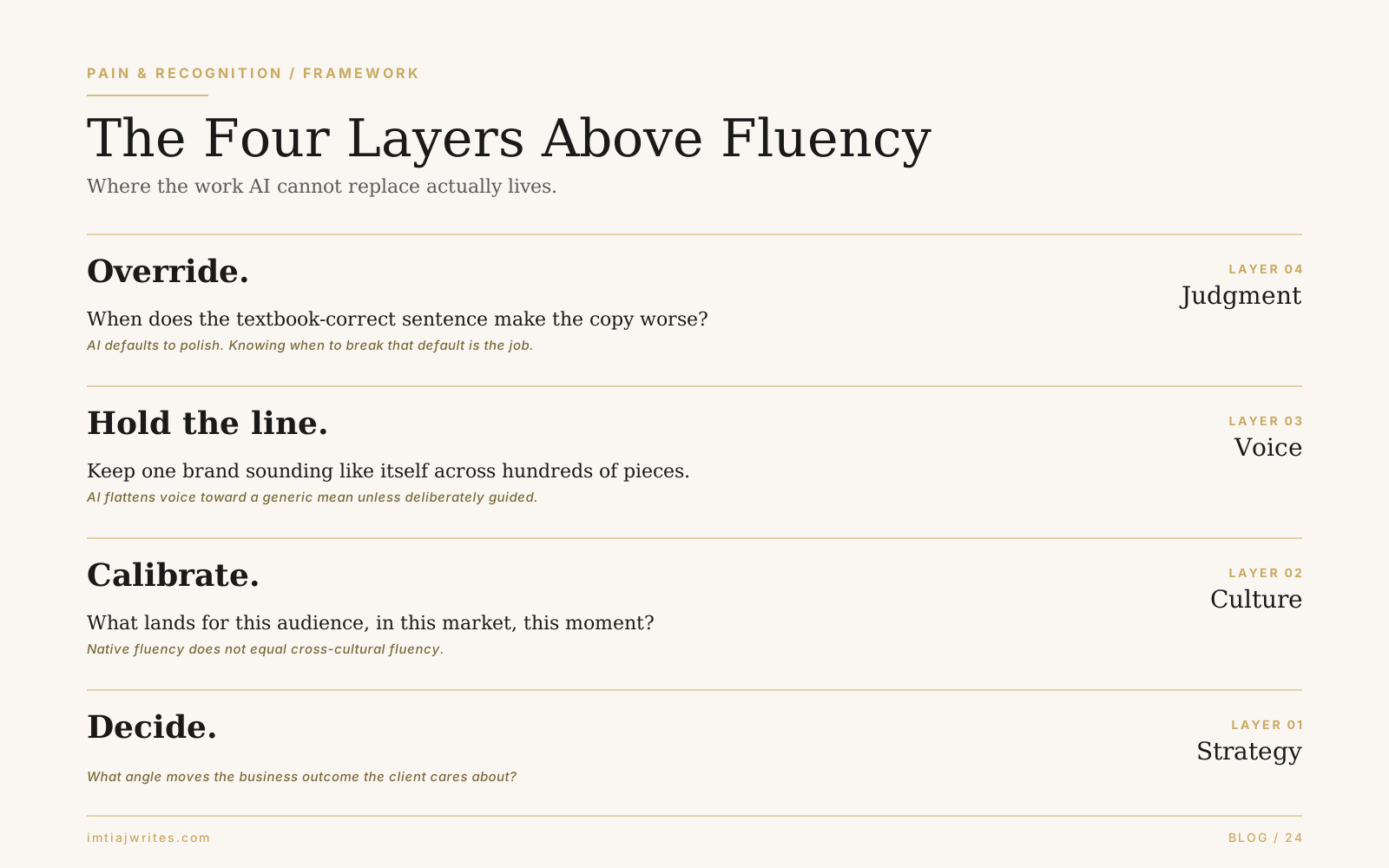
The framework: The Four Layers Above Fluency
When you stop trying to compete with AI on fluency and start working at the layers above it, four things become more useful than your sentence-level English.
Call this The Four Layers Above Fluency:
1. Strategy. What angle moves the business outcome the client cares about?
2. Culture. What lands for this specific audience, in this specific market, in this specific moment?
3. Voice. What does this brand sound like when it is at its best, and how do you protect that across volume?
4. Judgment. When does the textbook-correct sentence make the copy worse, and what do you do instead?
AI does Layer 0 (fluency) better than you on average. The four layers above sit beyond what current models do well without expert direction. That direction is your job. The model is a tool that produces text. You are the one who decides what text the tool should produce.
If that framing feels uncomfortable, that is because the freelance market is full of people selling Layer 0 services and calling it copywriting. Their work is the work AI replaces first. Yours, if you build it deliberately at the four layers above, is the work AI makes more valuable, not less.
The honest part
Three honest qualifications, because the rest of the internet has enough overconfident posts about how “AI just makes writers more powerful.”
First, the layers above fluency are harder to charge for than fluency itself. A client knows what a “blog post that sounds like a native English speaker wrote it” is worth. They are less sure what “strategic copywriting calibrated to a specific cultural subgroup” is worth. You will sometimes have to teach them. That is real friction, not motivational fluff.
Second, working at the higher layers means doing more thinking per dollar earned, not less. The volume of copy you can produce per day stays roughly constant. The difference is the quality of decision baked into each piece. That is harder work, even though it produces less visible output.
Third, this transition takes 6-18 months. You do not wake up tomorrow positioned at Layer 4. You build the positioning across two or three quarters of deliberate work, including the portfolio rebuild, the pricing reset, and the client conversations. Most non-native writers underestimate the timeline and quit halfway. The ones who do not are the ones who end up paid for what they actually do well.
Why this is not a story of replacement
The replacement narrative, taken at face value, says non-native writers will be the first to be automated out of professional copy work, because their fluency disadvantage compounds with AI’s fluency advantage. The math seems to support it. The market behaviour does not.
The market behaviour is more interesting. The clients hiring writers right now are not asking for “more native-sounding English.” They are asking for “writers who can use AI well to produce work that lands.” The brief has shifted under our feet. The skill being purchased now includes prompt design, editorial judgment, and cultural calibration alongside writing itself.
For non-native writers who already use multiple languages as a thinking tool (covered in the bilingual copywriter advantage post) and who already understand cross-cultural framing instinctively, the new brief is a better fit than the old one. The fluency-only brief was the one you were always going to lose against native peers. The strategy-plus-AI brief is one you can win.
That is not a guarantee. Nothing in this market is. It is a pointing-out that the fight you thought you were losing was already over, and the new fight has different rules that suit you better than the old ones did.
What to do this week
Three small moves, in order.
One. Stop measuring yourself against AI on fluency. The comparison is mathematically unfair and emotionally expensive. The hours you spend feeling inadequate are hours you could spend at the layers above.
Two. Pick one piece of recent copy you produced. Strip it of its surface English. What is the strategic decision you made? Can you articulate it in one sentence? If yes, that decision is the actual product you sold. Practice naming it.
Three. Update your portfolio, your bio, or your next pitch to lead with one of the four layers above fluency, not with sentence-level English. “I write copy that lands for cross-cultural audiences in major Western markets” is a different sale than “I am a fluent English copywriter.” The first one gets paid more, because the first one names a value the model does not deliver.
If you want a longer version of how to apply this thinking specifically to your written drafts (the layer right above fluency, where editorial judgment lives), the Natural English Edit is the 15-pattern checklist with ChatGPT prompts to run on your own copy. Free.
Where to go next
→ If the fluency comparison is what has been holding you back, the most useful next step is reading the post on the bilingual copywriter advantage, which covers what your two languages actually do for your work that no monolingual native writer can replicate.
→ For the portfolio strategy that makes the higher layers visible to clients, see the proof-over-polish post.
→ For the diagnostic on the writing itself, the Natural English Edit is the 15-pattern checklist with the ChatGPT prompts to spot patterns in your own copy. Free.
AI writes more natural English than you do. That is not the problem. The problem is mistaking fluency for value, in a market that pays for everything sitting on top of it.
Frequently Asked Questions
Does AI really write more natural English than non-native writers? On average, yes, on surface fluency alone. Models like ChatGPT are trained on trillions of words, which is roughly 12,000 to 100,000 lifetimes of human reading. The pattern density they can return at the sentence level exceeds what any individual writer, native or non-native, can produce in real time. This is a mechanical fact about training data scale, not a measurement of any individual’s skill or worth.
If AI writes more naturally than I do, why am I still being paid to write? Because clients pay for four layers above sentence-level fluency: strategic angle, cultural calibration, voice consistency, and editorial judgment. AI does not deliver these on its own. A skilled writer who uses AI well is paid to make these higher-layer decisions and direct the model to execute them. The fluency itself is now a commodity. The judgment around it is not.
Why do AI detectors flag non-native writing as AI-generated? Stanford research from 2023 found that 61% of TOEFL essays written by non-native students were flagged as AI-generated by the seven major detector tools, while essays by U.S.-born students were correctly identified as human. The cause is technical: detectors score “perplexity,” which correlates with lexical and syntactic complexity. Non-native writers tend to produce cleaner, simpler structures, which the detectors misread as machine output. The bias is in the tool, not in your writing.
What is The Four Layers Above Fluency? A framework for understanding what professional writers actually sell once AI handles surface fluency: Strategy (what angle moves the business outcome), Culture (what lands for the specific audience and market), Voice (consistent brand identity across volume), and Judgment (knowing when polish kills the copy). AI does the layer below this stack better than most humans. The four layers above are where human writers, especially non-native writers with cross-cultural instincts, still earn their rate.
Should non-native writers stop using AI to avoid feeling replaceable? No. Avoiding AI does not protect you from the market shift, it isolates you from it. The clients hiring writers now expect AI fluency as part of the workflow. Use AI for what it does well (fluency, drafts, options) and direct your effort at the layers above (strategy, culture, voice, judgment) where the actual money is. The writers who refuse to use AI are losing the same brief twice: once on output speed, once on positioning.
How long does it take to reposition from fluency-based work to higher-layer work? Most non-native writers need 6-18 months to make the transition fully, including portfolio rebuild, pricing reset, and client education. The first two or three months feel slow because the higher-layer positioning is harder to communicate than fluency. By month six, the new framing starts attracting different clients. By month twelve, the change in client mix is visible in income. By month eighteen, the old fluency-based pitch feels like a previous version of your career.
