
The bilingual copywriter advantage is real, and most non-native writers spend their early career hiding from it instead of using it. They apologise for the second language. They scrub their copy until it sounds like nobody in particular wrote it. Then they wonder why their work feels less alive than the writers they admire.
The framing is wrong. Two languages aren’t a deficit minus one. They’re a perspective layered on a perspective, and that combination produces creative moves a monolingual writer cannot make at all. Not because they aren’t talented enough. Because they don’t have the source material.
This post is about the three specific moves that the bilingual brain enables. None of them depend on having “perfect” English. All of them depend on stopping the apology.
The math is on your side, even if it doesn’t feel that way
Here’s the data point most non-native writers never see when they’re agonising over a Slack message at 11pm.
According to EC English’s compilation of British Council Future of English data (EC_English Data), only 4% of global English conversations involve two native speakers. Ninety-six percent of professional English in the world today is happening between people for whom at least one party isn’t writing in their first language. That’s the reality of the audience your copy is actually being read by.
The same compilation cites a separate finding: 88% of employers prefer hiring bilingual individuals over monolingual ones. The commercial premium on a second language is already priced in by the people doing the hiring. You’re competing in a market that values the thing you’re trying to hide.
The discomfort about being non-native exists in your head, the brief, and the gut reaction to a Western applicant pool. It does not exist in the underlying market reality. Once you internalise that gap, the whole strategy shifts.
You’ve probably had a moment that hinted at this
Imagine a brief lands in your inbox. The product is a fitness app launching globally. The agency’s first draft of the homepage opens with a sports analogy: “Get off the bench. Get in the game.” You read it twice. You can’t put a finger on what’s wrong, but something is. Then it hits you. The metaphor is American, and the app’s biggest growth market is Southeast Asia, where the sport that frame implies (American football, baseball) doesn’t even register.
The native writer who drafted it didn’t notice. They couldn’t notice. The metaphor was invisible to them because it was the water they swim in. To you, it was a foreign object on the page, because you’ve watched English-language copy from outside before you started writing it.
That moment, when you see something a native writer can’t, is the first hint of the actual advantage. The post is just naming what’s already happening when you let yourself notice it.
The framework: The Bilingual Lens
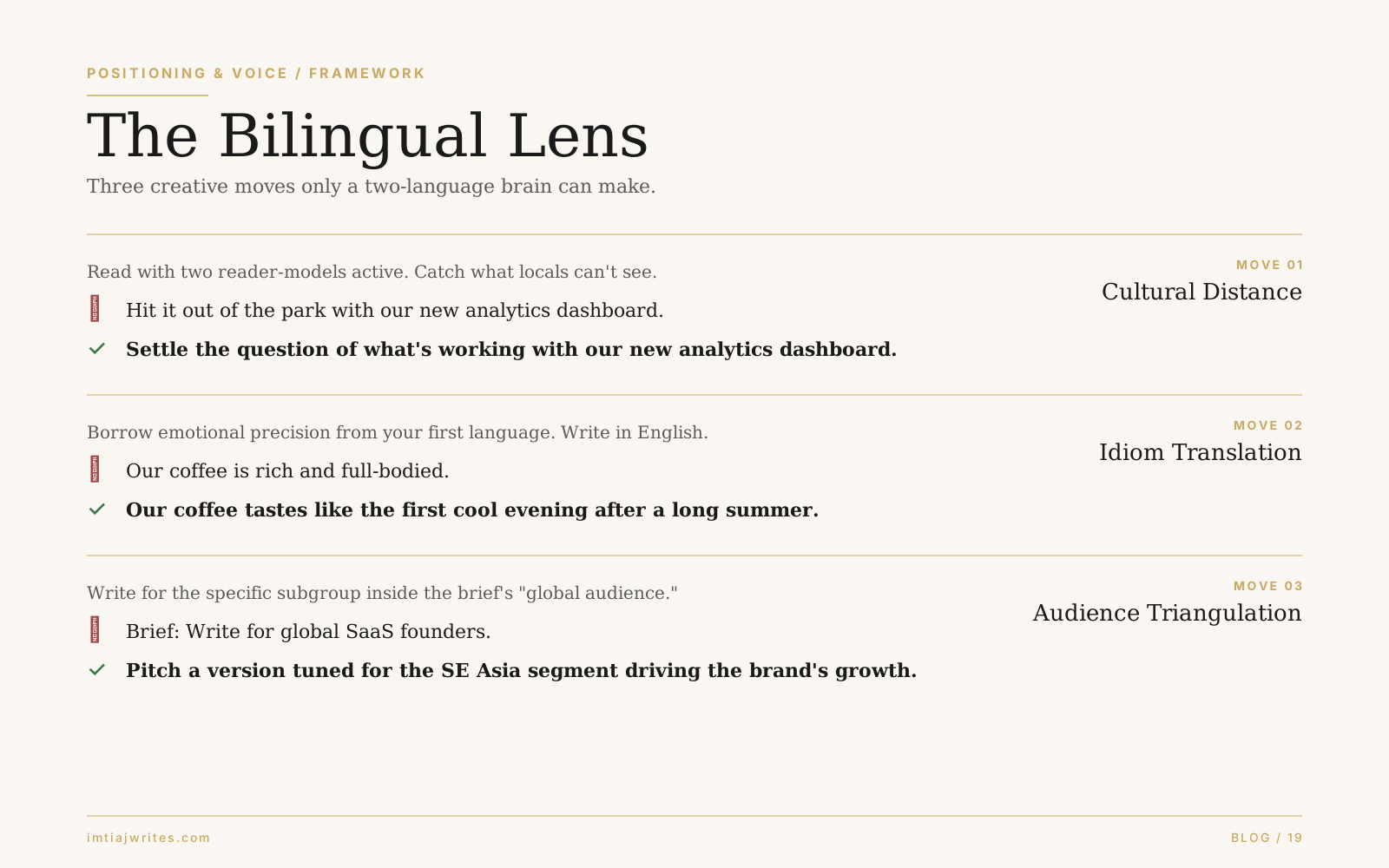
When you stop apologising for the second language and start using it, three specific creative moves become available. Together they make up what I call The Bilingual Lens:
1. Cultural Distance. Seeing the copy the way a non-Western reader will see it, because that’s how you first encountered Western copy yourself.
2. Idiom Translation. Borrowing emotional precision from your first language to fix something English alone is too clinical to express.
3. Audience Triangulation. Writing for a specific cultural subgroup of English readers (your own, or one adjacent) that monolingual native writers tend to lump into a generic “global audience.”
Each of these is a practical move, not a vibe. Each one shows up in the work as a measurable craft decision. And each one is something a monolingual writer literally cannot do, no matter how skilled.
Move 1: Cultural Distance
This is the most underused move in non-native commercial writing, and the one that compounds fastest once you start using it deliberately.
Cultural Distance means you read English copy with two reader-models active in your head at the same time. The Western reader the brief was probably written for. And the non-Western reader (a version of your earlier self, often) who has to translate the cultural reference, decode the idiom, or otherwise pay a small attention tax that the Western reader doesn’t pay at all.
❌ Hit it out of the park with our new analytics dashboard.
✅ Settle the question of what’s working with our new analytics dashboard.
The first version is a baseball idiom. It’s fine for the half of the market that grew up watching baseball. For the other half, it’s a brief speed bump where the brain has to either decode the metaphor or skip past it. Multiply that small tax across a homepage and you’ve lost real attention.
The second version uses an image (settling a question) that translates intact across almost every culture on earth. It’s not “less native.” It’s more globally legible, which for a product targeting more than one country is the actual brief.
A native writer almost never proposes the second version, because the first one is genuinely invisible to them as a cultural choice. To you, it’s a switch you can flip. That’s leverage.
For more on the deeper mechanics of how non-native perspective becomes a paid skill rather than something to hide, see the post on non-native perspective in copy.
Move 2: Idiom Translation
This is the more advanced move, and the one that takes the longest to get comfortable with, because it requires using your first language as a craft tool rather than treating it as background noise.
Every language has emotional precision in some areas where English is comparatively flat. Bengali has shades of melancholy English does not have a single word for. Spanish has registers of warmth English approximates with paragraphs. Japanese has aesthetic vocabulary (wabi-sabi, mono no aware) that whole genres of English copy try to reach toward without getting there.
You don’t translate these words. You translate the feeling shape. You let your first language tell you what emotional precision the line is reaching for, and then you find the English construction that lands closest to it.
❌ Our coffee is rich and full-bodied.
✅ Our coffee tastes like the first cool evening after a long summer.
The first line is technically correct English doing its standard work. The second line is emotional precision borrowed from a different language tradition. (Bengali lyrical writing, in this case, leans heavily on weather and seasonal change as an emotional vocabulary.) The English itself is plain. The idea behind the English came from somewhere a monolingual writer’s training set wouldn’t go to first.
The skill here isn’t bilingual word-substitution. It’s bilingual idea generation. You use your first language to find the angle, then you write the angle in English. The reader doesn’t need to know where the angle came from. They just notice that the line lands harder than the average product description.
This is also a useful corrective to the common non-native instinct to scrub all personality out of professional English in the name of “sounding more native.” Personality usually survives the scrub. Distinctiveness doesn’t. Idiom Translation is how you put distinctiveness back in deliberately.
Move 3: Audience Triangulation
This is the most commercially valuable of the three, and the most underused.
Most native English copywriters, even strong ones, write for an implicit “global English-speaking audience” that’s actually a slightly disguised version of the writer’s own native market. American writers default to American assumptions. British writers default to British. The implicit reader is monolingual, monocultural, and roughly the writer’s own demographic.
The bilingual copywriter advantage in this dimension is that you can write for a specific cultural subgroup of English readers with much more precision than a native writer can, because you’ve actually been one of them. You know what register lands in a Dubai-based marketing team. You know how a Bangalore engineer reads a sales email differently from a Berlin one. You know which words sound earnest in Manila and which sound smarmy in Sydney.
The brief almost never says “write for South Asian English-speaking professionals in tier-one cities.” But if you can identify that subset inside the brief’s audience and write a version that lands harder for that subset specifically, your copy outperforms in that segment. And that segment is increasingly a meaningful slice of revenue for the brands you’re writing for.
A practical move: when a brief says “write for global SaaS founders,” ask which markets are growing fastest. If the answer is Southeast Asia, India, or LatAm, propose a version that triangulates to that market explicitly. Frame it as a test, not a replacement. You will be the only writer in the applicant pool offering this. That’s positioning.
The trust dynamics around this kind of pitch (and how to navigate the country-of-origin trust gap when proposing a non-default angle) are a separate conversation. But the move itself is real, and the brands paying attention to global growth are starting to specifically request writers who can make it.
Where this stops working
I want to be honest about the ceiling here, because the rest of the internet has enough overconfident posts about non-native superpowers.
Cultural Distance only helps when the brief actually has a global audience. If you’re writing for a US-only DTC brand selling to a US-only audience, the native writer’s instinct for in-language idiom is the correct instinct, not a deficit. Don’t pitch The Bilingual Lens as a universal advantage. Pitch it as a specific advantage for specific kinds of work.
Idiom Translation depends on you actually maintaining your first language as a living tool. If you’ve spent ten years writing only in English and your first language is rusting, the well you’re drawing from is shallower than you remember. The move requires keeping both languages active. Most non-native professional writers don’t, and then wonder why their copy lost its earlier distinctiveness.
Audience Triangulation only matters to clients who are genuinely investing in non-Western markets. Some are. Many aren’t. Pitching this advantage to a client whose actual revenue is 95% domestic is wasted breath. Read the brief carefully before you offer it.
The point isn’t that two languages make every piece of copy better. The point is that two languages give you a specific, namable set of moves that, used at the right moments, do work a monolingual writer can’t replicate. That’s a positioning asset. Treat it like one.
Where to go next
→ If positioning is the next bottleneck after this post, the country-of-origin trust gap post covers how to handle the prejudgment that sometimes meets non-native writers in Western markets.
→ If you want to see how the bilingual lens shows up specifically as a portfolio asset (rather than a private craft input), the proof-over-polish post on portfolio strategy covers how to make this kind of advantage visible to a paying client.
→ For the broader system behind writing professional English at the level where these three moves can compound, the Natural English Edit is the diagnostic that runs on the writing itself: fifteen patterns with the ChatGPT prompts to run on your own copy. Free.
Two languages. Three moves. One stop apologising. That’s the Bilingual Lens, and that’s the work.
Frequently Asked Questions
What is the bilingual copywriter advantage? The set of three creative moves only a two-language brain can make: Cultural Distance (seeing copy the way a non-Western reader sees it), Idiom Translation (borrowing emotional precision from your first language to find angles English alone wouldn’t reach), and Audience Triangulation (writing for specific cultural subgroups of English readers more precisely than a native writer can). Together these make up The Bilingual Lens.
Does being bilingual really make you a better copywriter? Conditionally yes. Bilingualism by itself doesn’t improve writing. Using bilingualism as an active craft tool (rather than treating the second language as background noise) does. The advantage shows up in specific moves a monolingual writer can’t replicate, especially when the brief involves cross-cultural audiences. For domestic-only briefs, the advantage is smaller or neutral.
Should non-native copywriters lean into their cultural background or hide it? Lean in, but selectively. Don’t put it in your bio or apologise for it. Use it as a craft input on briefs where it produces a measurable angle a native writer wouldn’t reach. The positioning win is doing the work, not announcing the perspective.
What is The Bilingual Lens? A three-move framework for using two languages as a creative advantage in commercial writing: Cultural Distance, Idiom Translation, and Audience Triangulation. Each move is a specific craft decision rather than a soft claim about perspective. Each is something a monolingual writer cannot reproduce no matter how skilled.
Will clients pay more for a bilingual copywriter? The market data says yes in aggregate. EC English cites that 88% of employers prefer hiring bilingual individuals over monolingual ones, and that bilingual employees can expect up to a 20% pay increase relative to monolingual peers. Whether that translates to your specific freelance rates depends on whether your portfolio shows the bilingual advantage as work, not as a claim.
Does this advantage apply if I’m writing only in English, not translating? Yes, and that’s the core point. The Bilingual Lens doesn’t require you to write bilingually. It requires the bilingual brain to inform the English you write. The output is monolingual. The thinking behind it is not. That’s the leverage.
