
If you’ve ever sent a clean draft to a native editor and got it back covered in changes you didn’t recognise as “errors,” this is the checklist that closes most of the gap. The non-native writer’s self-editing checklist below isn’t grammar fixes. It’s the twelve patterns native editors silently rewrite when they “smooth your draft out” — patterns that aren’t wrong, but reliably mark prose as second-language even when every sentence is technically correct.
The way to use it: one pass per pattern. Twelve scans through your draft, each one looking for one thing. Sounds slow. Is faster than the alternative, which is reading through ten times trying to fix everything at once and missing most of it. (More on that in a minute.)
I’ll cover the method first, then the twelve patterns with before/afters. The whole thing is built to be a working tool, not a thing to read once and forget.
Why one pass per pattern, not one read for everything
Reading your own draft “to edit it” mostly doesn’t work. Your brain knows what the sentence is supposed to mean and fills in the gaps. You read what you intended, not what’s on the page. This is true for everyone, but it’s worse for non-native writers because the patterns we miss aren’t grammar errors that announce themselves — they’re register choices, rhythm defaults, and habitual word picks that look fine because they are fine in isolation. They only look off in aggregate.
The fix is what professional editors actually do, even though almost nobody describes it this way: scan once for one thing. Then scan again for the next thing. Single-purpose passes catch what omnibus reads miss because attention isn’t divided.
You don’t have to do all twelve. Most working writers I know batch them — three or four passes covering related patterns. I’ll suggest groupings at the end. The point is that “edit my draft” is too vague an instruction for your own brain. “Find every instance of Furthermore” is specific enough to actually work.
One audience-scale note before the patterns. The EF English Proficiency Index 2024, based on test results of 2.1 million non-native English speakers across 116 countries, reports an ongoing softening of worldwide English proficiency (PR Newswire). Most non-native professionals self-edit harder than they used to, partly because the bar is moving up under them. The checklist is built for that pressure.
The twelve patterns
Each pattern below has the same shape: what to look for, why it marks your draft as non-native, and a before/after. Read them all once, then do the passes one at a time on your actual draft.
Pattern 1: Textbook transitions
Look for: Furthermore, In addition, Moreover, Therefore, Consequently, Thus, Hence.
These connectors are taught as “good academic English” in most second-language curricula. They’re correct. They’re also the highest concentration of perplexity-flattening words in your toolkit, and they make prose feel assembled rather than thought. The Stanford / Liang et al. 2023 study on AI detectors found that non-native essays were misclassified as AI-generated at an average rate of 61.3% — and a major driver was lower lexical and structural variability, the exact pattern these connectors create. ResearchGate Cut them. The relationship between sentences is usually obvious without the marker.
❌ Furthermore, the pricing is competitive. In addition, the onboarding is fast.
✅ The pricing is competitive. Onboarding is fast — the demo runs you through it in seven minutes.
Pattern 2: Over-formal register where casual fits
Look for: In the event that, Please do not hesitate, We are pleased to, Kindly be advised, At your earliest convenience.
These are correct in formal letters from 1965. In a 2026 product email, a SaaS landing page, or a LinkedIn post, they read as a costume. The pattern I see most often when reviewing copy from non-native teams is over-formality used as a safety blanket — formal language feels less risky in a second language, even when the context is asking for casual.
❌ In the event that you encounter any issues, please do not hesitate to reach out.
✅ If something breaks, email us.
Pattern 3: Translated idioms
Look for: any idiom that almost works in English. Solve a headache, share some words, beat the iron while it’s hot, take the bull by its horns (when “tackle it head-on” is what you mean).
Idioms are the last thing to come naturally in a second language because they require cultural rather than linguistic memory. A literal translation usually produces something a native speaker would recognise as “almost an idiom” but not quite. Either get the idiom right or rephrase to plain language. Wrong-idiom is worse than no-idiom.
❌ This feature solves a big headache for your team.
✅ This feature takes one annoying job off your team’s plate.
Pattern 4: Rhythm flatlining
Look for: three or more consecutive sentences within two or three words of the same length.
Native English prose varies sentence length instinctively. Non-native prose often doesn’t, because rhythm was never taught as a separate skill from grammar. This is the single highest-payoff edit on most drafts. Cut one sentence in half. Merge two others. Vary until your eye stops noticing a pattern. (I covered this in more depth in why your English copy sounds translated — it’s the same root cause as a lot of “sounds off” feedback.)
❌ Our platform helps teams work better. It saves time. It improves collaboration.
✅ Our platform helps teams work better. It saves time, mostly by killing the second meeting nobody wanted. Collaboration just stops being the hard part.
Pattern 5: Safe-vocabulary defaulting
Look for: important, helpful, useful, effective, optimize, leverage, enhance, improve.
These are the words you reach for when you want to be correct in a second language. They’re correct. They’re also the lowest-information words in their category. Replace one in three with something more concrete. Not all of them — just enough to lift the draft out of generic-business-English.
❌ Our solution helps businesses optimize their workflow and improve operational efficiency.
✅ This cuts a step out of the workflow you probably do twice a week.
Pattern 6: Hedge stacking
Look for: somewhat, fairly, quite, rather, perhaps, possibly, in some cases, to some extent, generally speaking — especially two or three of these in the same sentence.
Hedging is a non-native instinct because confident assertions in a second language feel risky. Stacked hedges read as either nervous or evasive, neither of which lands well. Pick the one hedge the sentence actually needs. Cut the others.
❌ This feature might possibly be somewhat helpful for users in certain cases.
✅ This feature helps when your team is pulling reports from more than one source.
Pattern 7: Article and preposition fingerprints
Look for: missing articles (“user wants…” instead of “the user wants…”), or prepositions that don’t quite fit (“on the weekend” vs “at the weekend” depending on dialect; “discuss about” instead of “discuss”).
Articles and prepositions are the things grammar checkers miss most often, and they’re the loudest non-native fingerprint in otherwise clean prose. Run a single pass looking only at every “the / a / an” and every preposition. Yes it’s tedious. Yes it’s the pass that closes the most invisible distance.
❌ We need to discuss about the proposal on the weekend.
✅ We need to discuss the proposal over the weekend.
Pattern 8: Possessive overuse
Look for: of the constructions where ‘s would be tighter (or vice versa, depending on what reads cleaner).
Many languages use “of [thing]” structurally where English prefers “[thing]’s.” This is a small thing per sentence and a large thing across a draft.
❌ The strategy of the company has shifted in the direction of the enterprise market.
✅ The company’s strategy has shifted toward enterprise.
Pattern 9: Nominalisation
Look for: nouns formed from verbs that hide the action: make a decision (decide), carry out an analysis (analyse), give consideration to (consider), have a discussion (discuss).
Non-native writing leans on nominalisations because they sound formal and feel safe. They also flatten energy. A draft full of nominalised verbs reads like a memo. Recover the verb.
❌ The team will conduct an analysis of the data and make a decision regarding the next phase.
✅ The team will analyse the data and decide the next phase.
Pattern 10: Modal verb pile-ups
Look for: would, could, should, might, may used together or in close succession.
English modals carry a lot of nuance, and stacking them (“we would be able to potentially help you with this”) usually means the writer wasn’t sure which one was the right one and used several. Pick one.
❌ We would be able to potentially help you with this if it could possibly fit your timeline.
✅ We can probably help, depending on your timeline.
Pattern 11: Empty connector phrases at the start of sentences
Look for: It is important to note that, It should be mentioned that, It is worth pointing out that, As a matter of fact.
These phrases announce that something important is coming, then take three to seven words to do nothing. Cut them. Start with the actual content.
❌ It is important to note that the pricing tier changes for teams above ten users.
✅ Pricing changes above ten users.
Pattern 12: Conclusion fillers
Look for: In conclusion, To summarize, To wrap up, At the end of the day, All in all.
These are the writing equivalent of clearing your throat before saying the thing. Native English-language writing in 2026 mostly skips them and goes straight to the point. If you have a real conclusion, just write the conclusion sentence and let it sit there.
❌ In conclusion, the platform offers strong value for mid-market teams.
✅ For mid-market teams, this platform earns its price.
The framework: The Twelve-Pass Filter
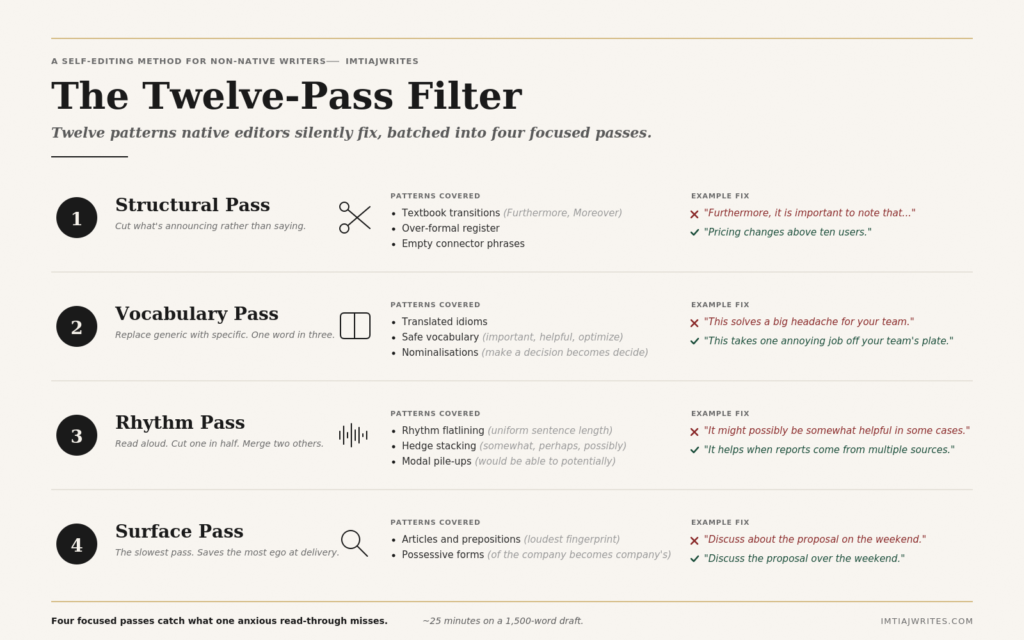
Twelve passes feels like a lot. In practice, you can batch them into four passes that cover everything, which is the version most working writers I know actually use. Call it The Twelve-Pass Filter, but run as four:
1. Structural pass — Patterns 1, 2, 11, 12 (transitions, register, throat-clearing, conclusion fillers). Cut everything that’s announcing rather than saying.
2. Vocabulary pass — Patterns 3, 5, 9 (translated idioms, safe vocabulary, nominalisations). Replace generic with specific.
3. Rhythm pass — Patterns 4, 6, 10 (sentence-length variation, hedge stacking, modal pile-ups). Read aloud.
4. Surface pass — Patterns 7, 8 (articles/prepositions, possessive forms). The slowest pass. Saves the most ego at delivery.
Four passes on a 1,500-word piece is roughly 25 minutes if you’re focused. Less than the time you’d spend reading through it anxiously six times catching less.
What the checklist won’t fix
Three things, named honestly so you don’t expect it to do work it can’t do.
It won’t fix structure. If the argument is wrong, smoother sentences make it more polished, not more correct. Reorder your points before you run the checklist.
It won’t fix voice. The patterns are about removing non-native fingerprints, not adding personality. Voice is a separate skill — I covered the situational version in your non-native perspective in copy.
It won’t fix register at the strategic level. The checklist scrubs the prose; it doesn’t tell you which register the brief is asking for. That’s a brief-reading skill, not an editing one.
What it will do reliably: close most of the visible distance between your draft and the version a native editor would hand back.
Where to go next
🡢 Read why your English copy sounds translated for the deeper version of why these patterns mark prose as second-language in the first place.
🡢 Read why AI detectors flag your writing — most patterns on this checklist are also the ones triggering false-positive AI scores.
🡢 Or grab the Natural English Edit — the 15-pattern version of this checklist, with ChatGPT prompts attached, designed to run on a draft in under ten minutes.
FAQ
What is a self-editing checklist for non-native English writers? A short list of recurring, non-grammatical patterns that mark prose as second-language English, with concrete fixes for each. The patterns are about register, rhythm, and word choice — not grammar errors. Native editors silently fix these patterns when they “smooth out” your draft.
Why edit one pattern at a time instead of all at once? Because dividing your attention across many problems means you catch fewer of them. A single-purpose pass — “find every textbook transition,” “look at every preposition” — is specific enough that your brain can actually execute it. Multi-purpose reading produces the illusion of editing without the result.
How long does it take to edit a piece using the twelve-pattern method? Roughly 20–30 minutes for a 1,500-word piece if you batch the patterns into four grouped passes. Twelve separate passes is more thorough but rarely necessary in working contexts. Batched, the method is faster than re-reading anxiously and catches more.
Will this checklist make my writing sound like a native English speaker? It will close most of the visible distance, not all of it. The remaining gap is voice and cultural specificity, which the checklist doesn’t address. The goal isn’t sounding native; it’s removing the patterns that flag your draft as second-language regardless of content quality.
What’s the most important pattern to fix first? Sentence-length rhythm (Pattern 4), because it’s the highest-payoff edit on most drafts and a single pass closes a lot of the “sounds translated” gap. After that, textbook transitions (Pattern 1) and articles/prepositions (Pattern 7) are the next two highest-impact passes.
Can I use ChatGPT to run this checklist for me? Yes for a first pass, no as a final step. ChatGPT will catch many of these patterns if you ask it to look for them specifically — pasting the twelve-pattern list into a prompt works. But ChatGPT also tends to replace your voice with generic American business English in the same edit, so a final human pass is still required to keep the draft yours.
