
The honest version of “how I write copy for global brands” is less glamorous than the LinkedIn version. There’s a brief that’s never as clear as the brief should be. There’s a draft that’s worse than the second draft will be. There’s a stretch of editing that makes you doubt the work, and a moment where the piece comes together and you remember why you do this. None of that is unique to non-native writers.
What’s unique is what sits underneath the workflow: the small, constant calibration of which voice is this brief asking for, and how much of mine belongs in it. After more than five years doing this from Shenzhen for tech brands targeting global English-speaking audiences — including public work on many EcoFlow campaigns — I’ve settled on a workflow that handles that calibration deliberately, instead of leaving it to anxiety. This post is that workflow, step by step, with the trade-offs named.
Quick map: how I read briefs, the four-stage drafting loop, the references I keep close, the AI step (handled honestly), and the parts of being a non-native writer that turn out to be assets in this work — and the parts that genuinely don’t.
What “global brand” actually means for the writing
Before the workflow, one piece of context that changes everything downstream.
“Global brand copy” is not one thing. A US-headquartered SaaS expanding into Europe wants something different from a Chinese energy storage/automobile/drone/camera company launching to American consumers, which is different again from a European luxury brand running a global digital campaign. The writing problem is different in each case, and the part of being non-native that’s an asset is different in each case too.
For most of the work I do, Asian-headquartered or globally-distributed tech brands writing English copy for Western and global audiences, the core problem is cultural translation without translation-feel. The brand has a real story, often shaped by its origin culture. The copy needs to land for a reader who doesn’t share that culture, without losing what made the story worth telling. Native writers who’ve never lived the cultural origin sometimes flatten that story into generic Western tech copy. Non-native writers who haven’t done the calibration work sometimes preserve cultural texture that doesn’t travel. The job sits in the middle.
This is the same dial-control idea I covered in your non-native perspective in copy — applied to the specific case of writing for global brands rather than to the general positioning question.
How I read a brief
Most briefs are not as clear as the client thinks they are. The first hour of any project is treating the brief as a document that needs interrogation, not just a set of instructions to follow.
Three questions I run on every brief, in order:
1. Who exactly is reading this, and what mental state are they in when they read it? “B2B audience” is not a reader. “An ops manager at a 200-person company who’s been told to evaluate three competing tools by Friday” is a reader. The mental state matters: a reader hunting for a fast comparison wants different prose than a reader scrolling LinkedIn at 9 pm. The brief usually doesn’t specify this, so I write my best guess, attach it to the brief, and ask the client to confirm or correct before I draft.
2. What does the brand sound like when it’s being itself, not when it’s being marketed? The strongest source for brand voice is rarely the brand guidelines document. It’s the founder on a podcast, the support team’s email replies, the engineering team’s blog posts. I’ll often spend the first 20 minutes of a project reading those rather than the brand guidelines, because that’s where the actual voice lives.
3. What does this piece need to do, in one sentence? Most briefs are written in feature-language (“highlight the new pricing tiers, emphasize the security improvements, mention the upcoming integrations”). I rewrite this in reader-language: “Convince an ops manager who’s been burned by a previous tool that this one won’t burn them again.” The reader-language version is the actual brief. The feature-language version is a list.
The output of this hour is a one-page document that I send back to the client before drafting. It says: here’s who I think the reader is, here’s the voice I’m aiming for, here’s what I think the piece needs to do, here’s what I’d skip from the original brief and why. Either I get a quick “yes” and the project becomes a draft job. Or the conversation that follows clarifies something I would have gotten wrong otherwise.
The market wants this skill more than the market knows it does. CSA Research’s 2020 survey of 8,709 consumers across 29 countries found that 76% of online shoppers prefer to buy products with information in their native language, and 40% will never buy from websites in other languages. Global brands with English copy are competing for the audience that’s still comfortable in English — which is a smaller group than most clients assume — and within that group, the difference between competent English and resonant English determines outcomes (Social Media Today).
The four-stage drafting loop
After the brief is solid, the actual drafting runs in four stages. I’ll write them as a sequence; in practice, they overlap.
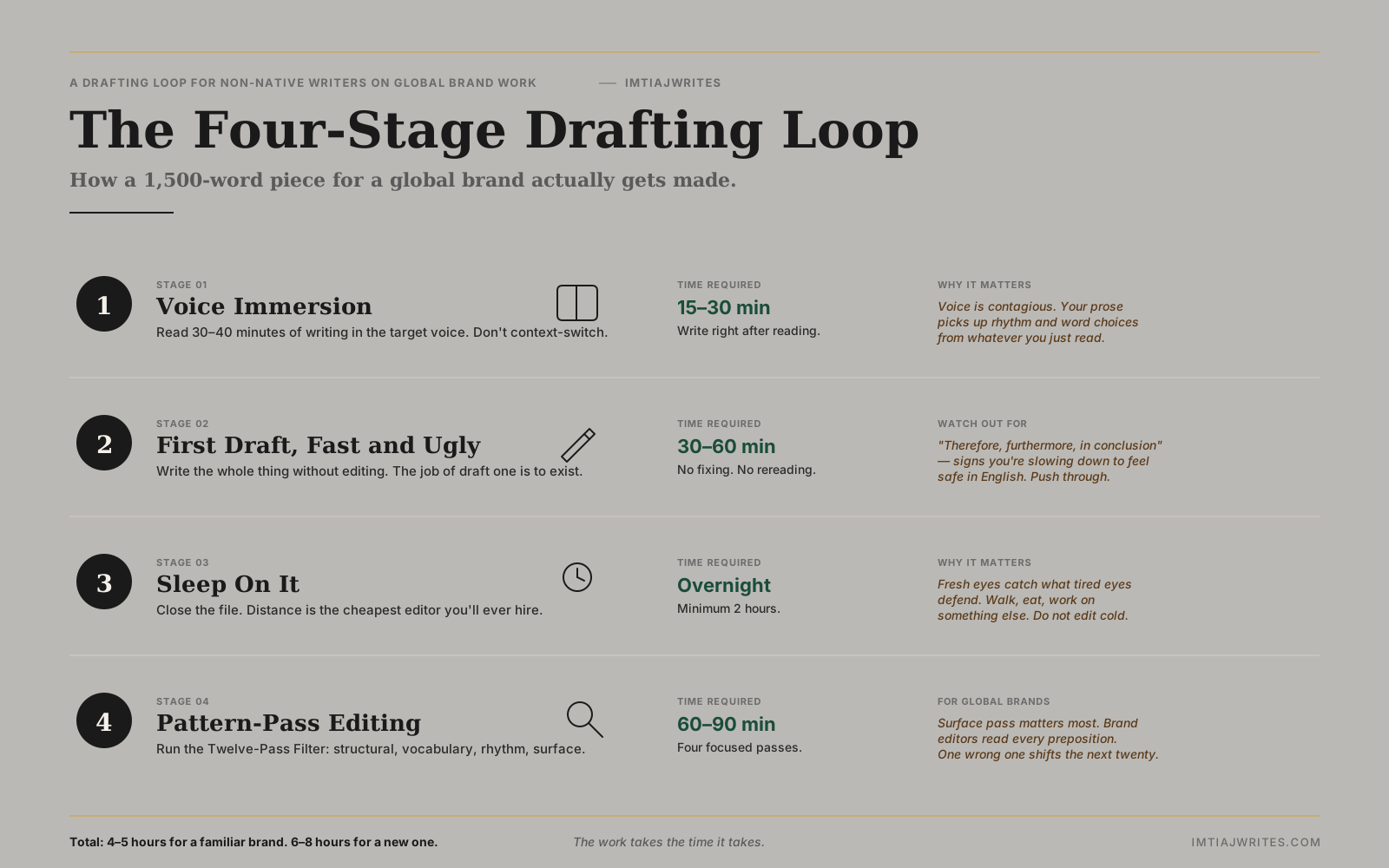
Stage 1: Voice immersion (15–30 minutes)
Before I write a word, I read 30–40 minutes of writing in the voice I’m aiming for. Brand-specific, where possible (their last six months of published work). Closely-related where not (two or three brands whose voice the target brand would aspire to, or a writer whose register fits).
This is the step most non-native writers underuse, and the one with the highest leverage. Voice is contagious — your prose will naturally pick up some of the rhythm and word choices of whatever you’ve just been reading. Write right after reading. Don’t read the brief again, don’t check email, don’t context-switch. The window stays open for about an hour.
Stage 2: First draft, fast and ugly (30–60 minutes)
Write the whole thing, beginning to end, without editing. Don’t fix sentences. Don’t reread paragraphs. Don’t pick the better word — circle the okay word and move on. The job of the first draft is to exist, not to be good.
For non-native writers specifically, this stage is where over-formality usually creeps in. Watch for it. If you find yourself reaching for therefore, furthermore, in conclusion, you’re slowing down to feel safe in English. Push through. The patterns can be cleaned up in stage 4.
Stage 3: Sleep on it (overnight, ideally; minimum 2 hours)
Distance is the cheapest editor. If the schedule allows it, I close the file at the end of stage 2 and don’t reopen it until the next morning. The draft I read with fresh eyes is a much more honest reading than the one I read while still inside it.
If overnight isn’t possible, two hours is the minimum useful gap. Walk, eat, work on something else. Do not edit cold.
Stage 4: Pattern-pass editing (60–90 minutes)
This is the Twelve-Pass Filter I covered in the self-editing checklist, batched into four focused passes: structural, vocabulary, rhythm, surface. I run all four in this stage, in that order. Each pass takes 15–20 minutes on a 1,500-word piece.
What changes for global-brand work specifically: the surface pass matters more than usual, because brand-side editors will read every preposition. A draft with one wrong preposition gets the same flag from a Western brand editor as it does from a recruiter — quietly, in their head, and it shifts the next twenty things they read.
Total time
For a 1,500-word piece for a brand I’ve worked with before: 4–5 hours of focused time. For a brand I’m new to: 6–8 hours, with the extra hours mostly in voice immersion and the post-brief calibration document. New writers usually try to do this work in 2–3 hours and wonder why the result sounds like a draft. The work takes the time it takes.
Where AI fits in this loop (and where it doesn’t)
I use AI tools deliberately, in two specific places, and I deliberately don’t use them in three others.
Where I use them: Voice-matching during the editing pass, using the four-layer prompt structure I covered in the prompt framework to match your voice. And vocabulary research — when I want a more specific verb than the one I’ve defaulted to but can’t find it in the moment, AI is faster than a thesaurus and produces options I can evaluate quickly.
Where I don’t use them: The first draft (because AI’s default register overrides voice work I’ve already done). The brief interrogation (because the questions worth asking come from thinking, not from generation). And the final read-aloud pass before delivery — because the rhythm of a piece is something my ear catches and AI flattens.
The non-native writer’s specific risk with AI is over-reliance: trading visible non-native fingerprints for invisible generic-American ones. Used carefully, AI accelerates the cleanup. Used carelessly, it replaces the writer with the model’s default voice, and the client paid for the writer.
Where being non-native is genuinely an asset in this work
Three places, named honestly. Not the universal “your accent is your superpower” pep talk — three specific work situations where the non-native writer has a real edge.
1. Spotting where translated thinking has snuck into the source brief. When a brand’s original copy was written by a non-native team in their home market and is now being adapted for global audiences, a non-native English writer can usually spot the patterns that won’t travel. We are pleased to announce in a Chinese tech brand’s English press release isn’t a stylistic choice — it’s a register translation that lands wrong on a US reader. A native writer might smooth it without naming the cause; a non-native writer can point at the cause, fix it, and explain it to the brand team.
2. Cultural translation in either direction. A brand expanding from Asia into Western markets benefits from a writer who has lived inside both cultural defaults. Same for the reverse — a Western brand writing for an Asian audience often needs someone who can flag where the literal translation is technically correct and pragmatically wrong.
3. Pricing flexibility on long retainers. The cost-of-living arbitrage is real, and within ethical limits, it’s a feature for both sides — the brand gets a senior-skill writer at a rate that’s sustainable for the brand’s marketing budget, and you make a strong income relative to your local market while saving the difference for whatever the long game is. The honest framing of this is in non-native copywriter pricing and closing the country-of-origin trust gap.
And where it isn’t
Two places to name honestly, so you don’t confuse them with assets.
Pure American cultural reference work. A campaign that needs to feel born of American suburban Gen X nostalgia — sitcom callbacks, regional inside jokes, specific generational textures — is not the brief where being non-native helps. It’s the brief where it doesn’t, full stop. Take the work if you can, decline if you can’t. Don’t fake it.
High-velocity short-form social. Twitter-pace copy in a specific platform-native voice is faster for a native writer than a non-native one for one simple reason: you’re not running the calibration loop, you’re just writing. At my own pace, I can do this work, but a 14-tweet thread takes me 90 minutes, where a native writer might do it in 30. Decide whether the work is paying enough to be worth the time.
What I’d tell you to focus on first
If you’re trying to move from “freelance writer in Asia” to “writer global brands hire,” the highest-leverage moves are not the ones LinkedIn rewards.
They’re: building a portfolio of three to five live, published pieces for any named Western brand, even small ones. Running the brief interrogation step on every project until it becomes muscle memory. Investing in the voice-immersion habit even on small projects, so it scales when the projects get bigger. And reading published global-brand copy weekly, the way other people doomscroll — not to copy it, but to keep your ear calibrated.
The five-year version of this is a portfolio that does the qualifying work for you. Inbound briefs from clients who already trust the work. Rates that reflect skill rather than location. Most days, that’s just the work — same draft, same edit, same sleep-on-it gap. The thing the LinkedIn version skips: most of it is boring. The boring is what makes it sustainable.
Where to go next
➡️ Read your non-native perspective in copy for the dial-control framework that sits underneath all of this.
➡️ Read the non-native writer’s self-editing checklist for the editing pass that runs in stage 4 of the drafting loop.
➡️ Read the prompt framework to match your voice for the AI step.
➡️ Or grab the Natural English Edit — the 15-pattern checklist for tightening the writing before delivery.
FAQ
Can a non-native English writer realistically write copy for global brands? Yes, and a meaningful number do. The skill is matching the voice the brief is asking for and managing the cultural translation deliberately. Non-native writers have specific advantages in cross-cultural work and brands with international positioning, alongside genuine limits on certain kinds of culturally-specific work.
What does a non-native copywriter’s workflow look like for global brand projects? Roughly: an hour of brief interrogation, 15–30 minutes of voice immersion, a fast first draft, an overnight gap, and 60–90 minutes of pattern-pass editing. For a 1,500-word piece for a familiar brand, that’s 4–5 hours of focused work. For a new brand, 6–8 hours.
How do non-native writers handle brand voice when English isn’t their first language? By treating voice as a signal you import deliberately rather than something you have by default. Read 30–40 minutes of writing in the target voice before drafting, and write while that voice is still in your ear. The voice-matching prompt structure works for the editing pass.
Should non-native writers use AI tools when writing for global brands? Selectively. AI is useful for editing-stage voice matching (with a structured prompt) and vocabulary research mid-draft. It’s a poor fit for the first draft, brief interrogation, or final read-aloud — because it overrides voice work or flattens rhythm. Use it where it accelerates cleanup, not where it replaces thinking.
What’s the highest-leverage skill for a non-native writer aiming at global brand work? Brief interrogation — the skill of treating the brief as a document to question rather than instructions to follow. This skill compounds: it produces better drafts, better client relationships, fewer revision cycles, and, over time, a portfolio that reflects clearer thinking, not just cleaner writing.
Are there parts of global-brand copywriting where being non-native is a real disadvantage? Yes. Highly culturally-specific work (American suburban nostalgia, regional generational humor) and high-velocity short-form social copy in platform-native voices both run faster for native writers because the calibration step is automatic for them and deliberate for you. The honest move is recognising those briefs and either pricing in the extra time or declining.
