
Rewriting non-native English copy is rarely a grammar problem. Your sentences are clean. Your meaning is clear. The feedback still comes back with something vague: “can you make it flow better?” or “something feels a little off.”
That’s the ceiling fluent non-native writers run into. It isn’t beginner errors. It isn’t vocabulary. It’s something quieter, and harder to name without a framework.
This post is a diagnostic. Three before-and-after rewrites of the kind of copy I see most often when reviewing work from non-native professionals writing for Western audiences. The edits are small. The shift in how the copy lands is not.
If you’ve ever stared at a paragraph of your own writing and known something was wrong without being able to point at what, this is for you.
Why grammar isn’t the problem
The audience for this post is large, and it’s growing. Of the roughly 1.4 billion people who speak English to some degree, fewer than 400 million are native speakers (Engram, citing Statista 2023). So the math is simple: most professional English in the world today is written by people for whom it isn’t a first language.
Grammar isn’t where they get stuck. Register is.
A 2023 study published in PLOS Biology found that papers written by non-native English speakers are 2.5 times more likely to be rejected and 12.5 times more likely to be sent back for revision, on the basis of language alone (Amano et al., The manifold costs of being a non-native English speaker in science). That’s academia, but the same dynamic shows up in commercial copy. The difference between “approved” and “send it back” often isn’t whether the writing is correct. It’s whether the writing sounds like it belongs. PLOS
That’s what the three rewrites below address.
The framework: The Layer Check
When non-native copy reads as off, it’s almost never one thing. It’s usually some combination of three layers firing slightly wrong at the same time.
Here’s the diagnostic I run before I touch a sentence. Call it The Layer Check:
👉🏻 Register. Is the formality level matched to the audience and the channel?
👉🏻 Idiom. Is there a phrase that’s been translated directly from your first language, even though English has its own equivalent?
👉🏻 Rhythm. Does the sentence move the way an English speaker would actually say it out loud?
You don’t always need to fix all three. But you should always check all three. One misfiring layer is usually enough to make the whole sentence feel slightly wrong to a native ear, even when nothing in it is technically incorrect.
Now the three rewrites.
Case 1: The over-formal product description
This pattern shows up constantly in copy from professionals who learned English in formal academic settings. The grammar is perfect. The register is set to “boardroom” when the channel is “product page.”
Here’s the type of line I see often:
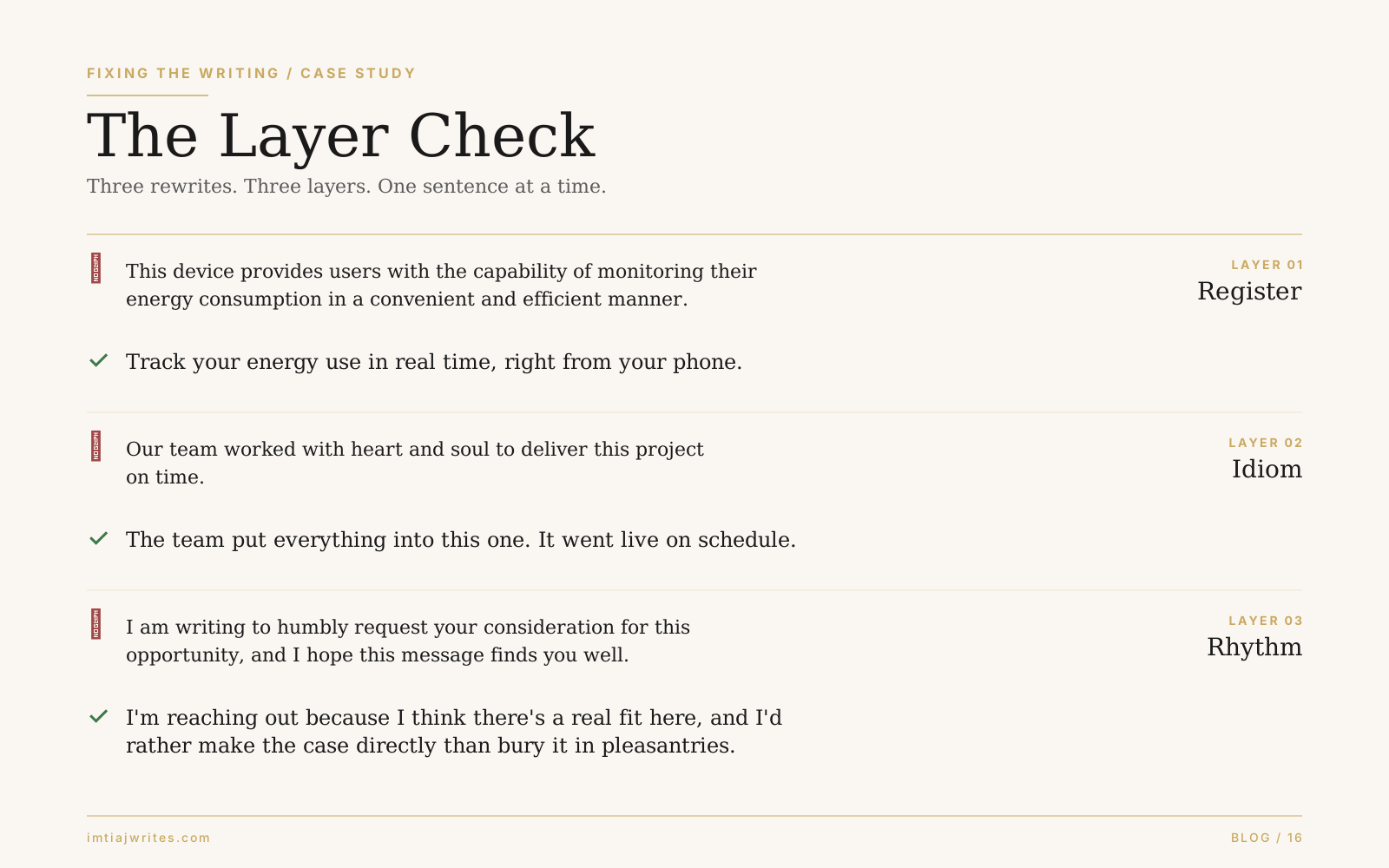
❌ This device provides users with the capability of monitoring their energy consumption in a convenient and efficient manner.
Nothing’s wrong, technically. But “provides users with the capability of” is nine words doing the work of one: lets. “In a convenient and efficient manner” is what gets written when someone isn’t sure how to end a sentence and reaches for ceremony.
A copywriter writing for a consumer tech audience would probably land closer to:
✅ Track your energy use in real time, right from your phone.
Layer Check: Register too formal. Rhythm too slow.
The fix didn’t add information. It removed weight. The product is the same. The reader’s experience of meeting that product on the page is completely different.
This kind of pattern is why I wrote why your English copy sounds translated. The Register Gap is the single most expensive habit in non-native commercial writing.
Case 2: The translated idiom
This one’s harder to catch because the idiom makes complete sense in your first language. You’re not making an error. You’re translating a thought that happens to have a different shape in English than the one you reached for.
❌ Our team worked with heart and soul to deliver this project on time.
“Heart and soul” is a near-direct translation of an idiom that exists in Bengali, Hindi, Mandarin, Arabic, and several other languages. English has its own version, but it’s not “heart and soul” used this way. In professional English, that phrase reads as slightly literary, almost old-fashioned outside song lyrics.
The fix isn’t to scrub personality. It’s to find the equivalent that carries the same weight in the target register:
✅ The team put everything into this one. It went live on schedule.
Layer Check: Idiom directly translated from L1. Register slightly theatrical for the context.
The revised version isn’t colder. It’s just calibrated for where it actually appears: a project update, a case study, a portfolio caption. Not a motivational speech.
Case 3: The respectful opener that creates distance
This is the one that trips up the most experienced non-native writers, because the instinct behind it is real courtesy. In many cultures, opening an email or a pitch with a warm acknowledgment is the correct social move. In Western professional writing, the same instinct often reads as hesitation.
❌ I am writing to humbly request your consideration for this opportunity, and I hope this message finds you well.
Two phrases are working against the writer. “Humbly request your consideration” signals deference in a context where Western readers expect confident self-presentation. “I hope this message finds you well” has been used so many times it’s become invisible. Most readers skim past it before the actual pitch even starts.
✅ I’m reaching out because I think there’s a real fit here, and I’d rather make the case directly than bury it in pleasantries.
Layer Check: Register too deferential. Rhythm delays the point.
The revision is still respectful. It just respects the reader’s time, which is what Western professional culture codes as polite. The cultural instinct isn’t wrong. The translation of that instinct into English copy is what needs the adjustment.
If you’ve felt this exact pull (the gap between sounding polite in your first language and sounding confident in English) you’re not the only one.
What these three cases share
None of these are grammar mistakes. None would get flagged by Grammarly, ProWritingAid, or any other proofreading tool. That’s exactly why rewriting non-native English copy is harder than it looks: the tools were built to find what’s wrong, and these patterns aren’t wrong. They’re just not native.
That’s why The Layer Check is a framework, not a feeling. When you finish a draft, you run each line through the three questions: register, idiom, rhythm. Then you decide whether to edit.
Feeling is unreliable, especially when the language you’re editing isn’t your first. A checklist is slower for the first few days. After that it becomes automatic, and your drafts start landing on the right register the first time.
If you want a longer version of this kind of diagnostic, I built a free 15-pattern checklist (with ChatGPT prompts to run on your own copy) called the Natural English Edit. It’s the same diagnostic logic, expanded across the patterns I see most often. You can grab it here.
A note on AI tools and rewrites
I want to address this directly, because I get the question every week.
Yes, you can paste any of the “before” examples above into ChatGPT or Claude and get a competent rewrite. The output will probably be acceptable. It will also probably sound like every other AI-rewritten paragraph on the internet right now: smooth, generic, forgettable.
The Layer Check matters because it teaches you which layer to fix, not just that something needs fixing. Once you know that, AI becomes useful for the right job. You stop asking it to “make this sound better” (vague, generic output) and start asking it to “rewrite this with a less formal register but keep the original sentence rhythm” (specific, useful output).
The framework is the leverage. The tool is just the lever.
Where to go next
If a specific layer kept showing up while you were reading these examples, the next steps depend on which one.
→ For register, read the difference between correct English and natural English.
→ For idiom and rhythm, read why your writing sounds translated even when it’s not wrong.
→ For a diagnostic you can run on your own drafts, the Natural English Edit is the longer version of The Layer Check. Fifteen patterns, with the ChatGPT prompts to run them automatically. Free.
Three layers. One sentence at a time. That’s the work.
Frequently Asked Questions
Why does my English copy sound off even when the grammar is correct? Usually because of a register mismatch, a directly translated idiom, or rhythm that doesn’t match how an English speaker would say the sentence aloud. Grammar checkers don’t catch any of these because none of them are technically wrong.
What is the Layer Check? A three-question diagnostic for non-native English drafts. Before you finalize a sentence, ask: Is the register matched to the audience? Is there a translated idiom? Does the rhythm match how an English speaker would say it out loud? If all three pass, the sentence will sound natural even without a native rewrite.
Can I use ChatGPT or Claude to rewrite my non-native copy? Yes, but only after you know which layer is failing. Generic prompts like “make this sound better” produce generic output. Specific prompts about register, idiom, or rhythm produce useful edits. Knowing what to ask for is the actual skill.
How do I know if my copy is too formal for the audience? Read it aloud. If it sounds like a press release when the channel is a product page, an Instagram caption, or a sales email, the register is too high. Most non-native over-formality comes from how English was taught, not from what the audience actually wants.
Do native English copywriters make these mistakes? Native writers occasionally hit the wrong register, but they rarely produce translated idioms or unnatural rhythm because their ear catches it before the sentence is finished. The non-native version of editing has to do consciously what a native writer does instinctively. That’s a difference in process, not in skill.
Are these mistakes common in professional copy from non-native writers? Yes. The over-formal register is the most common, the translated idiom the second most common, and the over-respectful opener mainly shows up in pitches, applications, and outreach emails. All three are fixable once you know what to look for.
