
Open Shopify’s homepage and look at the verbs. “Set up payments.” “Start for free.” Two calls to action on the same page, one a phrasal verb and one a plain one-word verb, and neither is “Configure payment infrastructure” or “Commence your complimentary period.” You can check this yourself in ten seconds, along with Spotify’s “Sign up” beside “Cancel anytime” and Wise’s “Log in,” “Sign up,” and “Send money” all on one screen.
Now look at the same actions in copy written by most non-native professionals I review. “Activate.” “Configure.” “Purchase.” “Commence.” Every one is grammatical, every one is correct, and every one is the reason the page reads like it was translated from a manual.
The problem with phrasal verbs in copy is not that non-native writers don’t know them. You know “turn off” and “set up” perfectly well. The problem is that you were trained not to use them, and that training is measurable.
The avoidance reflex, and where it came from
Here’s the mechanism, and it’s not a guess. It’s one of the most replicated findings in second-language research.
In 1985, Dagut and Laufer tested Hebrew-speaking learners of English and found something odd. The learners knew phrasal verbs like “let down” and “show off.” When asked to express the same idea, they reached for “disappoint” and “boast” instead. They avoided the phrasal form while knowing it. Hulstijn and Marchena found the same avoidance in Dutch learners in 1989, for a different reason: Dutch has similar constructions, and the learners distrusted them as too easy. Liao and Fukuya replicated it with 70 Chinese learners in 2004, published in Language Learning, and found the avoidance strongest at intermediate proficiency and weaker, but still present, at advanced levels.
Across Hebrew, Dutch, Chinese, Arabic, Japanese, and a dozen other first languages, the pattern holds. And the research names the trigger: the mere existence of a one-word synonym makes learners avoid the phrasal verb. If “commence” exists, you’ll write “commence” over “start,” because your schooling filed the Latinate word under “advanced vocabulary” and the phrasal one under “casual.”
That filing is backwards for the copy. In professional English, “start” is not the casual version of “commence.” “Commence” is the ceremonial version of “start,” and readers hear the ceremony.
So the textbook sound isn’t a vocabulary gap. It’s a systematic preference for the wrong column, installed by the same instruction that gave you correct grammar. The fix isn’t learning more phrasal verbs. It’s learning when your reflex is steering you wrong.
What a phrasal verb actually is
Briefly, so we agree on terms. A phrasal verb is a verb plus a particle that together mean something the verb alone doesn’t: “turn off,” “set up,” “find out,” “back up.” The particle changes the meaning, which is why “turn” and “turn off” are different actions.
Two things people file under phrasal verbs but shouldn’t: fixed phrases like “let us know” and “make use of,” and verb-plus-preposition pairs like “depend on,” which I covered separately in the prepositions that mark you as non-native. Different mechanisms, different fixes.
And one rule that trips non-native writers even when they use phrasal verbs correctly: with a separable one, the pronoun goes in the middle.
❌ Turn off them before you leave.
✅ Turn them off before you leave.
“Turn off notifications” and “turn notifications off” are both fine. “Turn off them” is the one native readers flinch at, and it’s a tell in its own right.
The three-verb test
Now the method, because “use more phrasal verbs” is the wrong lesson and would make your copy worse in a different direction.
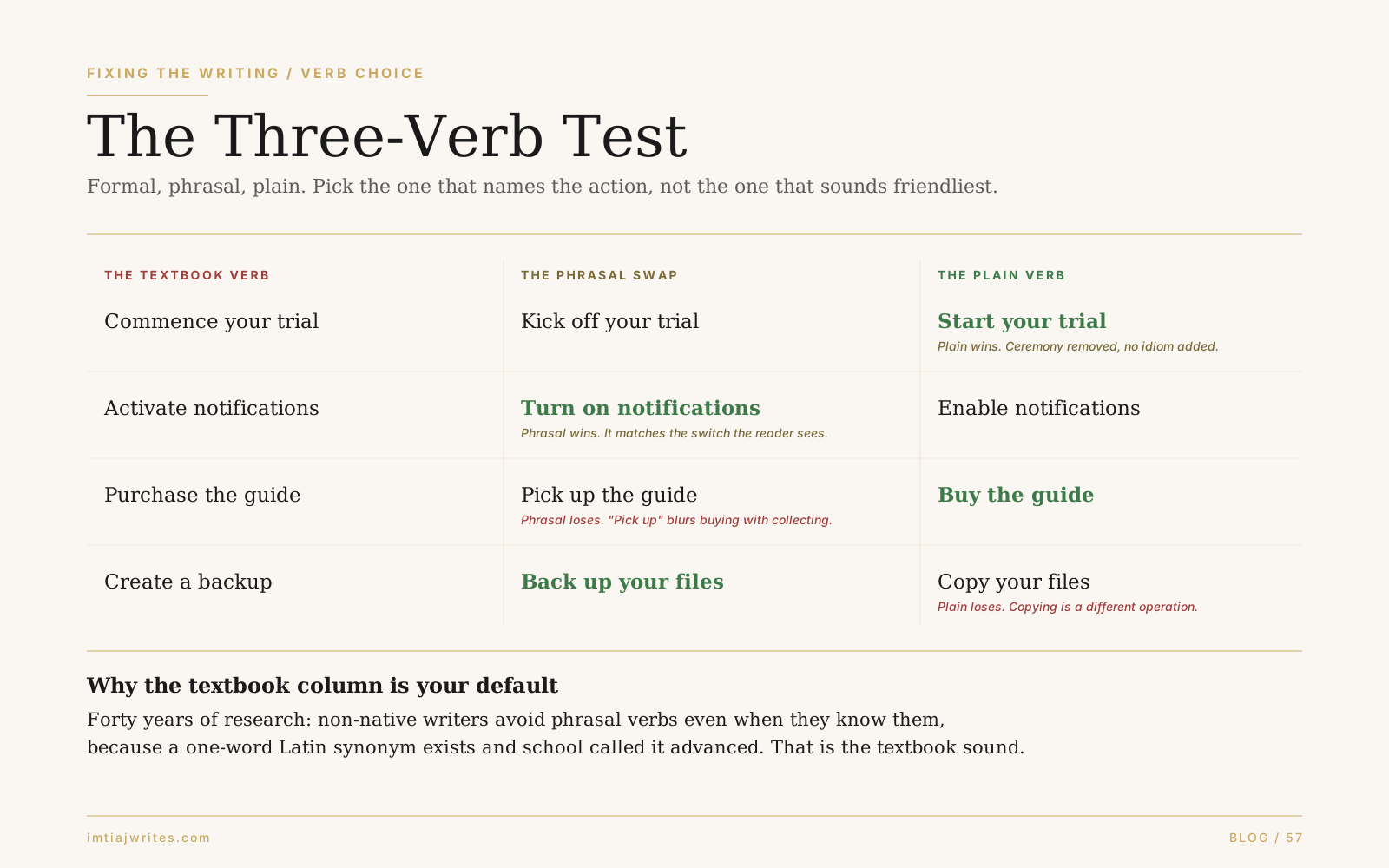
For any verb that sounds stiff, line up three candidates: the formal word you wrote, a phrasal alternative, and the plain one-word verb. Then pick the one that names the reader’s action most precisely. Not the friendliest. The most precise.
Commence your trial → Kick off your trial → Start your trial. Plain wins. “Commence” is a ceremony. “Kick off” adds an idiom nobody needed. “Start” names the action and stops.
Activate notifications → Turn on notifications → Enable notifications. Phrasal wins, because the reader is looking at a switch, and switches turn on. “Enable” is fine but one degree more abstract than the thing on the screen.
Purchase the guide → Pick up the guide → Buy the guide. Plain wins, and the phrasal version is actively worse. “Pick up” can mean collect, and a reader buying a download shouldn’t have to resolve that.
Create a backup of your files → Back up your files → Copy your files. Phrasal wins, and the plain version is wrong. Apple’s own support pages say “Back Up Now” because backing up is a specific operation. “Copy” describes a different one. Here the phrasal verb is doing technical work, not tonal work.
Notice there’s no rule that the plain column wins. In two of four, the phrasal verb is the better choice. What decides it is whether the verb names what the reader actually does.
Here’s the pattern across a few more:
❌ Reduce your editing time.
✅ Cut your editing time.
❌ Utilize the template to generate your draft.
✅ Use the template to write your draft.
❌ We will endeavour to respond within 24 hours.
✅ We’ll get back to you within 24 hours.
That last one is the phrasal verb earning its place. “Get back to you” is what a person says. “Respond” is what a form says.
When the object changes the answer
This is the part a substitution list can’t teach, and it’s where the three-verb test earns its keep.
“Call off the launch” is a reasonable sentence. “Call off your subscription” is not, even though “call off” and “cancel” sit next to each other in a dictionary. The object changes which verb is natural. Launches get called off. Subscriptions get cancelled.
So never build a dictionary of “formal word → phrasal replacement” and apply it mechanically. Evaluate each verb with the noun it’s attached to. The test is a decision, not a lookup.
The same logic protects you from the most common failure the other way, which is decorative phrasal verbs that sound lively and say nothing:
❌ Level up your results, dial in your strategy, and kick off your journey.
✅ Cut your review time from two weeks to three days.
The first is three phrasal verbs and no information. It sounds conversational. It’s still a textbook sentence, just a different textbook. The fix wasn’t a livelier verb. It was supplying the missing fact, which is the same principle behind how to edit AI copy so it sounds human.
Where the caution is real
The strongest published argument against my title comes from Google’s developer documentation style guide, which tells writers producing content for global audiences to avoid phrasal verbs when a simpler verb exists. That’s serious guidance from people who think hard about translation, and it deserves a straight answer.
The answer is that Google’s own word list keeps “sign in” and “set up.” Even the guide that says to avoid them retains the conventional ones, because “sign in” names a recognisable action and “authenticate” does not, to most readers. So the distinction isn’t phrasal versus single-word. It’s conventional task language versus decorative language. “Sign in” is a label everyone reads instantly. “Level up your possibilities” is a promise the reader has to decode.
Three specific places to keep the plain verb even when a phrasal one is available:
Where the phrasal verb is figurative and unfamiliar. “Turn off” is transparent. “Put up with” is not, to a reader whose English came from a classroom. Research on non-native readers finds figurative phrasal verbs harder to process, though the studies are careful to say this depends on context and the specific verb, and I’d be careful too.
Where the edit changes the task. Netflix’s help page spells it out: signing out does not cancel your account. “Sign out” and “cancel” aren’t tonal variants. They’re different actions with different consequences, and no register preference is worth that confusion. Same with “contact us” versus “email us,” which quietly adds a channel requirement.
Where the action has consequences. Buttons involving money, accounts, or deletion get the plainest, most explicit verb available. “Cancel subscription,” not “Call it off.” Descriptive copy has room for tone. Controls don’t.
The honest limit
I looked for a study showing phrasal verbs improve conversion, or that readers process them faster, or that they build trust. I didn’t find one, and neither did the research pack this post draws on. The reading studies that exist are small, careful, and full of caveats. One 2019 result about word order stopped being significant when a single common verb was removed from the sample. That’s how fragile the evidence is.
So I’m not telling you phrasal verbs convert better. I’m telling you that a measurable reflex, installed by your schooling, is steering you toward the ceremonial column by default, and that a two-minute test per verb reverses it where it should be reversed and leaves it alone where it shouldn’t.
Formal, phrasal, plain. Name the action. That’s the whole method, and it survives every style guide.
Frequently Asked Questions
Why does my English sound like a textbook even though it’s correct?
Often because you default to formal one-word verbs where native professional writing uses phrasal or plain verbs: “commence” for “start,” “activate” for “turn on,” “purchase” for “buy.” Research since 1985 shows non-native writers systematically avoid phrasal verbs even when they know them, because a Latinate synonym exists and schooling labelled it advanced. In copy, that reads as ceremony rather than sophistication.
Should I use more phrasal verbs in my copy?
Not automatically. Use the three-verb test: line up the formal verb, a phrasal alternative, and the plain one-word verb, then pick whichever names the reader’s action most precisely. Sometimes that’s phrasal (“turn on,” “back up”). Often it’s plain (“start,” “buy,” “cancel”). Decorative phrasal verbs that add tone without information make copy worse.
Are phrasal verbs bad for international audiences?
Some are. Google’s style guide recommends avoiding them for global documentation when a simpler verb exists but keeps conventional ones like “sign in” and “set up.” The practical distinction is between task language readers recognise instantly and figurative idioms they have to decode. Keep the first, be cautious with the second.
What is the most common phrasal verb mistake non-native writers make?
Pronoun placement in separable phrasal verbs. “Turn them off” is correct; “turn off them” is not. The pronoun goes between the verb and the particle. This doesn’t apply to inseparable ones like “look into it.”
Can changing a verb change the meaning of an instruction?
Yes, and it’s the most important check. “Sign out” doesn’t cancel an account. “Copy” isn’t the same operation as “back up.” “Email us” adds a channel that “contact us” didn’t specify. Always confirm the substitute verb describes the same task before choosing it for tone.
Where to go next
👉🏼 For the companion problem, verb-plus-preposition pairs, see prepositions that mark you as non-native.
👉🏼 For the school habits behind the formal default, see unlearning school English.
👉🏼 For the editing pass where you run this test, see the two-pass edit.
👉🏼 For why lively verbs with no information still read as generic, see how to edit AI copy so it sounds human.
Formal, phrasal, plain. Name the action.
