
You’ve probably already tried. Fifty applications on a job board, a portfolio page nobody visited, maybe a profile on a freelance marketplace where the same three gigs get four hundred proposals each. Somewhere in there, you started wondering whether the problem was your English.
It usually isn’t. Getting your first copywriting client is not a writing problem, and treating it as one is why capable non-native writers stay stuck for months. The bottleneck is that nobody can see evidence you can do the job, and you’re trying to solve that by asking permission from people who have no reason to give it.
The plan below fixes that in four weeks. It is a 30-day plan, not a 30-day guarantee, and I’ll give you the honest version of what it can and can’t do, because a plan that promises a certain client in thirty days is lying to you, and you’ve probably read six of those already.
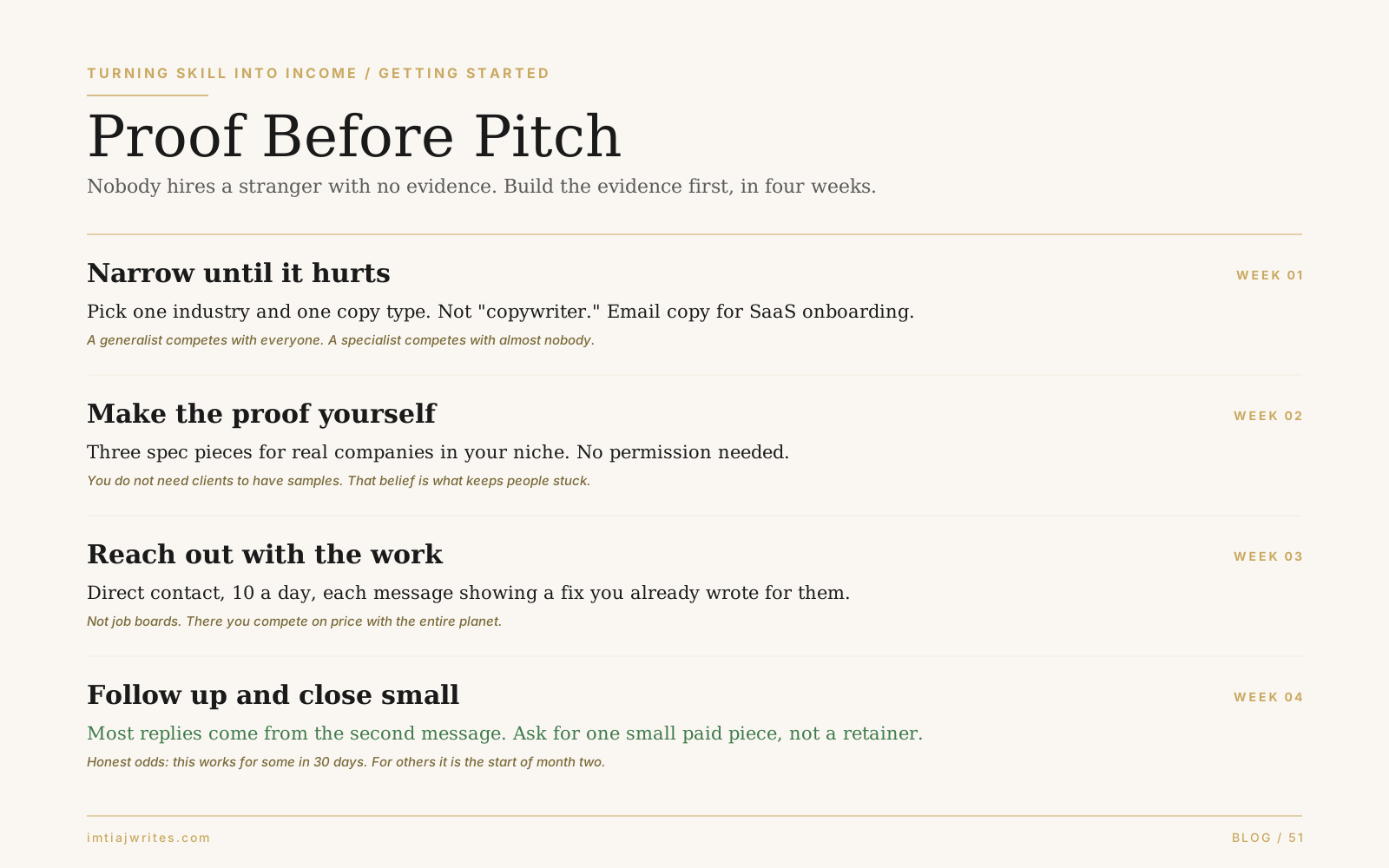
The honest odds, first
The plan takes thirty days. The client may take longer, and the difference between those two things is predictable.
It works within thirty days if you can put in real daily hours, you pick a niche you already understand, and you’re willing to do outreach that feels uncomfortable. It stretches to sixty or ninety days if you’re working full-time with limited evening hours, if you keep switching niches, or if you stall at the outreach step, which is where almost everyone stalls.
What the plan does reliably in thirty days is put you in a position where a first client becomes likely rather than random. That’s the honest promise. The client might land on day 22 or day 51, and the variable is mostly volume of outreach, not talent.
I’d rather you start this knowing that than quit on day 31 thinking you failed.
The principle: Proof before pitch
Here’s the thing that unlocks everything else.
Nobody hires a stranger who has no evidence. That’s not prejudice against beginners; it’s a sensible risk decision by someone spending money. So the entire game is manufacturing evidence before you have permission to make it.
Most beginners get this backwards. They pitch first, hoping someone gives them a chance, and then plan to build a portfolio from the paid work. That’s a queue you never get to the front of, because everyone ahead of you already has samples.
You don’t need clients to have samples. You need samples to get clients. And you can write samples today, for real companies, without asking anyone.
Week 1: Narrow until it hurts
Pick one industry and one type of copy. Not “copywriter.” Not even “B2B copywriter.” Something like email copy for SaaS onboarding sequences, or product descriptions for outdoor gear brands, or landing pages for online course creators.
This feels like it’s shrinking your opportunity. It’s doing the opposite. A generalist competes with every writer on earth for every job. A specialist competes with almost nobody and gets found by the specific people who need exactly that.
For a non-native writer, this matters twice over, because narrow expertise is the strongest counterweight to any doubt about your English. Nobody hesitates over a writer who clearly understands SaaS churn better than the alternatives.
Choose using two filters: an industry you already understand from work or genuine interest, and a copy type you can produce well. Your existing job is usually the best clue and the most overlooked one.
Spend the rest of week one building a list of 40 real companies in that niche. Name, website, the person who’d hire you, their email if findable. That list is your week three ammunition.
Week 2: Make the proof yourself
Write three spec pieces. Real companies from your list, real copy you’d actually pitch, written without being asked and without payment.
Take a company whose onboarding emails are weak, rewrite the sequence, and write two short paragraphs explaining what you changed and why. That last part is what separates a sample from a case study, and it’s the part beginners skip.
This is legal, standard practice, and it’s how most copywriters build their first portfolio. Label it clearly as spec work. Don’t imply you were hired.
❌ “Portfolio: Email sequence for [Company].” (implies you were hired)
✅ “Spec work: I rewrote [Company]’s onboarding sequence to fix the drop-off at email two. Here’s my thinking.”
The second version is honest and stronger because it shows diagnostic reasoning rather than just finished text. Clients hire the reasoning.
Three pieces is enough. Ten is procrastination dressed as preparation, which is the most comfortable way to avoid week three.
Week 3: Reach out with the work, not about it
This is where most people stop, so I’ll be direct: outreach is the step that decides the outcome. Everything before it is preparation, and preparation without outreach produces exactly zero clients.
Ten direct contacts a day, five days a week. Not job boards. On job boards you compete on price against the entire planet, and as a non-native writer that’s a race you’ll be pushed to the bottom of. Direct outreach puts you in a conversation instead of an auction.
The message that works isn’t a pitch. It’s a piece of finished thinking about their specific business.
❌ “Hi, I’m a freelance copywriter with strong English skills. I’d love to work with you. Here’s my portfolio.”
✅ “Hi [Name], your onboarding email two asks for a credit card before showing the product working. I rewrote that email to delay the ask. Here it is, no strings: [link]. Happy to do the rest of the sequence if it’s useful.”
The first asks for something. The second gives something and demonstrates the skill in the act of describing it. That’s the whole difference in reply rate, and it’s why week two exists.
Keep a simple tracker. Company, date sent, reply, follow-up date. Fifty contacts a week, two hundred over the month.
Week 4: Follow up, then close small
Most replies come from the second message, not the first. People are busy, your email arrived at a bad moment, and one polite follow-up a week later converts far better than the original.
One follow-up. Not four. “Just checking if this was useful” is enough.
When someone bites, ask for something small. One email, one landing page, one product description, at a real but modest price. Not a retainer, not a package. A small first job is easy to say yes to, and it converts a stranger into a client, which is the only threshold that actually matters. The second job is dramatically easier than the first, and the tenth is easier still.
On pricing that first job: charge something. Free work sets a precedent you’ll fight for years, and it signals uncertainty about your own value. If you’re unsure what to charge, the pricing models matter more than the number, which I broke down in how much copywriting costs.
What goes wrong, and what to do about it
You stall at week three. Almost everyone does. The fix isn’t motivation; it’s lowering the bar: send five instead of ten, but send them today. Outreach volume is the single variable most correlated with landing the client.
You get no replies at all. Usually, the message is about you rather than about them, or the niche is too broad to say anything specific. Reread your last ten emails and count how many sentences are about their business. If it’s under half, that’s the problem.
Someone questions your English. It happens, and it stings more than it should. Answer with work, not with defensiveness, and know that the specific patterns that read as non-native are fixable and identifiable rather than mysterious, which I mapped in the three mistakes that mark non-native copy.
Day 30 arrives with no client. You’re not behind. You have a niche, three portfolio pieces, two hundred contacts made, and a list of people who’ve now heard your name once. Month two starts from a position month one didn’t have. Keep going with the same system rather than redesigning it, because the redesign is usually just avoidance with a plan attached.
Thirty days of this puts most people close. Sixty puts most people over. The one thing that guarantees zero is the version where you spend all four weeks polishing samples and never send the emails.
Frequently Asked Questions
How do I get my first copywriting client with no experience?
Build proof before you pitch. Write three spec pieces for real companies in a narrow niche, clearly labeled as unpaid spec work, showing both the copy and your reasoning. Then contact those companies directly with the finished work attached rather than applying through job boards, where you compete on price with hundreds of others.
Is 30 days realistic for landing a first copywriting client?
It is realistic for some and not for others. It works within thirty days with consistent daily hours, a niche you already understand, and sustained outreach. It commonly takes sixty to ninety days for people working full-time or switching niches repeatedly. What thirty days reliably produces is the position from which a first client becomes likely rather than random.
Should I use job boards or Upwork to find copywriting clients?
Direct outreach converts better for a first client. On job boards and marketplaces you compete primarily on price against a global pool, which particularly disadvantages non-native writers. Direct contact with a specific company, referencing their actual copy, puts you in a conversation rather than an auction.
Can I use spec work in my portfolio if I was never hired?
Yes, as long as you label it clearly as spec work and never imply you were hired. Rewriting a real company’s copy and explaining your reasoning is standard practice for building a first portfolio, and showing the reasoning often persuades clients more than polished text alone.
How much should I charge my first copywriting client?
Charge something rather than working free, since free work sets a precedent and signals uncertainty about your value. Keep the first job small and modestly priced to make it easy to say yes to. The pricing model you choose matters more long term than the specific first number.
Where to go next
👉🏼 For what to charge once you have that client, see how much copywriting costs in 2026.
👉🏼 For which type of writing pays better, see copywriting vs content writing.
👉🏼 For the writing patterns that cost you credibility, see the three mistakes that mark non-native copy.
👉🏼 For defending your work if a client questions it, see when a client says your writing is AI generated.
Proof before pitch. Everything else is arrangement. Send the emails.
