
You wrote it yourself. Every sentence, every citation, every careful qualification. Then a detector told your professor it was 98 percent AI, and now you are drafting an email that reads like a confession you never should have had to write.
AI detectors academic writing conflicts have one cause, and it is not your honesty. The two want opposite things from a sentence. Scholarship rewards prose that is careful, hedged, and predictable. Detectors read predictable prose as machine-made. You followed the rules of your field exactly, and the rules of your field are what got you flagged.
I want to name the mechanism, because once you see it you stop taking the flag personally. Call it the Convention Trap.
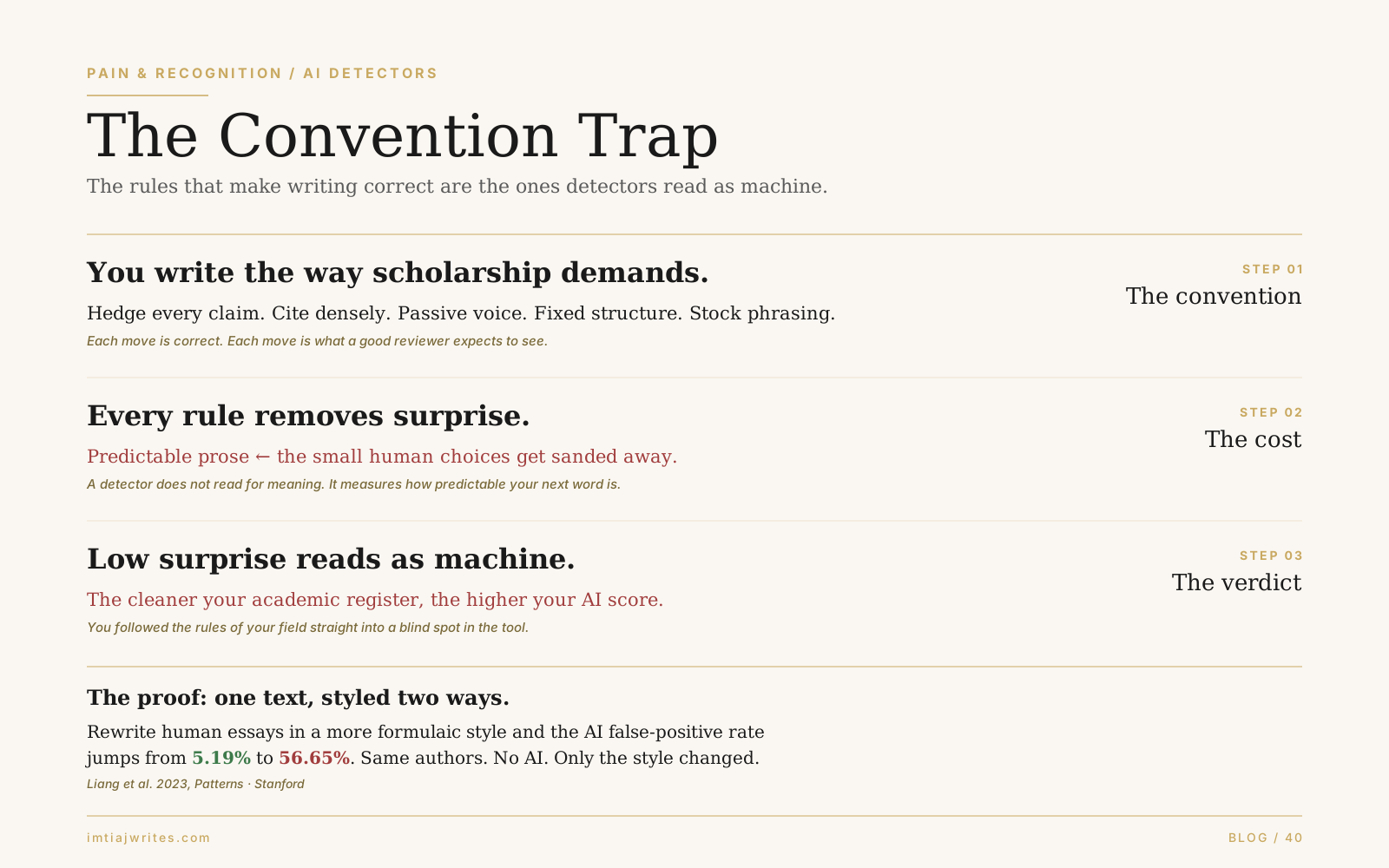
The Convention Trap
Formal academic writing is a style with strict conventions. You hedge your claims so you do not overstate. You cite densely so every assertion has a source. You lean on passive voice to keep yourself out of the sentence. You follow a fixed structure because reviewers expect it. You reuse the field’s standard phrases because that is how you signal you belong.
Every one of those moves reduces surprise. And surprise is what most detectors measure. A detector does not read for meaning. It estimates how predictable your next word is, and it treats low surprise as the fingerprint of a machine. The more correctly you write like a scholar, the more you erase the small unpredictable choices that mark a human hand. That is the trap. The register that earns you marks is the register that reads as artificial.
The proof is one text, styled two ways
Here is the finding that should change how you read any detector score.
In 2023, a Stanford group led by James Zou tested seven widely used detectors and published the results in the journal Patterns (Liang et al., 2023). They ran essays written by US eighth graders, real human writing, through the detectors. The false-positive rate was about 5 percent. Reasonable.
Then they changed one thing. They rewrote those same human essays with simpler, more formulaic word choices, the kind of flattened phrasing formal writing often produces. Same ideas. Same authors. Only the style moved. The false-positive rate climbed from 5.19 percent to 56.65 percent.
Sit with that, because it is the whole argument. Nothing about the authorship changed. No AI wrote the content. The researchers only made the prose more predictable, and the detectors reclassified more than half of it as machine-made. That is the Convention Trap in a controlled experiment. Make human text follow a tighter, more conventional style, and the machine starts calling it a machine.
The same study showed who pays most. When the researchers ran genuine TOEFL essays by non-native English writers, the detectors flagged about 61 percent of them as AI. Not because those students used AI. Because writing in a second language often means a narrower range of phrasing, and a narrower range is more predictable, and predictable is what detectors punish. If you write English as your second language and also write in a formal register, you are standing in the exact center of the trap.
What a normal abstract does, seen through a detector
Look at how a standard research abstract reads. It opens with a broad framing sentence. It names a gap using a stock phrase. It describes a method in passive voice. It reports a result with a hedge. It closes with a cautious implication. Every sentence is doing its job correctly, and every sentence is low-surprise by design.
A detector scanning that abstract sees near-uniform predictability from the first line to the last. It cannot know the uniformity comes from disciplinary convention rather than from a language model. It sees only the smoothness. The abstract that would clear peer review most cleanly is often the one that scores highest for AI, and that is not bad luck. It is the method working as built.
Three fixes that lower a false flag
You cannot abandon convention. You still have to hedge, cite, and structure. But you have more room inside those rules than you think, and small choices restore the variety detectors look for. These are real edits, not tricks.
❌ It was found that the intervention produced a significant effect on retention.
✅ We found that the intervention improved retention, and the effect was large enough to matter in practice.
The fix trades a stock passive opener for an active one and adds a specific human judgment. Still formal. Less flat.
❌ Prior literature has extensively explored this phenomenon in various contexts.
✅ Earlier studies looked at this in classrooms, clinics, and workplaces, though rarely all three together.
The fix swaps a vague, high-frequency phrase for concrete nouns. Concreteness is unpredictable in the way detectors credit.
❌ The results suggest that further research may be warranted in this area.
✅ These results raise a sharper question than we started with, and it is worth chasing next.
The fix keeps the caution but drops the formulaic closer that ends ten thousand papers. A sentence only your paper would write is a sentence a detector struggles to call generic.
None of these change your findings. They add back the small, surprising choices formal writing sands off. That is not gaming the system. It is undoing the flattening.
What the flag actually means
A detector score is a probability estimate about style. It is not evidence of authorship, and it cannot see your drafts, your sources, or the two weeks you spent on the argument. As a signal to start a conversation, it is fine. As proof, it fails the people who write most carefully, and it fails non-native scholars first.
So if you have been flagged, you are not a suspect. You are a careful writer who followed the conventions of your field straight into a blind spot in a flawed tool. Knowing that will not un-send the email. But it changes what you do next. You stop apologizing for your prose and start explaining how the tool works to the person holding the flag.
For the mechanism underneath all of this, how predictability drives every detector score, see the full breakdown of how AI detectors work. This post is one spoke of that larger map.
Where to go next
👉🏼 For the mechanism underneath every detector score, how predictability and perplexity drive the flag, see how AI detectors actually work.
👉🏼 For why non-native writers get hit hardest, see the three mistakes that mark non-native copy.
👉🏼 For a real detector run on real copy, see the three-detector roundup.
👉🏼 For the diagnostic on your own drafts, the Natural English Edit is the 15-pattern checklist with prompts to run on your own writing. Free.
You are not a suspect. You are a careful writer who followed the rules of your field into a blind spot. Fix the flattening, keep your voice, and explain the tool to the person holding the flag.
Frequently Asked Questions
Why do AI detectors flag academic writing as AI?
Academic writing follows conventions like hedging, dense citation, passive voice, and fixed structure. These make prose statistically predictable, and detectors treat predictability as a sign of machine authorship. Writing that follows scholarly rules correctly scores as more likely AI.
Is there research proving detectors flag formal human writing?
Yes. A 2023 Stanford study in Patterns rewrote native-speaker essays in a more formulaic style and watched the AI false-positive rate rise from about 5 percent to nearly 57 percent, with no AI involved. Only the style changed.
Does this affect non-native English writers more?
It affects both, but non-native writers are hit harder. The same study flagged about 61 percent of genuine non-native TOEFL essays as AI, because limited vocabulary variety produces the same predictability detectors punish.
Can I lower my AI detection score without cheating?
Yes. Vary sentence length, replace formulaic connectors, and let natural voice into sections that allow it. You are adding back the variety convention strips out, not gaming anything.
Should a detector flag be treated as proof of cheating?
No. It is a probability estimate, not evidence. A flag can start a review. Only human examination of drafts, sources, and process can fairly end one.
