
Most copywriting portfolio advice online is written for freelancers. The advice is good, but the reader of that advice is a paying client looking for a vendor. The reader for an in-house portfolio is a hiring manager looking for a teammate. Those are different jobs, and the portfolio that wins one rarely wins the other.
If you’ve used the same portfolio for freelance pitches and in-house applications and noticed that the in-house ones rarely lead to interviews, the portfolio is probably the reason. The format is wrong for the audience. Hiring managers reviewing applications scan for very specific things in under two minutes, and a freelance-style portfolio answers different questions than the ones they are asking.
This post is the playbook for the in-house version. The six sections of an in-house portfolio need, in the order hiring managers read them, with the specific format moves that work for non-native writers.
What an in-house hiring manager actually scans for
Two findings worth knowing before you change anything.
A 2024 study from Presentum on hiring manager portfolio reviews found that hiring managers spend an average of 55 seconds reviewing a portfolio and resume together before deciding whether to invite the candidate for an interview. Sixty percent of applications are dismissed in that window. The decision is fast, and most of it happens above the fold of the homepage.
A 2025 Copy House Urchin analysis of 34 live copywriting job postings found that hiring managers consistently complain about the same portfolio failure: “writers provide writing samples that are ONLY the content itself. No brief. No explanation. Nothing to help the recruiter understand what they’re looking at.” A portfolio of links without context is the most common version of the wrong portfolio.
Together, the two findings tell you what the portfolio actually has to do: in 55 seconds, communicate not just that you can write, but that you can think strategically, work on a team, and produce the specific kind of work the role requires. That is more than a freelance portfolio has to do, and it requires a different structure.
Why the freelance portfolio doesn’t work here
The pattern I see most often when reviewing in-house applications from non-native writers is that they reuse their freelance portfolio without changing anything. The freelance portfolio is built around proof of results: client outcomes, conversion lifts, before/after copy. Those are the right inputs for the Proof Stack framework I covered for freelance work, and they convert well in cold pitches.
In-house hiring managers are not converting on a single piece of copy. They are deciding whether to spend a year working with you. The questions they have are different:
👉🏻 Can you write across the formats and channels this role actually needs?
👉🏻 Can you adapt your voice to match a specific brand, not just produce in your own?
👉🏻 Can you handle feedback without ego?
👉🏻 Will you fit the team’s working style?
A freelance portfolio mostly does not answer these questions. It answers “did the writer produce a result?” which is the wrong question for a full-time hire.
The framework: The In-House Portfolio Stack
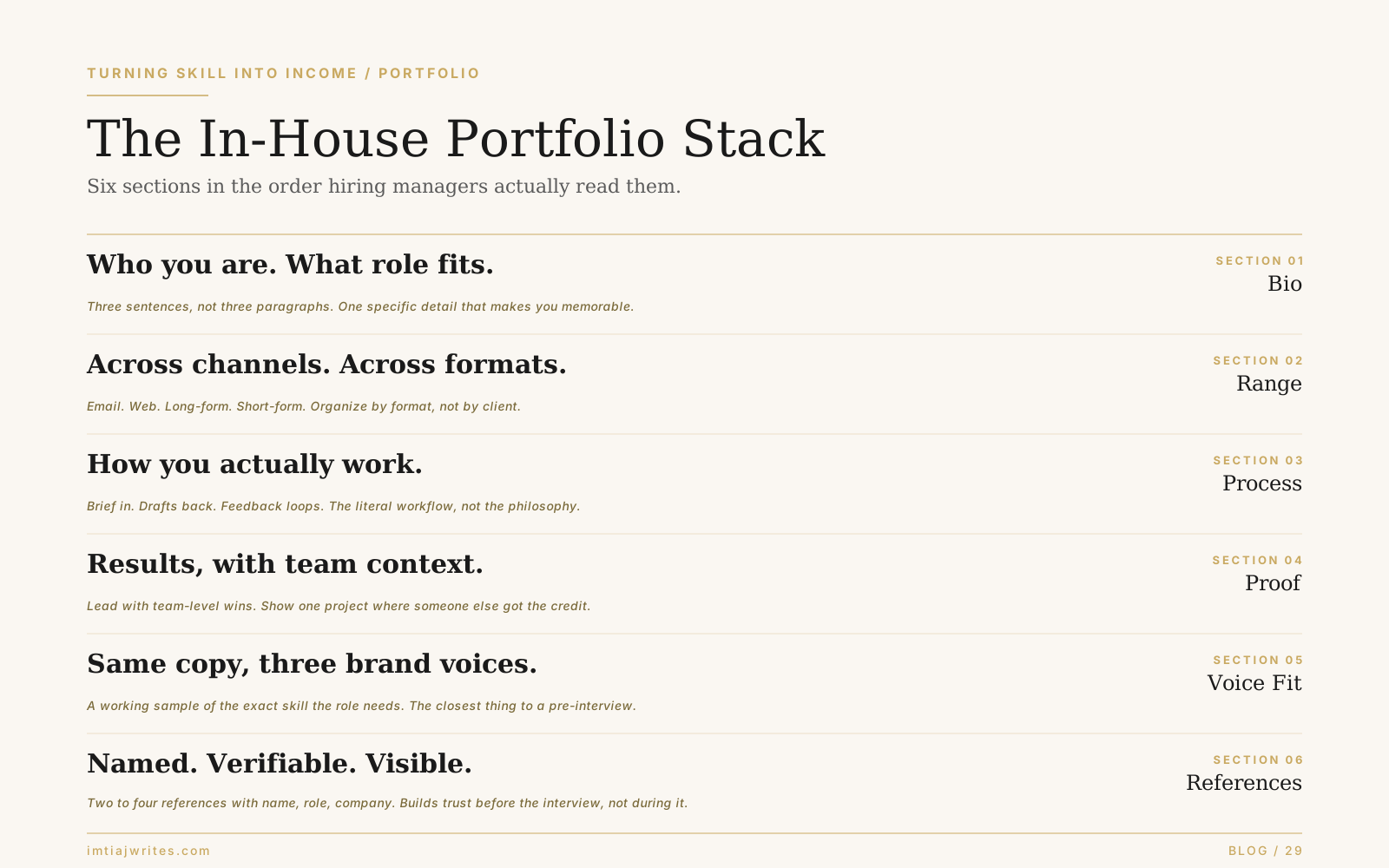
An in-house portfolio that wins interviews has six sections, in this order. Each one answers a specific question the hiring manager is asking. Call this The In-House Portfolio Stack:
1. Bio. Who you are and what role fits.
2. Range. Can you write across channels and formats?
3. Process. How do you actually work?
4. Proof. Can the work move a number when it has to?
5. Voice fit. Can you write inside a brand other than your own?
6. References. Will other people back what your work claims?
The freelance portfolio leads with section 4. The in-house portfolio leads with sections 1, 2, and 3. That single change is most of the difference between a portfolio that gets opened and a portfolio that gets read.
Section 1: Bio (the section everyone underbuilds)
Most copywriter portfolios open with a homepage that has the writer’s name, a tagline, and a list of clients. That is fine for freelancing. It is wrong for in-house because the hiring manager has not yet decided whether you fit the role they are filling, and your client list does not answer that question.
The in-house bio answers three things in three sentences:
👉🏻 The kind of role you are looking for.
👉🏻 The kind of work you do best.
👉🏻 One specific detail that makes you memorable.
❌ I am a copywriter with five years of experience writing for global brands, helping companies tell their story through compelling content.
✅ I am a copywriter looking for an in-house role on a B2B SaaS marketing team, ideally one that ships across email, web, and product. My specific strength is writing for non-Western markets while keeping the copy clean enough for US and EU readers, which I do every day from inside a Shenzhen tech company.
The first version could describe ten thousand writers. The second version could describe one. A hiring manager scanning for fit reads the second one twice because it tells them whether to keep reading or not. That decision is the only job the bio has.
For non-native writers, the bio is also where you can name your specific cross-cultural advantage without it sounding like an apology. Naming it as a strength, in one specific sentence, signals to the hiring manager that you understand your own positioning. The personal branding post on the Story Stack covers the sequencing of how to do this without leading with an apology.
Section 2: Range (the section that wins or loses interviews)
This is the section freelance portfolios usually skip and in-house portfolios live or die on.
In-house copywriters are expected to produce across multiple formats: emails, landing pages, product pages, social copy, internal docs, sometimes script writing or longform. The hiring manager is checking whether your portfolio shows you can do all of these, not just the format your last freelance client paid you for.
The fix is to organize your portfolio explicitly by format, not by client. A typical good range section has:
👉🏻 Email (3-4 examples across cold, lifecycle, and announcement)
👉🏻 Web copy (homepage, product page, landing page, all different)
👉🏻 Long-form (one blog post, one case study, one whitepaper if you have one)
👉🏻 Short-form (5-10 social posts, one ad, one push notification)
👉🏻 Anything specialized the role requires (UX writing, SEO content, etc.)
Each format gets its own row. Each row shows 2-4 examples. The hiring manager scans for the format the role needs and finds it immediately.
If you do not have samples in the required format, write spec work. A homepage rewrite of a brand you admire takes two hours and signals more about your range than three live samples in a single format.
Section 3: Process (the section that signals seniority)
Most portfolios skip this section entirely. It is the highest-leverage section you can add.
A process section is one or two paragraphs explaining how you actually work. Not your philosophy. Your literal workflow. How you receive a brief. How you research. How you handle feedback. How you collaborate with designers, developers, and other writers.
❌ My process is to deeply understand the client’s needs, conduct thorough research, and craft compelling copy that drives results.
✅ I start every project with a 20-minute brief conversation, usually with the marketing manager and one other stakeholder. I send back a one-page document with the brief restated in my words, the audience as I understand it, and three angles I’d consider. After we pick an angle, I write one full draft and three headline variations. I expect two rounds of revisions. If feedback is conflicting between stakeholders, I ask for one decision-maker to break the tie. I have never missed a deadline, but I have asked for an extension twice in five years and would do it again rather than ship work I am not proud of.
The second version is twice as long and ten times more useful. It tells the hiring manager exactly what working with you would feel like. They are deciding whether to spend twelve months collaborating with you. The process section is where they get the answer.
For non-native writers, this section also lets you communicate your actual fluency in professional environments without hedging or apologizing. The way you describe your process is a writing sample by itself. A clear, specific process description is more reassuring than any claim about your English.
Section 4: Proof (the freelance section, repurposed)
This is where the freelance Proof Stack still earns its place. The format from the Proof Stack post (Outcome / Approach / Evidence) works inside an in-house portfolio too, but it sits in section 4, not section 1.
For in-house roles, two adjustments to the freelance version of the Proof Stack:
Lead with team-level wins, not individual ones. “Our email program drove 22% of revenue last quarter, and I owned the lifecycle stream within it” lands better than “I wrote an email that converted 18%.” In-house hiring managers want to see that you can produce within a team, not as a solo act.
Show one project you did not lead. Pick a campaign you contributed to where someone else got the credit. Describe what you did, what you learned, and what you would do differently. This signals that you can work as part of a team, not just as the front-facing creative. Hiring managers read this section closely.
Three to five Proof Stack entries is enough. More than that crowds the portfolio.
Section 5: Voice fit (the section that closes the deal)
In-house copywriting is mostly writing inside a brand voice that is not your own. The hiring manager wants to see whether you can do that.
The format that works: pick three brands whose voice is very different from each other, and rewrite the same short piece of copy (a homepage hero, a product blurb, an email subject line set) three times, once in each brand voice.
❌ I am skilled at adapting to different brand voices, having worked with brands ranging from B2B SaaS to consumer goods.
✅ Here is the same homepage hero rewritten in three voices: one in Mailchimp’s friendly-with-edges voice, one in Stripe’s quiet-confidence voice, and one in Liquid Death’s deadpan-aggressive voice. Same product, three completely different reads.
The second version is a working sample of the exact skill the hiring manager needs to evaluate. They cannot fake-test you on it in an interview. The voice fit section is the closest thing to a working interview they can run before the actual interview, which is why it carries disproportionate weight.
For non-native writers, this section is also where the bilingual lens advantage shows up directly. If you can demonstrate range across cultural registers (a US tech voice, a UK editorial voice, a non-Western consumer voice) you are showing something most native applicants cannot match.
Section 6: References (the section everyone forgets)
Most portfolios end at section 5 and assume references will come up later in the process. They will. But putting them in the portfolio itself, with names and roles visible, does two things:
First, it signals that you have actual references in your back pocket, which separates you from the half of the applicants who don’t. Second, it gives the hiring manager something to verify quickly, which builds trust before the interview, not during it.
Two to four references, each with a name, role, company, and one-line context for why they would be a useful reference. Avoid LinkedIn-style endorsements that read as generic. Avoid quotes that try too hard. Direct contact information is fine if you have permission.
What to leave out
Three sections most non-native writers add that do not help.
A grammar or English proficiency claim. Do not include a “language skills” section listing your TOEFL or IELTS scores. The portfolio is the proof. Adding a separate language claim makes the hiring manager wonder why you felt you needed to defend it.
A long backstory. The bio handles your story in three sentences. A two-page about page reads as filler. If your background genuinely includes something the bio cannot fit, put it in section 3 (Process), not in a separate section.
Awards and certifications, unless they are well-known. A copywriting certification from a niche course is not impressive to most hiring managers. A One Show or D&AD pencil is. Be honest about which side your credentials sit on.
For more on what to skip generally, see the Proof Stack post.
The honest part
The In-House Portfolio Stack takes a weekend to build, sometimes two. That is real time, and most non-native writers underestimate it. The Range section alone often takes a full day if you have to write spec work to fill format gaps. The Voice fit section takes another half-day because you have to actually do the rewrites, not just describe them.
The trade-off is that you are building one portfolio that works for every in-house application you submit afterward, with small adjustments per role. The first version is slow. The fifth application using the same portfolio takes thirty minutes to send.
For the broader hiring loop this portfolio plugs into, see the four-stage hiring loop post.
For the writing workflow that produces the spec work you’ll need for the Range and Voice fit sections, see the AI writing stack post.
For the diagnostic on the writing itself, the Natural English Edit is the 15-pattern checklist with prompts to run on your own copy. Free.
Frequently Asked Questions
How is an in-house copywriting portfolio different from a freelance portfolio? A freelance portfolio leads with proof of results because the buyer is hiring you for one project. An in-house portfolio leads with bio, range, and process because the buyer is hiring you for one or two years and needs to know you can work across formats, fit a team, and adapt to a brand voice that is not your own. The Proof section still matters in-house, but it sits in position four, not position one.
What sections should an in-house copywriting portfolio include? Six sections, in order: Bio (who you are and what role fits), Range (samples across the formats the role needs), Process (how you actually work), Proof (results-driven case studies), Voice fit (the same copy rewritten in three different brand voices), and References (named contacts the hiring manager can verify). This is The In-House Portfolio Stack.
How long does it take to build an in-house copywriting portfolio? Usually a full weekend, sometimes two, especially if you have to write spec work to fill format gaps in the Range section or do the rewrites for the Voice fit section. The Range and Voice fit sections take the most time because they require new work, not curation of existing samples. The first build is slow. The same portfolio works across multiple applications afterward with small adjustments.
Should non-native writers include a language proficiency section in their portfolio? No. The portfolio itself is the language sample. A separate “language skills” section listing test scores or claiming professional fluency draws attention to a question the hiring manager was not asking, which is the wrong move. Let the work demonstrate the fluency. If you want to name your bilingual perspective as a strength, do it in the Bio section as a positioning point, not as a defense.
How do I show range when most of my work has been with one client or one industry? Write spec work for the formats and industries the role requires. A homepage rewrite of a brand you admire takes two hours. A three-email lifecycle sequence for a fictional product takes a half-day. Spec work clearly labeled as spec is not a weakness in a portfolio. It signals initiative and a willingness to learn the role’s actual requirements before the first day.
How many writing samples should an in-house copywriting portfolio show? Roughly 12 to 18 across all sections combined: 8-10 samples in the Range section across formats, 3-5 Proof Stack case studies, and 3 voice rewrites in the Voice fit section. The total is more than a freelance portfolio because in-house roles require demonstrated breadth, but each individual sample can be shorter than a freelance proof case.
Where to go next
If you are building this portfolio this weekend, work in this order: start with the Bio (one hour), then the Range section (one full day), then Process (one hour), then Proof (half day), then Voice fit (half day), then References (one hour).
For the broader hiring process the portfolio supports, see the four-stage hiring loop post.
For the freelance version of portfolio strategy, if you are building both, see the Proof Stack post.
For the writing workflow that helps you produce spec work efficiently, see the AI writing stack post.
For the diagnostic on the writing itself, the Natural English Edit is the 15-pattern checklist with prompts to run on your own copy. Free.
Six sections. One weekend. The portfolio that wins in-house roles is built differently from the one that wins freelance briefs. Build it once, use it for every application after.
