
You’ve submitted a draft you wrote yourself. The client runs it through Originality.ai. The score comes back 78% AI. You stare at it for a long minute, then run the same text through GPTZero. 94%. You try Copyleaks. Different number again, also bad. You wrote every word.
This is happening to thousands of non-native professionals right now, every day, and it has a specific, well-documented cause that nobody at the platforms wants to put on the front page of their marketing site. It is not your fault. It is not your English. It is not because your writing “sounds like AI.” It’s because AI detectors flag your writing using a statistical method that systematically misreads the way most non-native fluent writers naturally compose sentences.
Here’s the actual diagnosis, why it happens, and what works versus what wastes your time.
The headline number, with a real source
In 2023, researchers at Stanford ran seven widely used AI detectors against 91 essays written by non-native English speakers (TOEFL essays from a Chinese forum) and 88 essays written by US-born eighth graders. The detectors accurately classified the US student essays but incorrectly labeled more than half of the TOEFL essays as “AI-generated,” with an average false-positive rate of 61.3%. All detectors unanimously identified 19.8% of the human-written TOEFL essays as AI-authored, and at least one detector flagged 97.8% of TOEFL essays as AI-generated (ResearchGate).
Read those numbers slowly. Nineteen out of every hundred non-native essays were unanimously misclassified as AI by every detector tested. Ninety-seven out of every hundred were flagged by at least one. Native eighth-grade essays sailed through.
This is not a marginal effect. It’s the dominant signal. And the cause is structural, not a bug they’re about to fix.
For a sense of how shaky AI detection is in general — even on native writing — consider that OpenAI shut down its own AI text classifier in July 2023 after it correctly identified only 26% of AI-written text while incorrectly flagging 9% of human-written content. The company that builds the AI models couldn’t reliably detect its own output. That should set the bar for how much weight to give third-party tools that claim 99% accuracy.
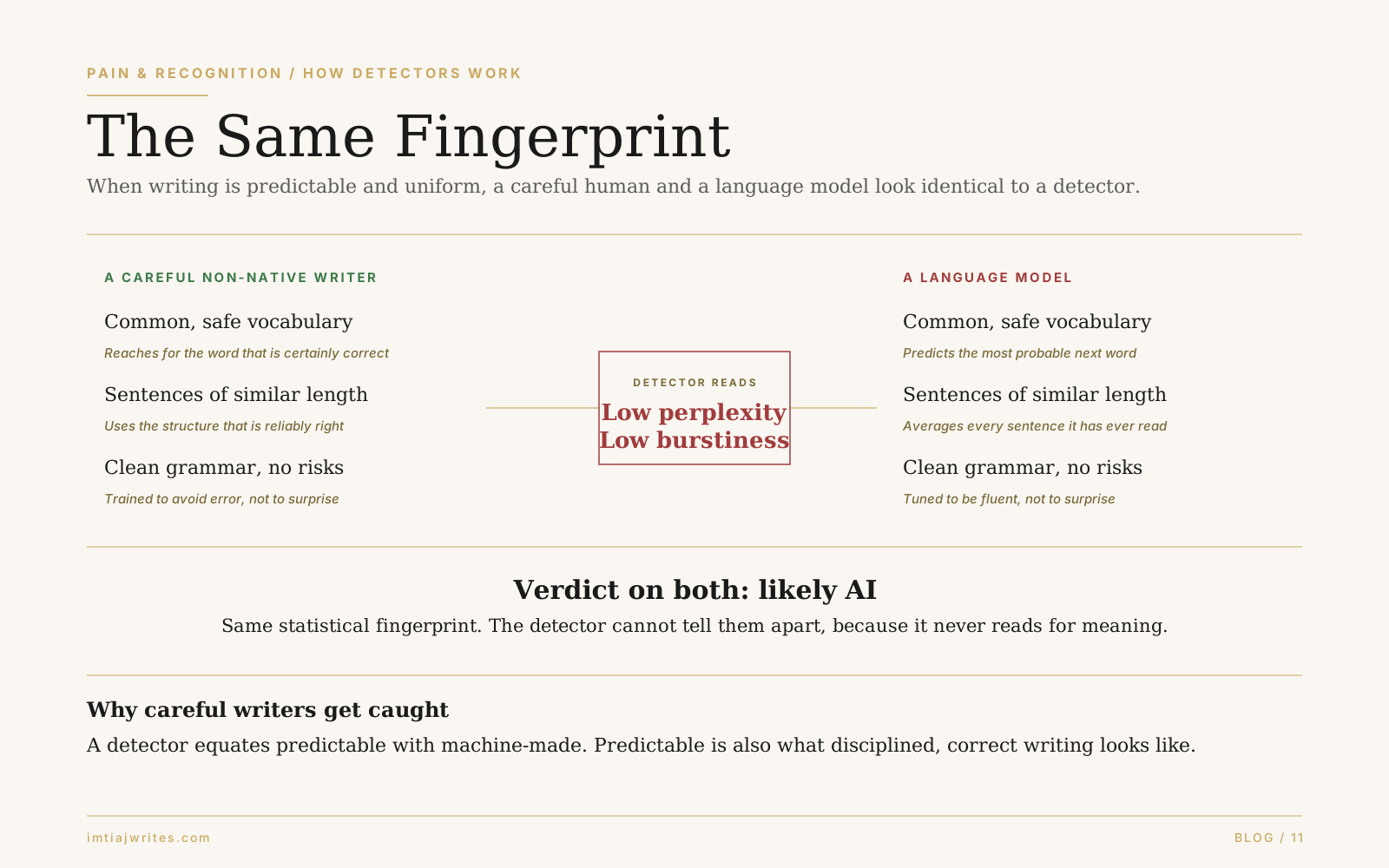
Both writers produce the same statistical fingerprint. The detector cannot tell them apart.
What detectors actually measure (and why it matters)
AI detectors measure two things, mostly. Both have technical names worth knowing because they’re the entire game.
Perplexity is how surprised the detector is by your next word. If your sentence reads “The cat sat on the mat,” perplexity is low — the model expected those words. If it reads “The cat sat on the existential,” perplexity is high — the model didn’t see that coming. AI-generated text tends to have low perplexity because the AI is, by definition, picking the most probable next word. The detector reads “low perplexity” and concludes “probably AI.”
Burstiness is how much sentence length and structure vary across a paragraph. Native speakers write with high burstiness — a short punchy sentence next to a winding one next to a medium one. AI tends to produce uniform, even-paced prose. Low burstiness, low burstiness, low burstiness, the detector says — must be AI.
Now look at how a fluent non-native professional typically writes. Vocabulary stays inside a controlled, dependable range — you use words you know are correct rather than reaching for the unusual word. Sentence structure stays even because you were taught English through structured writing exercises that rewarded consistency. Transitions are explicit (“Furthermore,” “In addition,” “Moreover”) because that’s how you were trained to signal flow.
Every one of those habits produces low perplexity and low burstiness. Every one of those habits is what the detector reads as “AI.”
The cruel part: these habits are mostly evidence that you learned English well. You picked the safe word, you wrote the clean sentence, you used the connector that signals structure. The detector reads the same patterns and concludes a machine wrote it.
The mechanism, named: The Fluency Trap
I’ll call this dynamic The Fluency Trap. The trap is that the more carefully you’ve learned English as a second language — the more you’ve internalised “correct” patterns, controlled vocabulary, predictable structure — the more closely your output matches what AI generators produce. Both you and the AI are picking the most probable next word. You learned to do that on purpose, because picking the unexpected word in a second language is risky. The AI does it because that’s how the model is built.
Result: you and the AI converge on the same statistical fingerprint. The detector cannot distinguish you.
This is why the Stanford team’s mitigation experiment was so revealing. When the researchers used ChatGPT to enhance the vocabulary of TOEFL essays — making them sound more like native-speaker writing — the average false-positive rate dropped from 61.3% to 11.6%. Conversely, simplifying the vocabulary in US eighth-grade essays to mirror non-native writing pushed the misclassification rate up from 5% to 56% (ResearchGate).
The detectors aren’t really detecting AI. They’re detecting “writing produced inside a narrower vocabulary range.” Which is to say, they’re detecting non-native fluency.
Before-and-afters: what trips the detector and what doesn’t
Three pairs, real patterns from non-native professional writing. The ❌ versions are what most fluent non-native writers default to. The ✅ versions are what reliably brings the AI score down — not because they’re “less AI-sounding” in any meaningful way, but because they break the perplexity and burstiness signals.
Pattern: predictable transitions
❌ Furthermore, the platform offers robust analytics. In addition, it provides seamless integration with existing tools. Moreover, the dashboard is highly customizable.
✅ The analytics are deeper than most. Integration is the part that surprised me — it actually worked on the first try. And you can rebuild the dashboard layout however you want.
The first version is grammatically clean and uses three textbook transitions in a row. Detector reads: low perplexity, low burstiness, AI. The second version varies sentence length deliberately, removes the formal connectors, and inserts one slightly unusual phrasing (“the part that surprised me”) that raises perplexity.
Pattern: safe-vocabulary defaulting
❌ Our solution helps businesses optimize their workflow and improve operational efficiency.
✅ This cuts a step out of the workflow you probably do twice a week.
“Solution,” “optimize,” “operational efficiency” are the safest words in their lexical category. You picked them because they’re correct. The detector picks the same words for the same reason. The second version uses concrete, slightly less expected language — and reads more naturally to a human anyway.
Pattern: uniform sentence rhythm
❌ The product launches next month. The features include real-time collaboration. The pricing starts at $29 per user.
✅ Product’s out next month. Real-time collaboration is the headline feature, but the pricing is what’ll move it: $29 per user, which undercuts most of the category.
Three short, similar-length sentences in a row is exactly the burstiness signature AI generates by default. Mixing one short sentence with one longer, more varied one breaks the pattern. (This rhythm problem is the same one I covered in why your English copy sounds translated — it shows up in detection too because rhythm and translation-feel share a root cause.)
What works to lower the AI score (in order of effort vs payoff)
1. Vary sentence length aggressively. This is the highest-payoff move. Read your draft aloud and count the syllables. If five sentences in a row are within two or three words of each other, cut one in half and merge two others. The Stanford finding implies most of the false-positive signal is structural, not vocabulary-based, so this single move closes a lot of the gap.
2. Replace one out of every three “safe” words with a less expected one. Not every word — just a sprinkling. Where you wrote “important,” try “load-bearing” if it fits. Where you wrote “many,” try “most of.” Where you wrote “improve,” try “stop being annoyed by.” Every unexpected word raises perplexity locally, which is exactly what the detector is measuring.
3. Cut the textbook transitions. “Furthermore,” “In addition,” “Moreover,” “Therefore,” and “Consequently” are the highest-perplexity-flattening words in your toolkit. Most of the time the relationship between sentences is implicit anyway. Drop the connector and let the reader follow.
4. Add one human texture — opinion, irritation, surprise, hedging. AI rarely writes “this surprised me” or “I thought this would be harder than it was.” A single sentence of writer-presence in a paragraph raises perplexity in a way detectors find very hard to misread.
5. Don’t use a “humanizer” tool. This is the move I’d specifically advise against, even though every non-native writer I know reaches for it first. The humanizer tools work by adding randomness — synonym substitution, unusual punctuation, slight grammatical jitter. They lower the AI score, but they damage the writing in ways a competent reader notices immediately. Trading a detector score for actual quality is the wrong direction. The fixes above lower the score by improving the writing, which is the only sustainable move.
What to do when you’re flagged anyway
Sometimes you’ll do all of this and still get flagged, because the detectors are inconsistent and a piece of clean writing can hit a 70% AI score on Tuesday and 12% on Wednesday with no edits. When that happens, three options.
Run it through three different detectors and screenshot all three. If GPTZero says 80%, Originality says 30%, and Copyleaks says 50%, you have legitimate evidence that the tools disagree, which is the actual state of the technology. Send the screenshots with a one-line note: “These tools produce inconsistent results on the same text. Happy to walk through my drafting process if helpful.”
Keep your drafts. Write in Google Docs or Notion where the version history is preserved. A live edit history showing you typed and revised the piece over hours is the only definitive proof against an AI accusation. Most non-native writers I know now treat this as standard hygiene.
Push back on the use case, not just the score. If a client is using detectors to decide payment, the conversation worth having is whether detectors should be a payment gate at all. The Stanford research is the strongest single argument here — share the link. The OpenAI classifier shutdown is the second. A reasonable client will reconsider; an unreasonable one will tell you who they are, which is also useful information.
The country-of-origin trust gap I covered in the country-of-origin trust gap post intersects with this directly — clients running detection on non-native writers’ work and acting on the false positives is the most concrete current example of that gap doing damage.
The thing nobody at the detection companies wants to say out loud
The detection industry’s marketing rests on one claim: 99% accuracy. That number is true on the dataset they tested it on, which usually means native English text written by Americans. It is dramatically less true on non-native writing, short text, edited text, or any text that doesn’t match their training distribution.
Some of the companies have started publishing this honestly. Most haven’t. The market they’re selling into — schools, publishers, content marketplaces, freelance platforms — uses the 99% number to make decisions that affect non-native writers disproportionately, and the gap between the marketing number and the real number is where the damage gets done.
The fix at the industry level is regulatory and slow. The fix at your level is the five tactics above plus the awareness that the score is not a verdict on your work. It’s a verdict on whether your prose pattern fell inside a statistical band the tool happened to be looking for that day.
Where to go next
➡️ Read why your English copy sounds translated for the deeper version of the rhythm-and-vocabulary problem that creates the AI-detection signal in the first place.
➡️ Read the country-of-origin trust gap for the wider career context — AI detection false positives are the most concrete current way that gap shows up in your inbox.
➡️ Or start with the Natural English Edit — the 15-pattern checklist for non-native writers. The patterns it catches are the same ones that lower your perplexity score, so the same edits work in both directions.
➡️ See what happened when I ran my own human copy through GPTZero: GPTZero Tested: I Ran My Human-Written Copy Through It
FAQ
Why do AI detectors flag non-native English writing as AI even when humans wrote it? Because AI detectors measure perplexity (word predictability) and burstiness (sentence variation), and fluent non-native writers tend to use a controlled vocabulary range and even sentence structure — the same statistical pattern AI produces. Stanford research found AI detectors misclassified 61.3% of TOEFL essays as AI-generated while correctly classifying near 100% of native-speaker essays.
Are AI detectors actually accurate? Not very. Vendors claim 98–99% accuracy on their own benchmarks, but independent testing shows much higher false positive rates, especially for non-native writers and short or edited texts. OpenAI shut down its own AI classifier in 2023 after it correctly identified only 26% of AI-written text. Even the model’s makers couldn’t reliably detect AI output.
How do I lower my AI detection score on writing I wrote myself? Vary sentence lengths aggressively, replace some safe vocabulary with less expected word choices, cut textbook transitions like “furthermore” and “moreover,” and add a sentence of personal opinion or hedging. These moves raise perplexity and burstiness — the two metrics detectors rely on — without compromising writing quality.
Should I use a “humanizer” tool to fix AI detection scores? Generally no. Humanizer tools add randomness through synonym substitution and grammatical jitter, which lowers the score but damages the writing in ways readers notice. The score improves; the work gets worse. Better to apply the manual fixes that improve the writing itself.
What should I do if a client accuses me of using AI when I didn’t? Run the text through three different detectors and screenshot all three — they’ll usually disagree, which is itself evidence. Keep version history of your drafts (Google Docs, Notion). Share the Stanford research link if the conversation continues. A reasonable client will reconsider once they understand how unreliable the tools are.
Will AI detectors get better at handling non-native writing over time? Probably slowly, but the underlying problem is structural, not a bug. Detectors rely on perplexity, and non-native fluent writing has lower perplexity than native fluent writing — that’s the entire mechanism. Until the detection industry moves to fundamentally different methods (like watermarking from the AI generators themselves), the bias is built into how detection works.
